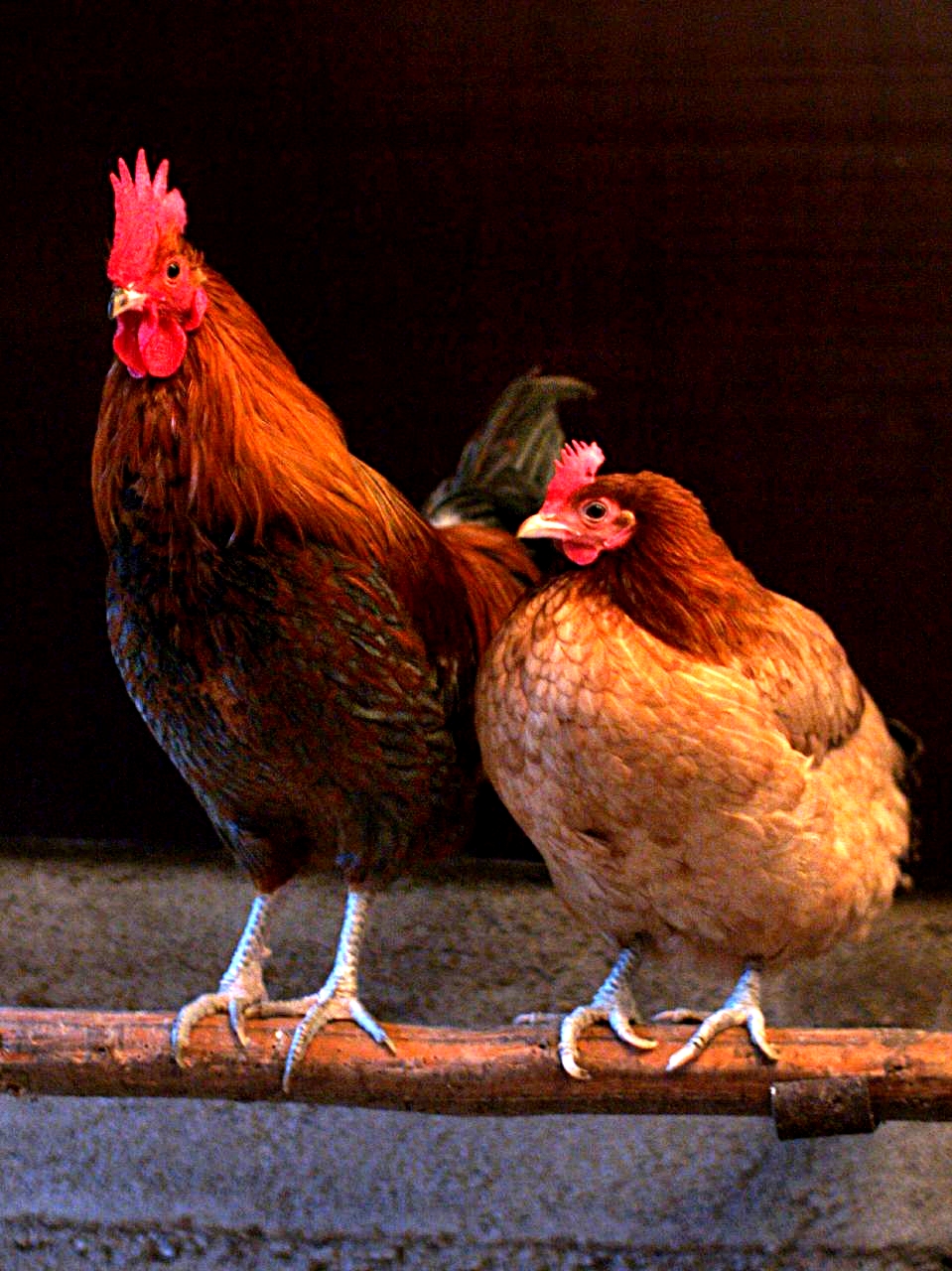
Not exactly. A hen does not become a rooster as it ages, and it never changes its genetic sex. But in rare cases, a hen can develop a cockscomb, rooster plumage and even start crowing — as a result of a disruption in her gonads and hormonal balance.
What really happens in the hen's body
Particularity of birds: in chickens, only the left ovary functions. The right gonadal tissue exists, but remains rudimentary and dormant. As long as the left ovary produces estrogen, everything follows its course: laying, hen's plumage, silence at dawn.
If this left ovary stops functioning — a cyst, a tumor, an infection — estrogen production collapses. Freed from this hormonal brake, the rectus tissue can then develop into an intermediate structure called ovotestis, which is part of both the ovary and the testicle and can produce hormones with male activity.
Publicité
Publicité
Why she starts to look like a rooster
In chickens, it is estrogen that maintains the feminine appearance. When it disappears and androgenic activity increases, masculine characteristics are expressed: the crest and barbels enlarge, the plumage takes on the appearance of that of a rooster at the next molt, dewclaws can develop — and the hen sometimes adopts rooster-like behavior, even singing.
Has she really become a rooster?
No. In birds, sex is written in the chromosomes — ZW for female, ZZ for male — and it does not change. Work carried out on chickens, notably at the Roslin Institute in Edinburgh, even indicates that the animal's cells retain their own sexual identity, independent of hormones. A masculinized hen therefore remains genetically a female, which has taken on the appearance and mannerisms of a rooster.
Can she be fertile?
In the vast majority of cases, no: it stops laying eggs, without becoming a male reproducer. The scientific literature reports very rare cases of sperm production in hens carrying an ovotestis — observations that have remained famous precisely because they are exceptional, and which do not describe the usual functioning of the phenomenon.
Why is this phenomenon rare?
Because a precise combination of circumstances is required: the loss of function of the only active ovary, then the development of the right gonadal tissue. Most ovarian damage simply makes the hen sick without triggering this cascade. A hen that “becomes a rooster” deserves a visit to the veterinarian: this change in appearance is often a visible sign of an internal problem.
🚀 SWConsulting — Turning Your Ideas into Digital Solutions
Do you have an idea, a project, or a business process that needs to be digitalized?
SWConsulting supports businesses from concept to deployment, delivering custom, reliable, and scalable digital solutions tailored to their real needs.
💻 Web & Mobile Development
⚙️ Business Applications & SaaS
🤖 Artificial Intelligence & Automation
📊 Custom CRM & Management Tools
🛒 E-commerce & Marketplaces
🔗 APIs & System Integrations
Our goal is simple: turn your business needs into practical digital solutions that help you improve efficiency, automate processes, and grow your business.
Have a project in mind? Let’s talk. 🚀
SWConsulting — Digital Solutions, Real Impact.