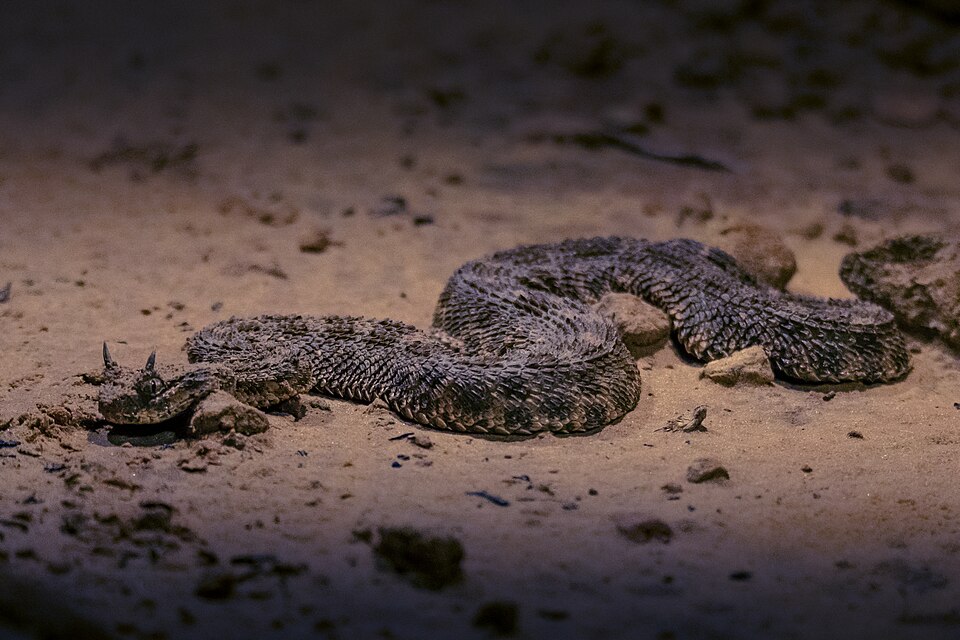
The horned viper detects its prey mainly thanks to its bifid tongue, which captures odorous molecules from the air and sand, and thanks to the vibrations of the ground perceived directly by its jaw placed on the substrate, the absence of an external ear making aerial hearing almost useless.
A language that “tastes” the desert air
Permanently agitated outside the mouth, the forked tongue sweeps the environment and brings chemical particles back to the vomeronasal organ, also called Jacobson's organ, located on the palate. The two tips of the tongue, spread apart, allow a form of “stereo-olfaction”: by comparing the concentration of molecules captured on the right and left, the snake can orient itself towards the nearest odorous source, whether it is a rodent, a lizard or a track left a few hours earlier on the sand.
In Cerastes cerastes, this chemical sense is particularly valuable in southern Tunisia, where sparse vegetation limits visual cues and where hunting is often practiced on the lookout, half-buried under the sand, leaving only the eyes and the famous supra-ocular “horns” protruding.
Publicité
Publicité
With no external ear and visible eardrum, the viper perceives the vibrations of the ground through the lower jaw, in direct contact with the substrate: the mechanical waves produced by the movements of prey travel up to the inner ear via the bones of the jaw and skull. This perception, very sensitive to low frequency vibrations, makes it possible to detect the approach of an animal before any visual or olfactory contact, a decisive advantage for a species which hunts mainly at night.
No heat-sensitive dimples in this species
Unlike rattlesnakes or certain boids, Cerastes cerastes does not have thermosensitive facial pits capable of detecting infrared radiation from warm-blooded prey. Its hunting strategy is therefore based on Jacobson's tongue-organ combination and vibratory detection, supplemented by vision adapted to dim light, rather than on thermal imaging, contrary to a popular belief often associated with vipers in general.