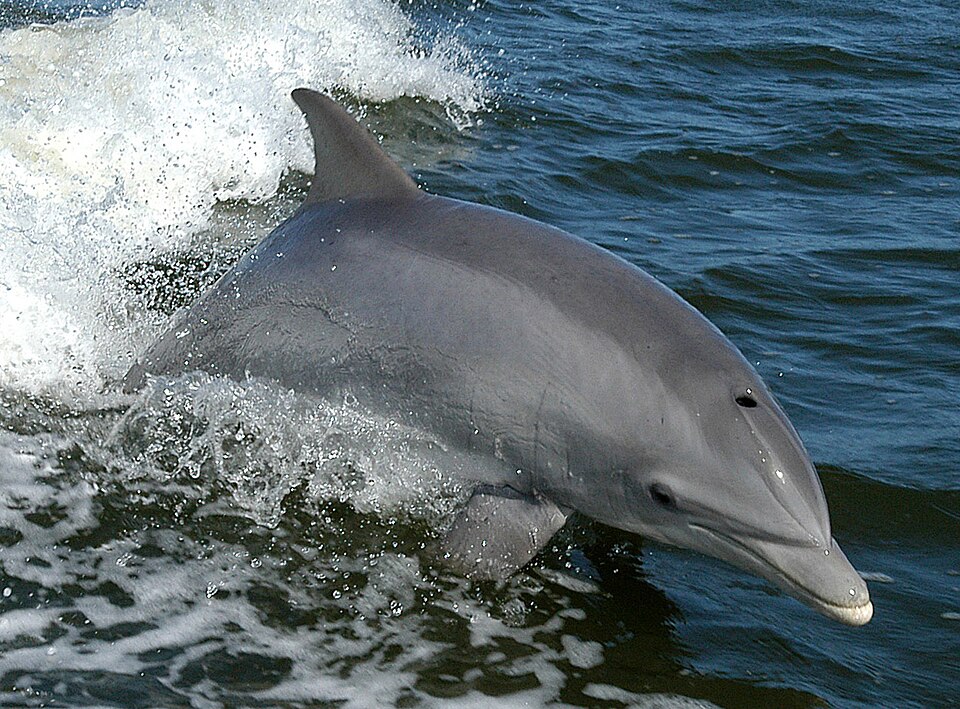
The bottlenose dolphin emits trains of ultrasonic clicks through the phonic lips located under the blowhole, focuses this sound beam using the melon (fatty organ of the forehead) then analyzes the echo received by the lower jaw, rich in conductive adipose tissue, to construct a three-dimensional acoustic image of its environment.
A high-precision biological sonar
Clicks are produced by the passage of air through the nasal sacs, without intervention of the classic vocal cords of land mammals. The melon, composed of lipids of variable density, acts like an acoustic lens: it concentrates the waves into a directional beam projected forward. The echo that bounces off an object or prey returns to the lower mandible, whose thin bone and internal fatty canal transmit the vibrations directly to the middle ear, bypassing the external ear canal which has become almost useless in cetaceans.
This organization allows the dolphin to distinguish the shape, size, texture and even internal density of an object: soft tissues, air and bony structures do not reflect sound in the same way. The bottlenose dolphin can thus spot a fish half buried in the sand or detect the presence of internal organs in prey, an ability documented by several behavioral studies in controlled environments. The frequency of the clicks, often greater than 100 kHz, adjusts according to the distance from the target: the closer the object is, the more the cadence accelerates, forming the “terminal buzz” characteristic of the capture.
A perception that passes through matter
Contrary to vision, echolocation allows a form of internal perception of bodies: a dolphin can potentially perceive a mass of air (like lungs) or a variation in density in a conspecific or prey, without contact or light. This capacity remains actively studied, particularly with regard to its exact resolution. In the Tunisian Mediterranean, where the species frequents the Gulf of Gabès and coastal canals, this sonar is essential for hunting in turbid waters where visibility is reduced.