
Dog or Cat Choking: Signs and Emergency First Aid

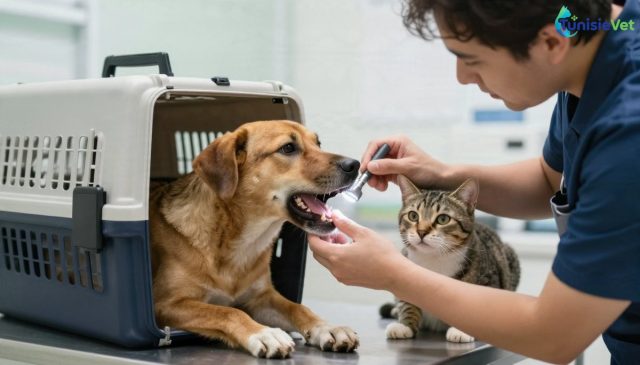
If your dog or cat is choking, first check whether the animal can cough and breathe, then call a veterinarian immediately if its breathing is difficult. Only remove an object if it is visible and easy to grasp, and never pull on a string. This guide helps you recognise warning signs, act according to the animal's size, and prevent accidents at home and outdoors.
The TunisieVet app to care for your pet
Vets, adoption and products



Dog or Cat Choking: Recognising Emergency Signs
A dog or cat that is choking may cough, drool heavily, become agitated, or paw at its mouth. It may also stretch its neck, breathe noisily, or struggle to draw in air. Blue or greyish gums and sudden weakness are particularly alarming.
Not every cough means an object is blocking the airway. Difficulty breathing can have other causes. In all cases, do not try to make a diagnosis on your own if the animal seems to be in distress.
| What you observe | What to do |
|---|---|
| Coughing, but breathing is still possible | Let the animal cough, keep watching it, and contact a veterinarian. |
| Breathing is very difficult, noisy or ineffective | Call a veterinarian immediately and leave for an emergency visit. |
| Blue or greyish gums, weakness or loss of consciousness | Life-threatening emergency: call and transport the animal without delay. |
If you see the animal swallow an object and then show these signs, tell the veterinarian. Even without an object having been seen, difficult breathing warrants an urgent call.
First Aid: What to Do Immediately
Stay calm and limit handling. A frightened or hurt animal may bite, even if it is normally gentle. Ask another person to call while you stay with the animal.
- Call a veterinarian. Describe the breathing, the level of consciousness and the object you suspect. Follow their instructions and prepare to leave.
- Let an animal that can still breathe cough. Do not force it, and do not put your fingers down its throat to search for an invisible object.
- Look briefly inside the mouth if you can do so safely. Remove only an object that is clearly visible, accessible and easy to grasp, without pushing it further in.
- Leave urgently if air is not passing properly. One person can drive while the other monitors the animal, without delaying departure to make repeated attempts.
Actions to Avoid
Do not sweep blindly with your fingers: you could push the foreign body further in or get bitten. Do not give water, food or medication to try to make it go down.
If a string, thread or ribbon is hanging from the mouth, do not pull on it, even if it seems easy to grab. A thread may be caught further down and cause injury. Leave its removal to the veterinarian.
Do not hang the animal by its legs and do not compress its neck. For transport, keep it in the position where it breathes best, without forcing an uncomfortable posture.
Clearing the Airway: Adapting the Action to the Animal
If the animal can no longer breathe and you cannot remove a visible object, ask the veterinarian to guide you by phone. Abdominal compressions can cause injury: they are reserved for a severe obstruction, when air is not passing. They never replace an urgent consultation.
For a Small Dog or Cat
Support the animal's body on a stable surface or against you, without compressing its chest. If the veterinarian asks you to, place your fingers on the soft part of the abdomen, just behind the ribs. Give brief inward and forward thrusts, with a force suited to its size.
Then look briefly into the mouth. Remove only an object that has become visible and easy to grasp. Stop handling as soon as the animal breathes and continue the journey to the veterinarian.
For a Large Dog
If the dog is standing and the veterinarian is guiding you, stand behind it. Wrap your arms around its abdomen, place one fist on the soft part just behind the ribs and cover it with your other hand. Give brief inward and forward thrusts, then check the mouth without searching blindly.
If the dog cannot stand, avoid lifting it alone at the risk of dropping it. Place it on a stable surface and ask the veterinarian how to handle it during transport.
If the Animal Loses Consciousness
Alert the veterinarian immediately and follow their instructions to check breathing and, if necessary, start resuscitation. Do not delay leaving for the clinic in order to look for a method or equipment on your own.
When to Seek Care and How to Prevent Foreign Bodies
Urgent consultation is needed if breathing remains difficult, if the gums change colour, if the animal weakens, or if an object remains stuck. Even after an apparent expulsion of a foreign body, have the animal examined promptly: the obstruction or the handling may have caused injury.
After the incident, report persistent coughing, unusual drooling, difficulty swallowing or a change in behaviour. If possible, state what was swallowed and bring an identical object or its packaging. To find a professional, consult the veterinarian directory; in a critical situation, call before travelling.
At Home and Where Animals Live
- Bones and leftover food: keep them out of reach and close the bins. Do not let an animal play with an object that can break into fragments.
- Toys: choose a size suited to the animal and remove those that are damaged or shedding pieces. Supervise play sessions.
- Strings, threads and ribbons: put them away after use, especially sewing accessories and packaging. Do not leave a cat playing alone with thread.
In the Yard, Garden and on Walks
In Tunisia as elsewhere, check the areas where animals roam and pick up accessible small debris. Keep an eye on dogs on walks and on cats that go outside, especially near food scraps or dry plant matter.
Plant fragments, pieces of toys and objects found on the ground can be swallowed. Teach your dog to drop an object on request and exchange it for a reward rather than chasing it. If an object is already stuck or the breathing changes, contact a veterinarian instead of continuing the game.
Key Takeaways
- If the animal is coughing and breathing, let it cough and contact a veterinarian.
- If air is passing poorly or the gums turn blue, call and leave for an emergency visit.
- Remove only an object that is visible and easy to grasp; never pull on a string.
- In case of a severe obstruction, ask the veterinarian to guide you through actions suited to the animal's size.
- Have the animal examined even if the object seems to have come out.
Frequently Asked Questions
Can I give water to an animal that is choking?
No. Do not give water or food to try to move the object. Contact a veterinarian and follow their instructions.
What should I do if my cat has a string in its mouth?
Do not pull on the string, and prevent the cat from continuing to play with it as far as possible. Call a veterinarian quickly; if its breathing is difficult, leave for an emergency visit.
Should I see a vet if my dog is breathing normally after coughing up an object?
Yes, have it examined promptly, even if it seems to be doing better. After a dog or cat choking incident, a consultation makes it possible to check for possible consequences of the incident and of the actions taken.
Leave a comment
Be the first to comment on this article.
