Veterinary case
A donkey covered in scales: a rat mite is to blame
⚠️ This information is provided for awareness only and does not replace an examination by a veterinarian.
🤖 Summary produced automatically from the scientific publication cited at the bottom of the page.
An old donkey suffered for years from scaly, itchy skin, until a tiny mite from rats revealed a much more serious problem.
What happened?
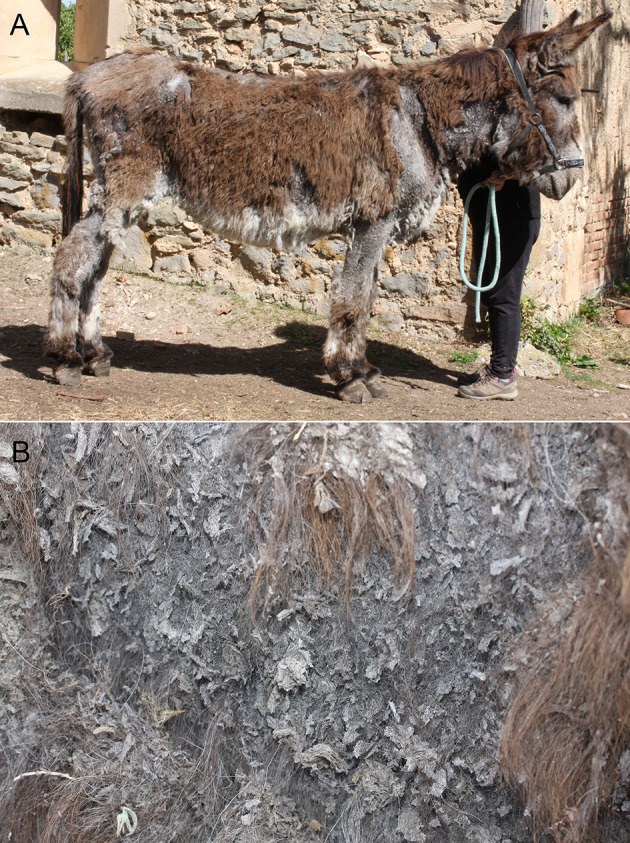
This 25-year-old donkey had lived in an enclosure in southern France for 10 years, with two other donkeys. For 7 to 8 years he had suffered from dermatitis with scales and mild to moderate itching, which had worsened in recent months along with weight loss. His owner had only applied an antiseptic, with no improvement. A water canal near the field sometimes attracted wild rodents.
What did the vet find?
The exam revealed large hairless areas covered with big, thin, grayish scales, with a few oozing sores at the skin-mucous junctions. On close inspection, the vet noticed tiny dark moving specks about 1 mm, which turned out to be a mite rarely seen on equids, confirmed by genetic testing. Further tests then revealed the real cause of the lesions: a skin lymphoma affecting certain immune cells, with the mite merely taking advantage of already damaged skin.
What did the vet do?
ℹ️ Treatment given to THIS animal, decided by its veterinarian. It is not a prescription: never apply it without veterinary advice.
The vet treated all three donkeys in the field with an antiparasitic applied to the skin, twice two weeks apart. No action was taken in the surrounding environment. Three weeks later, skin samples showed no remaining mites.
What happened next?
Despite complete parasite clearance, the donkey's skin condition did not improve. Further tests then confirmed a cutaneous T-cell lymphoma, the first such case reported in a donkey, explaining the persistent lesions.
Advice for the farmer
When dermatitis does not heal despite effective antiparasitic treatment, it's important to look for another underlying cause, such as a deeper skin disease.
Source
- Source
- PubMed Central
- Title
- Case report: Identification of the tropical rat mite (Ornithonyssus bacoti) on a domestic donkey in France.
- Authors
- Dumitrache MO, Györke A, Julien F, Kondratjeva J, Cadiergues MC.
- Year
- 2023
- DOI
- 10.3389/fvets.2023.1141290
- Licence
- CC BY