Veterinary case
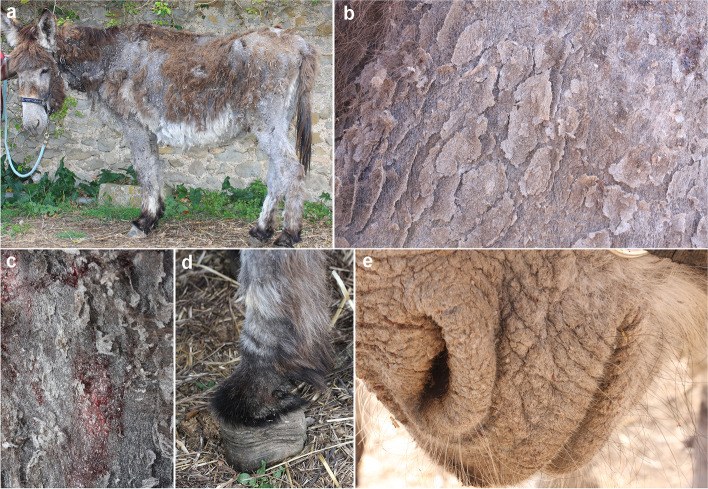
A 25-year-old donkey with a scaly, hairless skin
⚠️ This information is provided for awareness only and does not replace an examination by a veterinarian.
🤖 Summary produced automatically from the scientific publication cited at the bottom of the page.
For years this donkey's skin kept getting worse, until a rare skin cancer was found.
What happened?
This gelded donkey had lived outdoors for ten years with two other donkeys. For several years his skin had been flaking and mildly itchy, and it got worse over the last three months. The other animals were healthy. Mites were found recently and treated on the skin, without improvement.
What did the vet find?
The donkey was alert but thin. He had lost hair almost everywhere, and his thin skin was covered with large greyish scales and a few oozing sores. Lips and muzzle were affected, but not the hooves. Parasites and fungi were ruled out. Skin samples showed a cutaneous T-cell lymphoma, a cancer of certain white blood cells in the skin.
What did the vet do?
ℹ️ Treatment given to THIS animal, decided by its veterinarian. It is not a prescription: never apply it without veterinary advice.
As the donkey seemed comfortable enough, the owners declined cancer treatment. The vet advised weekly medicated shampoos for the skin and a product every two weeks against flies and mites. The two other donkeys were dewormed.
What happened next?
One year after diagnosis the donkey is still alive and the lesions seem stable.
Advice for the farmer
If an animal's skin keeps flaking for years despite care, ask for deeper tests such as a skin biopsy.
Source
- Source
- PubMed Central
- Title
- Cutaneous epitheliotropic T-cell lymphoma in a donkey - a case report.
- Authors
- Kondratjeva J, Julien F, Coutelier C, Humeau L, Moog F, Combarros D, Fourquaux I, Pressanti C, Delverdier M, Moore PF, Cadiergues MC.
- Year
- 2022
- DOI
- 10.1186/s12917-022-03365-7
- Licence
- CC BY