Veterinary case
A cat chokes from a throat lymphoma
⚠️ This information is provided for awareness only and does not replace an examination by a veterinarian.
🤖 Summary produced automatically from the scientific publication cited at the bottom of the page.
A cat was suffocating from a throat tumor: an emergency tracheostomy and radiation therapy gave her precious relief.
What happened?
A 12-year-old Maine Coon cat was being treated for lymphoma in the neck area and was receiving chemotherapy. During treatment, she began struggling more and more to breathe. Examinations showed that a mass had developed in her larynx, severely narrowing her airway despite the ongoing chemotherapy.
What did the vet find?
The vet found severe respiratory distress with marked thickening of the laryngeal tissues almost completely blocking the airway. CT scans also revealed enlarged neck lymph nodes and suspicious nodules on the liver, suggesting the disease affected multiple organs. A biopsy of the laryngeal mass confirmed it was lymphoma, a cancer of immune system cells, of the B-cell type.
What did the vet do?
ℹ️ Treatment given to THIS animal, decided by its veterinarian. It is not a prescription: never apply it without veterinary advice.
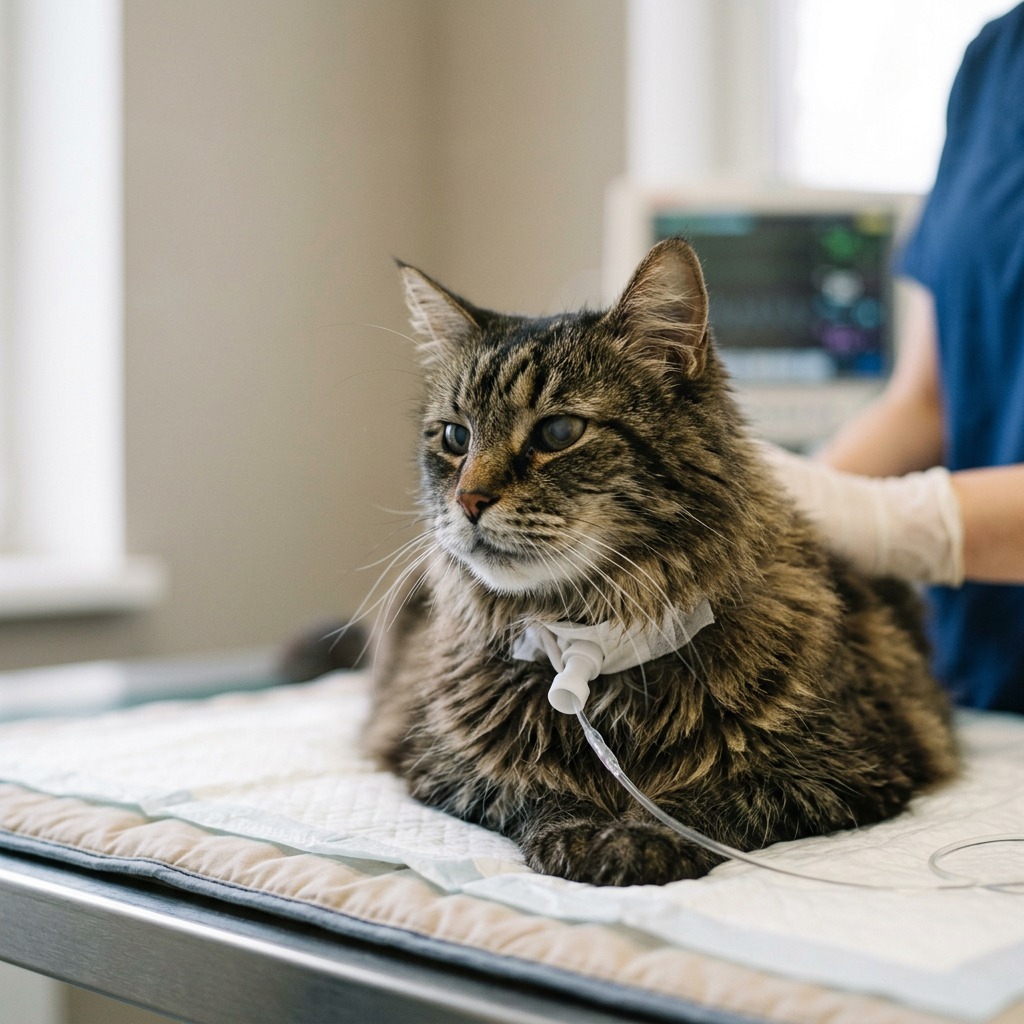
Given the life-threatening emergency, the vet performed a temporary tracheostomy so the cat could breathe through a tube placed in her neck. She then received a short, intensive course of radiation therapy (6 sessions) targeted at the laryngeal mass to quickly shrink the tumor. Once the tumor had shrunk enough and the airway was restored, the tracheostomy tube was removed.
What happened next?
By the fourth radiation session, the tumor had clearly shrunk and the airway had reopened, allowing the tracheostomy tube to be removed. A follow-up scan 17 days after starting treatment showed the laryngeal mass had almost disappeared, and the cat never had breathing problems again. Unfortunately, the disease had progressed elsewhere in her body (liver and kidneys), and she died 27 days after starting radiation therapy, not because of her throat, but because of this overall disease progression.
Advice for the farmer
In an animal already being treated for lymphoma, it's important to stay alert to new signs, especially breathing problems, as the disease can progress to new areas even during treatment.
Source
- Source
- PubMed Central
- Title
- Case Report: Palliative benefit of hypofractionated radiation therapy (6 Gy × 6 fractions) with temporary tracheostomy in a cat with laryngeal B-cell lymphoma progressing during chemotherapy
- Authors
- Kim J, Kim J, Jeong I, Choi H, Kim Y, Lee S, Eom K, Kim J.
- Licence
- CC BY