Veterinary case
A 17-day-old calf with liver abscesses
⚠️ This information is provided for awareness only and does not replace an examination by a veterinarian.
🤖 Summary produced automatically from the scientific publication cited at the bottom of the page.
A navel infection in a young calf spread to the liver, and surgery gave her a chance to recover.
What happened?
A 17-day-old Holstein heifer calf ate little and was in poor condition. Her navel was swollen and draining, and the skin on her knees was sore because she struggled to stand. Ten days of antibiotics from the referring vet did not help, and the abscess kept growing.
What did the vet find?
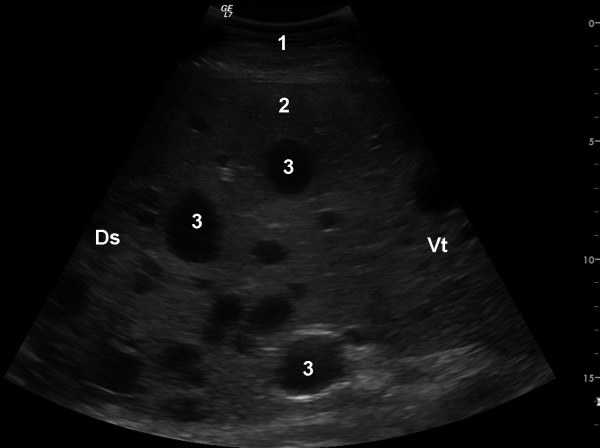
The navel was painful and the umbilical vein was swollen and led to the liver. Ultrasound and CT scan showed pus in the vein and several abscesses in the liver. The infection had started at the navel and travelled up to the liver.
What did the vet do?
ℹ️ Treatment given to THIS animal, decided by its veterinarian. It is not a prescription: never apply it without veterinary advice.
The vets operated under anesthesia and removed the part of the liver holding the reachable abscesses. Two small abscesses could not be removed. The calf then received an injectable antibiotic for 14 days and a painkiller for 3 days.
What happened next?
The day after surgery she was eating normally. Some blood collected in the belly but disappeared, with no peritonitis. She went back to the farm on day 38, and a year later no complications were reported.
Advice for the farmer
Disinfect the calf's navel well at birth and make sure it drinks enough colostrum. A swollen or draining navel should be shown to the vet quickly.
Source
- Source
- PubMed Central
- Title
- Partial hepatectomy for treatment of multiple liver abscess in a calf: a case report.
- Authors
- Sato R, Yamada K, Yokoyama T, Tanimoto K, Takeuchi S, Tatsuzawa N, Nakui S, Satoh H, Fadul M, Steiner A.
- Year
- 2021
- DOI
- 10.1186/s12917-021-02750-y
- Licence
- CC BY