
Presentation
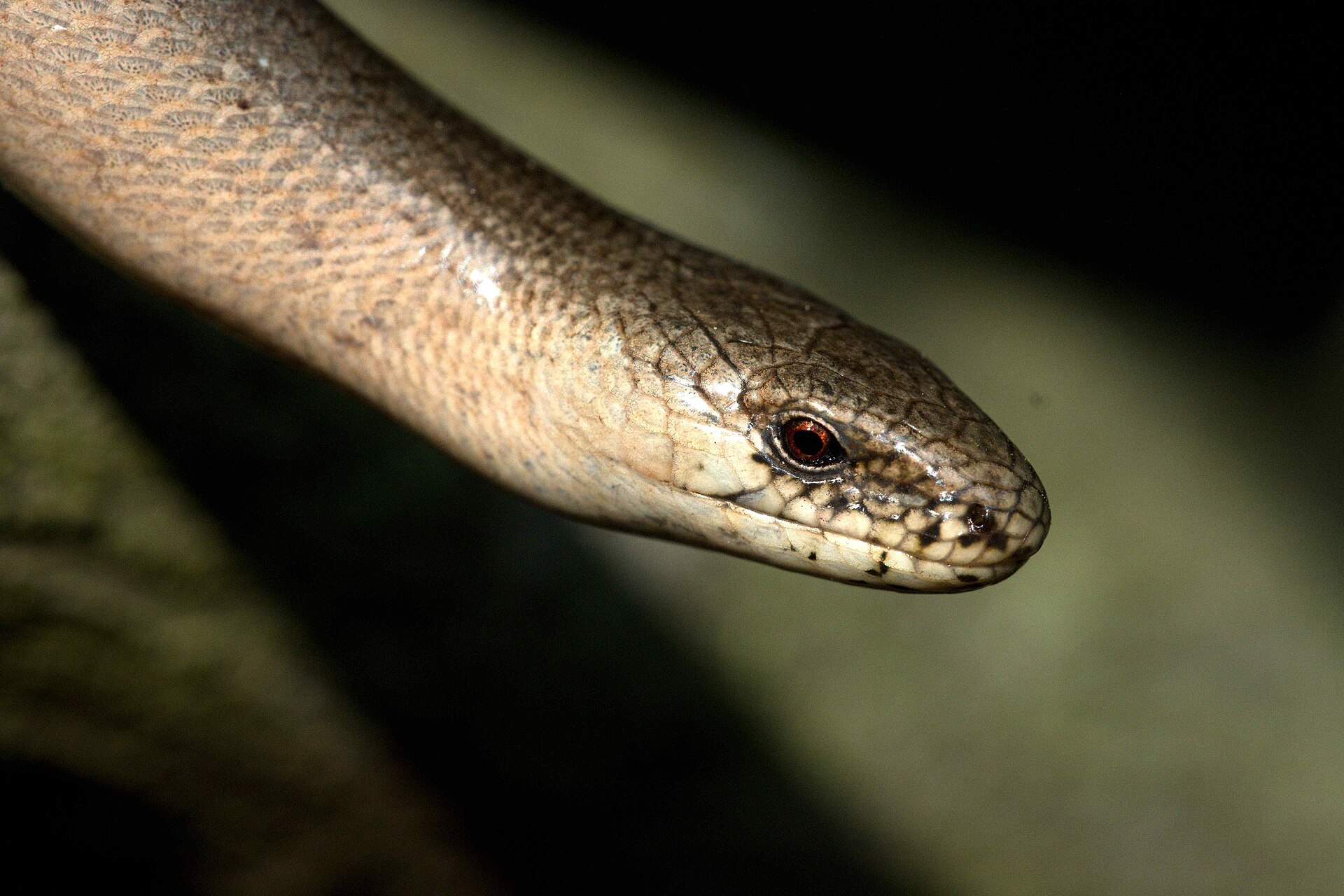
The Blind, also called the fragile slowworm, is a small legless reptile often confused with a snake, when it is actually a lizard belonging to the Anguidae family. Widespread in Europe and western Asia, this species frequents cool and humid environments such as meadows, forest edges and gardens. It feeds mainly on slugs, earthworms and insects, making it a valuable aid to gardeners. Discreet and harmless, Blind is completely devoid of venom and poses no danger to humans. Its remarkable longevity for such a small reptile and its ability to shed its tail to escape predators are among its most notable traits. It is not present in Tunisia, its natural distribution area being limited to the Western Palearctic.
Despite its snake-like appearance, the slowworm is a legless lizard, recognizable by its mobile eyelids and visible external ears, which are absent in snakes. Its smooth, cylindrical body is covered with shiny scales, copper brown to gray in color, sometimes with bronze reflections. Its skin is smooth and slightly stiff, different from the supple texture of grass snakes. It has a long tail, capable of detaching itself in the event of an attack.
Characteristics
Indicative values: they vary by subspecies, sex and region.
Habitat and distribution
This species likes cool, humid environments such as meadows, hedges, forest edges and gardens. It particularly appreciates areas with dense plant cover and loose soil conducive to burrowing. It is also found in compost heaps, under stones or decomposing stumps. It avoids environments that are too dry or too exposed to direct sunlight.
CURRENT RANGE
Blind is widely distributed across Europe, where it occurs almost everywhere except the far north, as well as in Asia Minor and the Caucasus. It favors temperate climates and regions with marked winter, during which it hibernates. Its distribution area does not extend to North Africa, which excludes its presence in Tunisia. It remains a typically European species, absent from the southern Mediterranean rim.
Behaviour
The slowworm leads a discreet and burrowing life, moving slowly in litter, under stones or in soft soil. It is active mainly at dusk and at night, taking refuge during the day under shelters to avoid desiccation and predators. In the event of capture, it can perform caudal autotomy, severing its tail to free itself, it subsequently partially regenerating. It winters in burrows or cavities protected from frost during the bad season.
Reproduction
The slowworm is an ovoviviparous species, the female retaining the eggs inside her body until they hatch. She gives birth to 6 to 12 young, sometimes more, generally at the end of summer. The young, measuring a few centimeters at birth, are immediately independent and receive no parental care.
Peculiarities
Blind has movable eyelids and external ears, two features absent in real snakes, making it easy to differentiate. Its scientific name, Anguis fragilis, refers to the fragility of its tail, which easily detaches during an attack. Contrary to popular belief linked to its common name, it is absolutely not blind and has functional eyesight.
Threats and conservation
The destruction of its habitat, in particular the disappearance of hedges and natural meadows, constitutes the main threat to the species. It is also the victim of road mortality and frequent confusion with venomous snakes, leading to its deliberate destruction through ignorance. The use of pesticides also reduces its food resources, particularly molluscs.
Numbers and trends vary across sources and regions. See the IUCN assessment for the latest reference data.
Gallery
1 documented photographs.
References
Profile updated 03 September 2026 · Reviewed by the TunisieVet editorial team.
Comments (0)
No comments yet.
CONSERVATION STATUS
Least concern (LC)
IUCN source, latest published assessment.
Species health
Documented diseases for this species.
This information is provided for educational purposes only and is not a substitute for a veterinary consultation. If you have any concerns about your animal's health, consult a veterinarian.
Similar animals
Other species documented in Animalpedia.

TunisieVet in your pocket 📱🐾 Access your veterinary services wherever you are. [ Download the app ]
Learn more