
Presentation
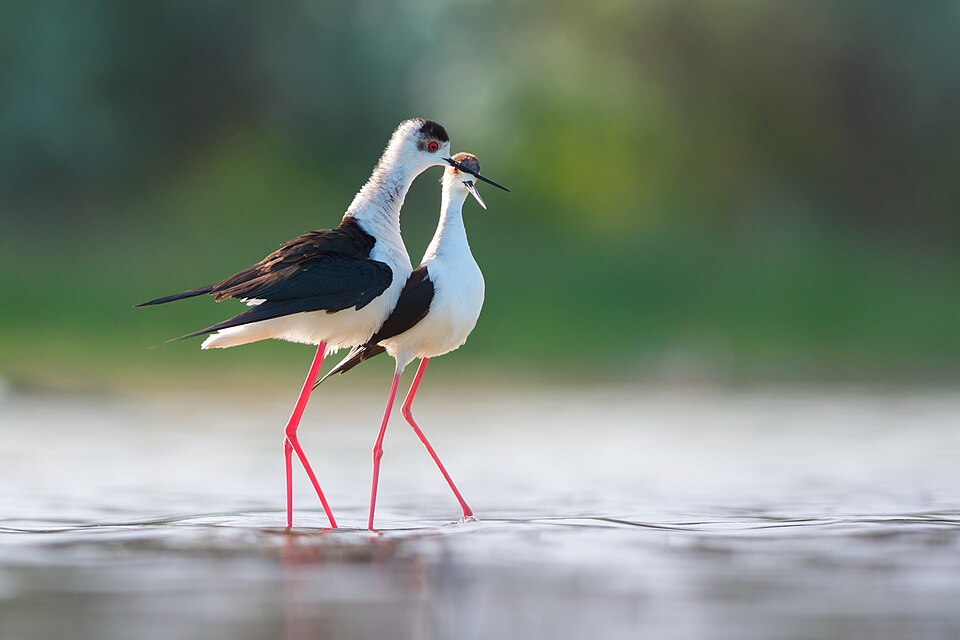
The Black-winged Stilt is a slender wading bird easily recognised by its disproportionately long, thin pink legs and its long, thin black bill. Its striking black and white plumage gives it a distinctive silhouette over shallow wetland areas. It frequents marshes, lagoons, and salt flats where it feeds by wading through water. In Tunisia, it is regularly observed in coastal and inland wetlands, notably during migration periods and breeding season. It is a gregarious species that often nests in small colonies. It is protected in many countries due to its dependence on threatened wetland habitats.
The Black-winged Stilt measures approximately 35 to 40 cm in length, with pink legs that represent an exceptional proportion of its total height. Its plumage is predominantly white with black areas on the back, wings, and sometimes the nape depending on sex and age. The bill is long, thin, and straight, adapted for capturing small aquatic prey. Males and females are distinguished by slightly different shades of black on the back.
Characteristics
Indicative values: they vary by subspecies, sex and region.
Habitat and distribution
The Black-winged Stilt favours shallow wetland areas: salt marshes, lagoons, sebkhas, lake shores and rice paddies. It avoids deep water, preferring mudflats and open banks where it can walk easily. In Tunisia, it is found in several coastal and inland wetland sites. It tolerates a degree of proximity to human activity as long as the aquatic habitat remains suitable.
CURRENT RANGE
The species has a wide range covering southern Europe, Africa, Asia and the Americas, with migratory and resident populations depending on the region. In North Africa, it is present year-round in certain areas and more notably during migration periods. Tunisia hosts the species for breeding and stopover in several protected wetland areas.
Behaviour
It is a diurnal species, often observed in groups of varying size, particularly during migration stopovers. It is territorial during breeding and actively defends its nest against intruders, including other birds and predators. Its flight is characteristic, with the long legs extended back beyond the tail. It produces sharp, repeated calls when alarmed.
Reproduction
Nesting takes place on the ground near water, in a shallow depression lined with vegetation. The female typically lays 3 to 4 eggs, incubated by both parents for about 25 days. The chicks are precocial and leave the nest shortly after hatching, following their parents to feed. The species often nests in loose colonies, sometimes alongside other shorebirds.
Peculiarities
The ratio of leg length to body size is among the highest in the avian world, giving rise to its common name. This morphological feature allows it to exploit slightly deeper water than other shorebirds of similar size.
Threats and conservation
Degradation and drying of wetland areas pose the main threat to the species, reducing its breeding and feeding sites. Water pollution and human disturbance during the breeding season also affect reproductive success. In some regions, illegal hunting or destruction of coastal habitats adds further pressure on local populations.
Numbers and trends vary across sources and regions. See the IUCN assessment for the latest reference data.
Gallery
1 documented photographs.
References
Profile updated 23 August 2026 · Reviewed by the TunisieVet editorial team.
Comments (0)
No comments yet.
CONSERVATION STATUS
Least concern (LC)
IUCN source, latest published assessment.
Species health
Documented diseases for this species.
See the 4 diseases of this species Find a veterinarianThis information is provided for educational purposes only and is not a substitute for a veterinary consultation. If you have any concerns about your animal's health, consult a veterinarian.
To discover around: Black-winged Stilt
Videos, facts, stories and records linked to this species.
RECORD
Leg length up to approximately 20 cm, representing roughly half the bird's total height
The largest leg-to-body ratio in birds
Comparative measurement of leg length relative to body size in wading birds.
Similar animals
Other species documented in Animalpedia.
