
Presentation
The hammerhead flatworm is a terrestrial flatworm identified by its head flattened into a half-moon or hammer shape, from which it takes its common name. Its elongated, ribbon-like body can reach several dozen centimeters in length and is covered with a slimy mucus that facilitates movement. Native to Southeast Asia, it has spread to many tropical and temperate regions worldwide through the horticultural trade. It lives hidden in damp, shaded areas beneath dead leaves, stones, or flower pots. This feared nocturnal predator has a significant impact on earthworm populations in gardens. Its toxicity and reproduction by fragmentation make it a distinctive species among terrestrial invertebrates.
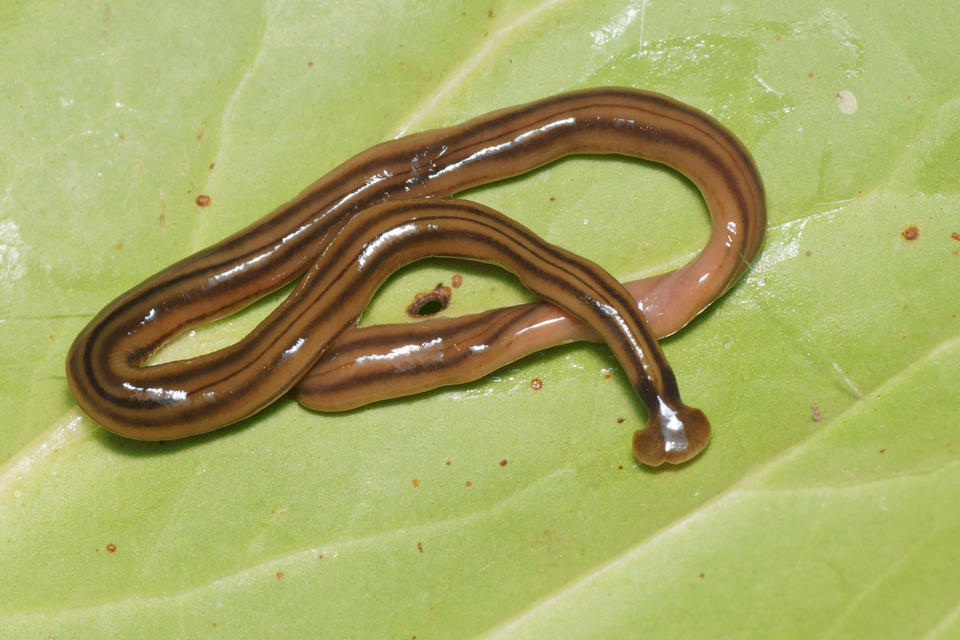
The body is flat, soft, and stretchy, ranging in color from brown-yellow to gray with dark longitudinal stripes along the back. The hammer- or crescent-shaped head bears numerous simple photoreceptors that detect light. The body secretes abundant mucus containing neurotoxic and paralyzing substances used to immobilize prey.
Characteristics
Indicative values: they vary by subspecies, sex and region.
Habitat and distribution
It prefers loose, moist soil in gardens, greenhouses, and potted plants in urban and suburban settings. It is also found in tropical forests within its native range, beneath leaf litter. It avoids dry and exposed areas, being highly sensitive to dehydration.
CURRENT RANGE
Native to Southeast Asia, the hammerhead worm has spread widely across the world through the transport of potted plants and potting soil. It is now reported on several continents, notably in the Americas, Europe, and Africa, often in human-modified environments. Its presence generally remains linked to gardening and horticultural areas.
Behaviour
Active mainly at night or in humid conditions, it remains hidden during the day to avoid drying out. It moves slowly while leaving a trail of mucus, much like a slug. It is capable of retracting and coiling around its prey to subdue it more effectively.
Reproduction
The hammerhead worm is hermaphroditic but reproduces mainly through fragmentation, with a tail portion detaching and regenerating into a complete individual. It can also lay cocoons containing several eggs that hatch within a few weeks. This dual reproductive capacity promotes rapid spread in colonized environments.
Peculiarities
Its hammer-shaped head is unique among terrestrial flatworms and makes identification straightforward. It produces a neurotoxin called tetrodotoxin, also found in certain venomous fish, which is exceptional for a terrestrial invertebrate. Its ability to regenerate from body fragments makes it a subject of study in regenerative biology.
Threats and conservation
The species is not threatened and is instead considered invasive in many regions where it has been introduced. It receives no particular protection measures. Its negative impact on local earthworm populations raises ecological concerns.
Numbers and trends vary across sources and regions. See the IUCN assessment for the latest reference data.
Gallery
1 documented photographs.
References
Profile updated 08 September 2026 · Reviewed by the TunisieVet editorial team.
Comments (0)
No comments yet.
CONSERVATION STATUS
Data deficient (DD)
IUCN source, latest published assessment.
Similar animals
Other species documented in Animalpedia.

TunisieVet in your pocket 📱🐾 Access your veterinary services wherever you are. [ Download the app ]
Learn more