
Presentation
The pelican is a large water bird easily recognized by its long bill fitted with an expandable throat pouch used to catch fish. Plumage is generally white or grayish depending on the species, with large wings adapted for soaring flight. It inhabits wetlands, lakes, and coastal areas where it finds abundant food. Gregarious by nature, it lives and travels often in large groups, especially during migration. Several species exist worldwide, including the white pelican occasionally found in North Africa. It is an emblematic bird of wetlands, sometimes observed in Tunisia during migration stopovers.
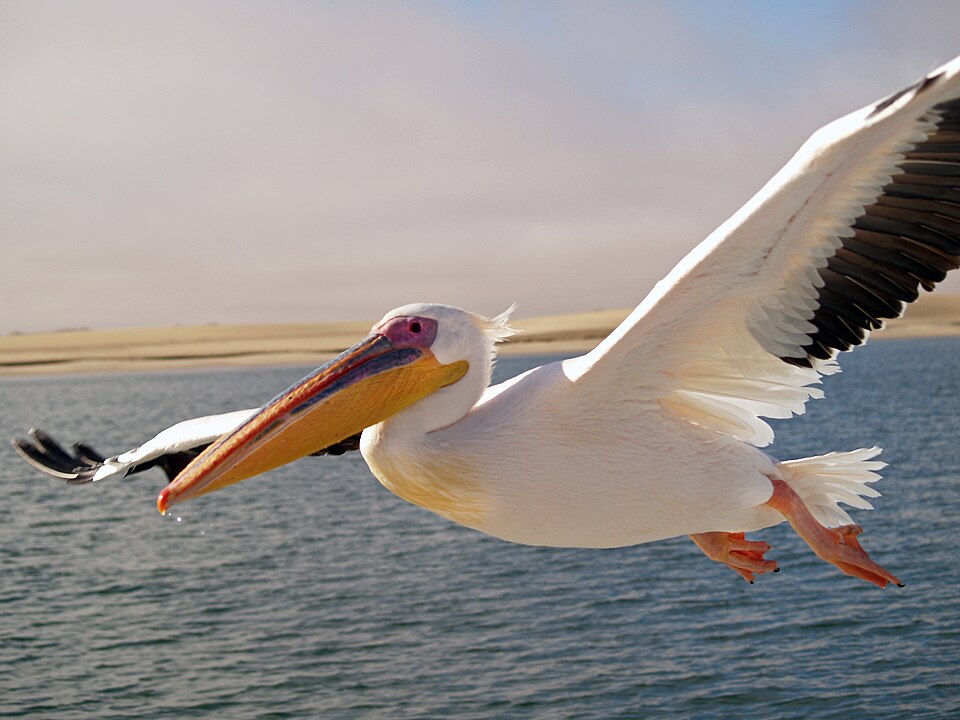
The pelican has a very long bill topped with a throat pouch capable of expanding to hold water and captured fish. Its body is massive yet light thanks to pneumatic bones, allowing efficient soaring flight over long distances. Its feet are webbed, suited for swimming. Plumage varies from white to grayish-brown depending on the species and age of the individual birds.
Characteristics
Indicative values: they vary by subspecies, sex and region.
Habitat and distribution
Pelicans frequent wetlands, lakes, deltas, and coastal lagoons rich in fish. Some species are also found on marine shorelines and estuaries. They favour calm waters that provide both feeding areas and secure nesting sites.
CURRENT RANGE
Different pelican species are distributed across Africa, Asia, Europe, North America, and South America depending on the region. The white pelican in particular breeds in Eastern Europe, Africa, and Asia, with seasonal migration patterns. Occasional sightings are reported in North Africa, including Tunisia, during migration periods.
Behaviour
The pelican is a gregarious bird, living in colonies sometimes quite large for breeding and fishing. Some species practice coordinated fishing in formation, herding fish toward shallow water. It alternates between energy-efficient soaring flight and rest periods on the shoreline. Social interactions are frequent, particularly during courtship displays.
Reproduction
Breeding takes place in colonies, often on islets or isolated areas sheltered from predators. The female typically lays one to three eggs, which both parents incubate for about a month. Young birds remain dependent for several weeks, fed by regurgitation. Fledging and independence occur after several months of development.
Peculiarities
The pelican's throat pouch, capable of holding a large volume of water, is a distinctive feature among aquatic birds. Its ability to soar over long distances by exploiting thermal currents is also noteworthy. Coordinated fishing in formation, observed in some species, is a remarkable social behaviour.
Threats and conservation
Main threats include degradation of wetlands, water pollution, and human disturbance of breeding sites. Reduction in fish resources due to overfishing can also affect local populations. Some species benefit from protection measures in their breeding areas.
Numbers and trends vary across sources and regions. See the IUCN assessment for the latest reference data.
Gallery
1 documented photographs.
References
Profile updated 06 September 2026 · Reviewed by the TunisieVet editorial team.
Comments (0)
No comments yet.
CONSERVATION STATUS
Least concern (LC)
IUCN source, latest published assessment.
Species health
Documented diseases for this species.
Find a veterinarianThis information is provided for educational purposes only and is not a substitute for a veterinary consultation. If you have any concerns about your animal's health, consult a veterinarian.
To discover around: Pelican
Videos, facts, stories and records linked to this species.
Similar animals
Other species documented in Animalpedia.

TunisieVet in your pocket 📱🐾 Access your veterinary services wherever you are. [ Download the app ]
Learn more