Presentation
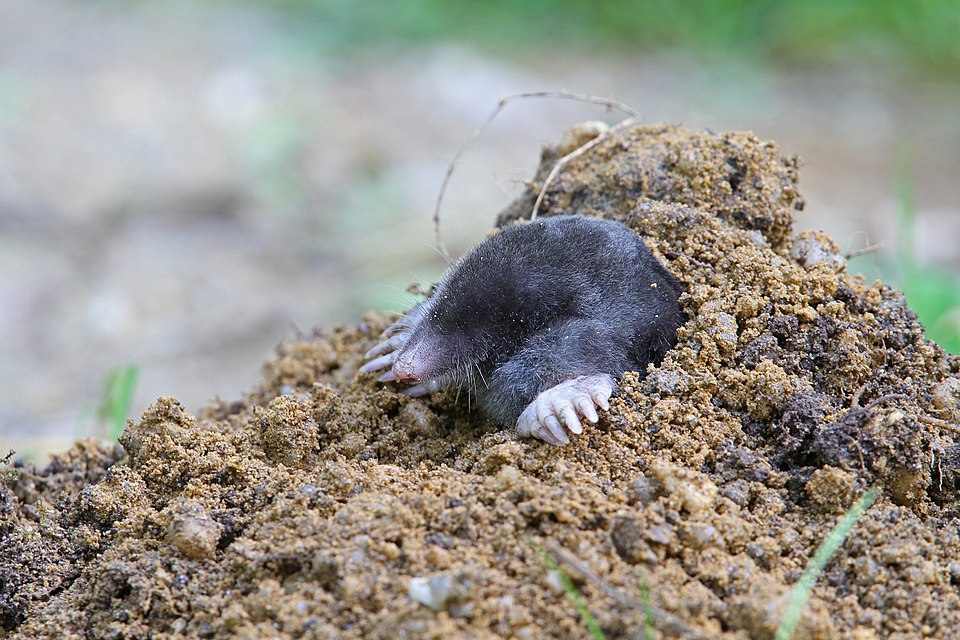
The European Mole (Talpa europaea) is a small burrowing mammal that spends almost all of its life underground, in a complex network of galleries. Its cylindrical body, its shovel-shaped front legs and its short, dense coat make it an animal perfectly adapted to underground life. She has very limited eyesight but extremely developed senses of touch and smell. Discreet and rarely observed directly, its presence is revealed mainly by the mounds of earth that it releases to the surface, called molehills. It is often perceived as harmful by gardeners and farmers although it provides a service by aerating the soil and regulating certain insects.
The body is cylindrical, robust, covered with gray-black velvety fur which does not present any particular direction, which facilitates its movements forward or backward in the galleries. The front legs, very large and equipped with powerful claws, are turned outwards to dig efficiently. The eyes are tiny and often hidden by the coat, while the snout bears highly developed sensory vibrissae.
Characteristics
Indicative values: they vary by subspecies, sex and region.
Habitat and distribution
Mole frequents loose soils rich in organic matter, favorable to digging and an abundance of earthworms. It is found in meadows, gardens, cultivated fields, meadows and sometimes at the edge of the forest. It avoids soils that are too dry, too compact, sandy or permanently waterlogged.
CURRENT RANGE
European Mole is widely distributed across Europe, from the Iberian Peninsula to western Russia. It is absent from Ireland, northern Scandinavia and some Mediterranean islands. In North Africa, including Tunisia, other genera of Moles or burrowing rodents occupy similar ecological niches.
Behaviour
The Mole is solitary and territorial, only tolerating the presence of a conspecific during the breeding season. It is active in short periods spread over the day and night, alternating phases of digging, searching for food and resting. Its intense burrowing behavior allows it to create kilometers of galleries during its life.
Reproduction
Reproduction takes place in spring, once a year, after a brief encounter between male and female. Gestation lasts about a month and the female gives birth to three to five young in an underground nest lined with dry grass. The young are weaned after four to five weeks and then leave the nest to establish their own territory.
Peculiarities
Mole has a slightly toxic saliva that allows it to paralyze earthworms without killing them, in order to store them alive as a food reserve. Its front legs can rotate almost 180 degrees, maximizing digging efficiency. She must feed very frequently because her rapid metabolism does not allow her to fast for long.
Threats and conservation
Mole is often hunted, trapped or poisoned by farmers and gardeners who consider it harmful. The destruction and fragmentation of grasslands and traditional agricultural areas locally reduces its favorable habitats. It is not subject to a conservation status of concern on the global scale of its distribution area.
Numbers and trends vary across sources and regions. See the IUCN assessment for the latest reference data.
Gallery
1 documented photographs.
References
Profile updated 26 August 2026 · Reviewed by the TunisieVet editorial team.
Comments (0)
No comments yet.
CONSERVATION STATUS
Least concern (LC)
IUCN source, latest published assessment.
Species health
Documented diseases for this species.
Find a veterinarianThis information is provided for educational purposes only and is not a substitute for a veterinary consultation. If you have any concerns about your animal's health, consult a veterinarian.
To discover around: Mole
Videos, facts, stories and records linked to this species.
Similar animals
Other species documented in Animalpedia.

📱 عندك صفحة على فايسبوك؟ باهي… أما وين موقعك؟ الصفحة وحدها ما تكفيش. موقعك يخلي الناس تلقاك، يعرفوك أكثر ويثقو في خدمتك. 🌐 موقع باسم مشروعك 📲 يخدم أربعة وعشرين ساعة 🤝 يعطي ثقة واحترافية .📈 يعاونك تكبّر خدمتك خلّيه موجود وين الناس تلوّج عليه 🚀نعملولك موقع يشرّف مشروعك
WhatsApp