
Presentation
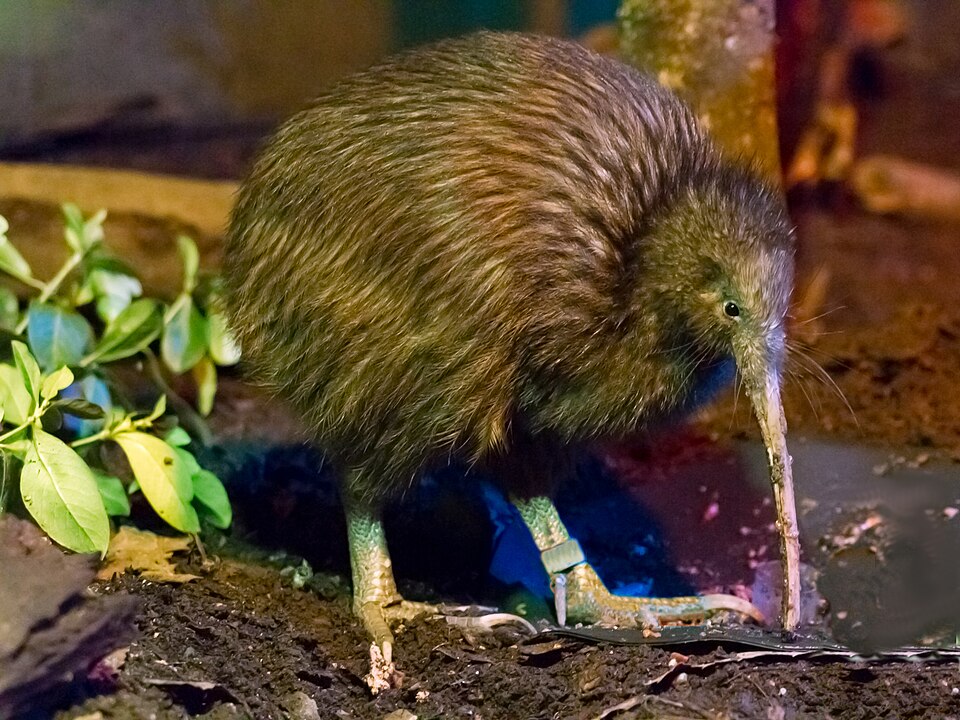
The kiwi is a flightless bird native to New Zealand and a powerful national symbol of the country. It belongs to the Apterygidae family and includes several distinct species found across the New Zealand islands. Smaller than other ratites, it stands out for its long beak and exceptionally developed sense of smell—unique among birds. Nocturnal and elusive, it lives hidden in dense forests and scrublands. Its population has declined sharply due to predators introduced by humans, making it a threatened and protected species today. It does not live in Tunisia and is found only in its native range.
The kiwi has a stocky body covered in fine feathers resembling hair, with no real capacity for flight. Its long, slender beak has nostrils at the tip, which it uses to detect prey underground through a highly developed sense of smell—rare in birds. Its wings are vestigial and hidden under plumage, and it lacks a well-developed sternum keel. Its short, sturdy legs are adapted for walking and digging.
Characteristics
Indicative values: they vary by subspecies, sex and region.
Habitat and distribution
The kiwi inhabits dense tropical and temperate forests of New Zealand, where substantial vegetation cover is present. It also frequents scrubland areas, wetland grasslands, and sometimes plantations at the forest's edge. It requires soft, invertebrate-rich soil for feeding, as well as shelter such as burrows or root cavities for daytime rest.
CURRENT RANGE
The kiwi is endemic to New Zealand, where it is distributed across the North Island, South Island, and several satellite islands. Different species occupy distinct geographical zones, often separated by terrain. Its range has dramatically declined since introduced predators such as rats, cats, and stoats arrived. Reintroduction programs and protected reserves now help stabilize certain local populations.
Behaviour
The kiwi is a nocturnal, solitary, and territorial bird that spends the day hidden in a burrow or under dense vegetation. It moves on the ground by walking and runs quickly if threatened, unable to fly. It locates prey using its highly developed sense of smell—exceptional among birds—by probing the ground with its long beak. Pairs may remain bonded for several years and actively defend their territory through nocturnal calls.
Reproduction
The female typically lays one or two eggs per season, which are remarkably large relative to her own body size. Incubation, which lasts approximately 70 to 80 days, is usually carried out mainly by the male. The chicks hatch already feathered and relatively independent, capable of feeding themselves shortly after hatching. Sexual maturity is reached several years after birth.
Peculiarities
The kiwi lays one of the largest eggs relative to body size among all birds. It has nostrils located at the tip of its beak, a unique feature among birds, which allows it to smell prey underground. Its plumage resembles fur more than typical feathers, and it has virtually no tail.
Threats and conservation
The main threats to the kiwi are human-introduced predators, particularly stoats, cats, and stray dogs, which attack eggs and young birds. The destruction and fragmentation of its forest habitat have also reduced populations. Intensive conservation programs, including captive breeding and predator control, are in place to protect the species.
Numbers and trends vary across sources and regions. See the IUCN assessment for the latest reference data.
Gallery
1 documented photographs.
References
Profile updated 07 September 2026 · Reviewed by the TunisieVet editorial team.
Comments (0)
No comments yet.
CONSERVATION STATUS
Vulnerable (VU)
IUCN source, latest published assessment.
Species health
Documented diseases for this species.
See the 4 diseases of this species Find a veterinarianThis information is provided for educational purposes only and is not a substitute for a veterinary consultation. If you have any concerns about your animal's health, consult a veterinarian.
To discover around: Kiwi
Videos, facts, stories and records linked to this species.
RECORD
up to about 20% of the female's weight
The largest egg relative to body size
Relative measure of egg weight compared to the adult female's body weight, a record among...
Similar animals
Other species documented in Animalpedia.

TunisieVet in your pocket 📱🐾 Access your veterinary services wherever you are. [ Download the app ]
Learn more