
Presentation
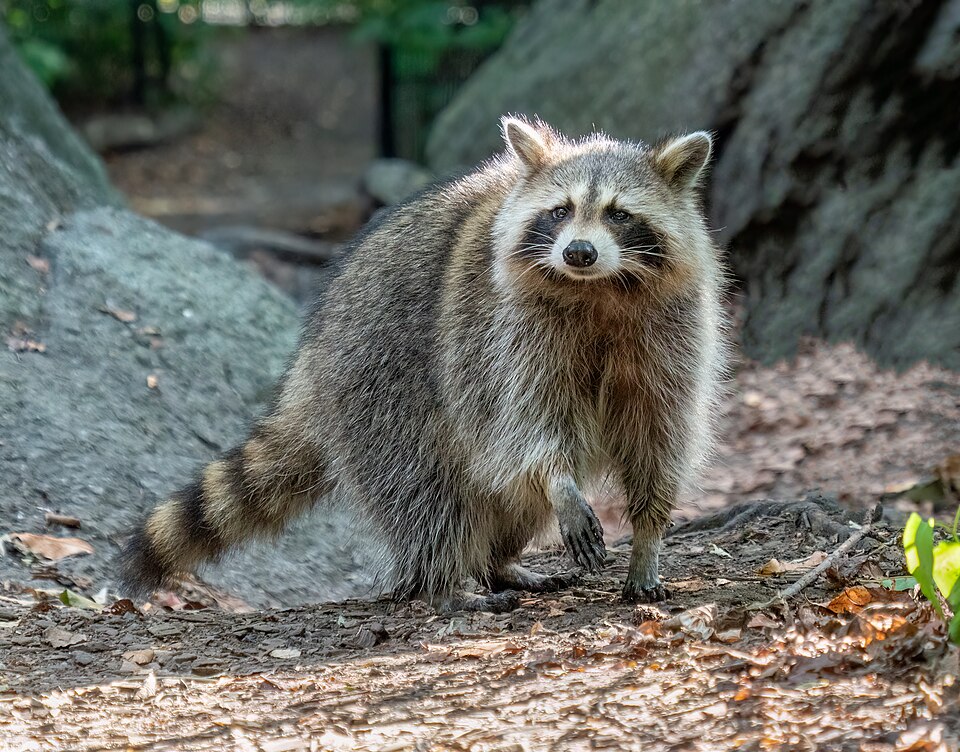
The Raccoon (Procyon lotor) is a medium-sized carnivorous mammal native to North America, recognizable by its black facial mask and ringed tail. Very opportunistic, it has adapted to many environments, from forests to urban areas. Its species has been introduced in several regions of the world, notably in Europe, where it is sometimes considered invasive. Endowed with great manual dexterity, it uses its front legs to manipulate and explore its food. It is active mainly at night and spends the day hidden in a shelter.
The Raccoon has a dense gray-brown coat, a characteristic black mask around the eyes, and a tail striped with five to seven dark rings. Its very mobile front legs end in fine fingers allowing it to precisely manipulate objects. It has a highly developed sense of smell and touch, compensating for relatively poor eyesight.
Characteristics
Indicative values: they vary by subspecies, sex and region.
Habitat and distribution
The Raccoon mainly frequents forests near water points, but also adapts to wetlands, meadows and urban environments. Its ecological plasticity allows it to colonize very diverse environments, including city parks and gardens.
CURRENT RANGE
Native to North America, it is present from Canada to Mexico. The species has also been introduced to Europe, notably Germany and France, where wild populations have become established. It is not naturally present in Africa or Tunisia.
Behaviour
The Raccoon is a primarily nocturnal and solitary animal, although females may share a territory with their young. It easily climbs trees and swims well, which allows it to exploit varied habitats. It does not build permanent burrows but uses temporary shelters such as tree cavities or buildings.
Reproduction
The breeding season is generally in winter and early spring. After a gestation of approximately two months, the female gives birth to two to five young in a protected shelter. The young stay with their mother for about a year before becoming independent.
Peculiarities
Raccoon is often associated with its behavior of "washing" its food in water, although this is actually tactile exploratory behavior. He is able to memorize solutions to problems for several years. Its great adaptability makes it a species sometimes considered harmful in areas where it has been introduced.
Threats and conservation
In its native area, the species does not face major threats and its populations are stable, even expanding in certain urban regions. It can be hunted or regulated in areas where it is considered invasive. The main causes of mortality remain road collisions and hunting.
Numbers and trends vary across sources and regions. See the IUCN assessment for the latest reference data.
Gallery
1 documented photographs.
References
Profile updated 26 August 2026 · Reviewed by the TunisieVet editorial team.
Comments (0)
No comments yet.
CONSERVATION STATUS
Least concern (LC)
IUCN source, latest published assessment.
Species health
Documented diseases for this species.
See the 4 diseases of this species Find a veterinarianThis information is provided for educational purposes only and is not a substitute for a veterinary consultation. If you have any concerns about your animal's health, consult a veterinarian.
Similar animals
Other species documented in Animalpedia.
