
Presentation
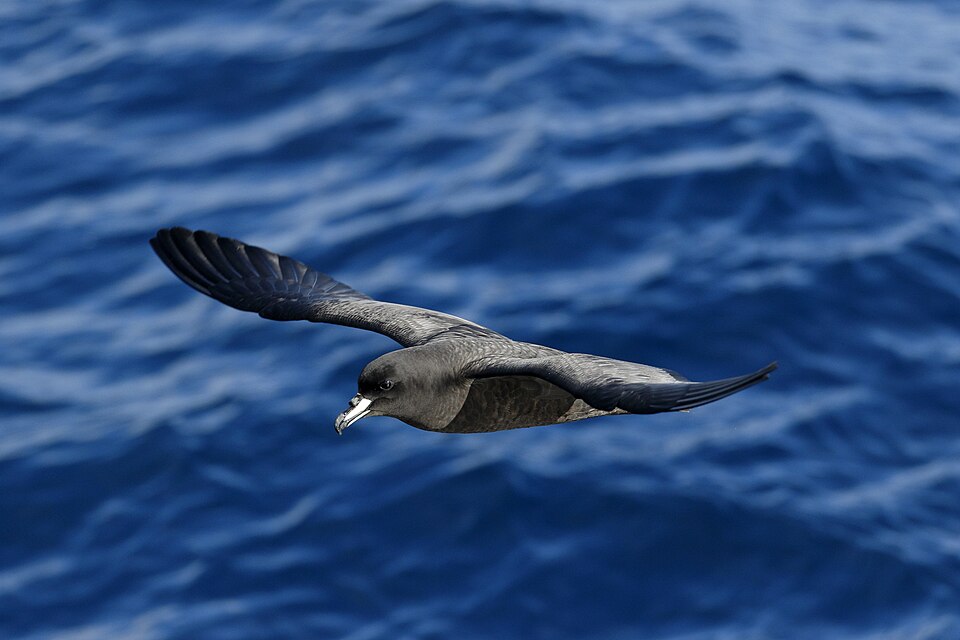
The petrel is a seabird belonging to the order Procellariiformes, which includes numerous species distributed across nearly all the world's oceans. It is characterized by controlled gliding flight skimming just above the waves and by external nasal tubes used to excrete excess salt. This bird spends most of its life at sea and returns to land only to breed, often on isolated islands. In the Mediterranean, the storm petrel and the Cory's shearwater (related species) frequent Tunisian coasts, particularly the Zembra and Galite islands. Its inconspicuous appearance and nocturnal habits at nesting sites make it a bird that is seldom seen despite its wide distribution.
The petrel has a compact body, long narrow wings suited to gliding flight, and a hooked beak equipped with nasal tubes characteristic of Procellariiformes. Its plumage ranges from grey-brown to black depending on the species, often with lighter underparts. It typically measures between 15 and 35 cm in length depending on the species.
Characteristics
Indicative values: they vary by subspecies, sex and region.
Habitat and distribution
Petrels live primarily at sea and along coastal waters, coming to land only to breed on remote islands or cliff faces. They generally avoid heavily populated coastal areas.
CURRENT RANGE
Petrels are found in most of the world's oceans, with particular diversity in the Southern Hemisphere. In the Mediterranean, several related species breed on rocky islands, notably around Tunisia at Zembra and La Galite.
Behaviour
The petrel is a gregarious bird at sea, sometimes forming large gatherings around food-rich areas. It is capable of traveling very long distances on gliding flight by exploiting marine air currents. At breeding sites, it often adopts nocturnal habits to reduce predation risk.
Reproduction
Petrels breed in colonies, typically nesting in burrows or rocky crevices on isolated islands or coastal cliffs. The female lays a single egg per season, incubated in turn by both parents over several weeks. The chick remains in the nest for several months before fledging, fed by regurgitation from the parents.
Peculiarities
The petrel owes its name to its distinctive manner of appearing to 'walk on water' by pattering across the surface while feeding, evoking the biblical account of Saint Peter. Its highly developed sense of smell allows it to locate food and its nest in darkness. Tubular nasal glands enable it to excrete excess salt absorbed from seawater.
Threats and conservation
Petrels are threatened by predation from mammals introduced to their breeding islands, such as rats and cats. Marine pollution, particularly ingested plastic, and accidental capture by fishing longlines also impact populations. Degradation of coastal habitats further reduces available breeding sites.
Numbers and trends vary across sources and regions. See the IUCN assessment for the latest reference data.
Gallery
1 documented photographs.
References
Profile updated 08 September 2026 · Reviewed by the TunisieVet editorial team.
Comments (0)
No comments yet.
CONSERVATION STATUS
Least concern (LC)
IUCN source, latest published assessment.
Species health
Documented diseases for this species.
This information is provided for educational purposes only and is not a substitute for a veterinary consultation. If you have any concerns about your animal's health, consult a veterinarian.
To discover around: Petrel
Videos, facts, stories and records linked to this species.
Similar animals
Other species documented in Animalpedia.

TunisieVet in your pocket 📱🐾 Access your veterinary services wherever you are. [ Download the app ]
Learn more