
Presentation
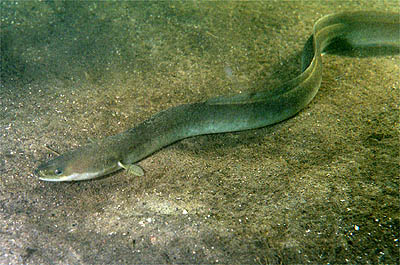
The European Eel (Anguilla anguilla) is a migratory fish with an elongated, serpentine body, covered with abundant mucus. It is born in the Sargasso Sea, crosses the Atlantic in larval form then colonizes the rivers, lakes and coastal areas of Europe and North Africa, including Tunisia. After several years of growth in fresh or brackish water, the adult returns to its oceanic birthplace to reproduce. This catadromous species presents a complex life cycle that is still partially mysterious to scientists. Long fished for its meat, it has experienced a major demographic decline in recent decades. It is today considered one of the most endangered fish in Europe.
The body is cylindrical and elongated, covered with smooth, slimy skin rather than visible scales. Coloration varies from green-brown to yellow on the back, with a lighter belly, changing to a bright silver in adults ready to migrate. The dorsal, caudal and anal fins are fused into a single continuous band. The eyes enlarge significantly during the marine migration phase.
Characteristics
Indicative values: they vary by subspecies, sex and region.
Habitat and distribution
The Eel frequents rivers, lakes, ponds, coastal lagoons and wetlands of fresh or brackish water. It can also be observed in coastal areas during its migration phases. It likes muddy bottoms or those rich in hiding places, such as roots and stones. In Tunisia, it is found in certain lakes, wadis and coastal lagoons.
CURRENT RANGE
The species occurs along the Atlantic and Mediterranean coasts of Europe and North Africa. Its breeding range is limited to the Sargasso Sea in the western Atlantic. In Tunisia, it is notably recorded in lagoons such as those of Ghar El Melh or Bizerte, as well as in certain rivers.
Behaviour
An essentially nocturnal animal, the Eel hides during the day in mud, rock cavities or aquatic vegetation. It can move short distances outside the water, notably to overcome obstacles or colonize new wetlands. Solitary for most of its life, it only regroups when moving downstream towards the sea. It tolerates a wide range of salinities, which allows it to live in fresh, brackish or marine water depending on the stages of its cycle.
Reproduction
Reproduction takes place exclusively in the Sargasso Sea, in the Atlantic Ocean, after a migration of several thousand kilometers. Mature adults stop feeding and undergo marked physiological changes, including enlargement of the eyes and a change in silver coloring. The larvae, called leptocephali, then drift for several months thanks to sea currents before reaching European coasts. The adults die after this single reproduction.
Peculiarities
The life cycle of Eel, combining massive oceanic migration and life in fresh water, remains one of the most fascinating and complex in the animal kingdom. Its ability to crawl out of the water on wet substrate is a rare feature among fish. Its abundant skin mucus gives it protection against parasites and facilitates its occasional terrestrial movements.
Threats and conservation
The European Eel population has declined drastically, largely due to dams and river barriers that prevent its migration. Overfishing, particularly of the highly prized glass eels (young Eels), has greatly aggravated its decline. Water pollution and wetland degradation also reduce its available habitats. An unintentionally introduced invasive parasite also affects its swim bladder and migratory capacity.
Numbers and trends vary across sources and regions. See the IUCN assessment for the latest reference data.
Gallery
1 documented photographs.
References
Profile updated 28 August 2026 · Reviewed by the TunisieVet editorial team.
Comments (0)
No comments yet.
CONSERVATION STATUS
Critically endangered (CR)
IUCN source, latest published assessment.
Species health
Documented diseases for this species.
See the 6 diseases of this species Find a veterinarianThis information is provided for educational purposes only and is not a substitute for a veterinary consultation. If you have any concerns about your animal's health, consult a veterinarian.
To discover around: Eel
Videos, facts, stories and records linked to this species.

TunisieVet in your pocket 📱🐾 Access your veterinary services wherever you are. [ Download the app ]
Learn more