
Presentation
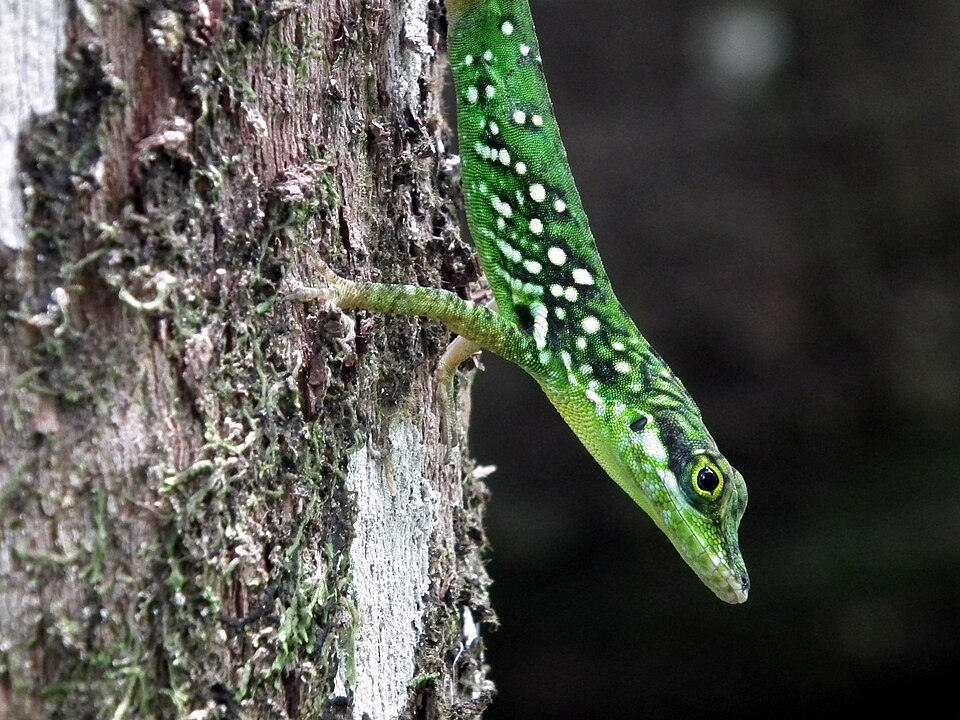
The Anole form a large genus of small arboreal lizards belonging to the Dactyloidae family, numbering several hundred species distributed mainly in the Americas. They are renowned for their colorful dewlap, displayed during territorial or nuptial displays. Some species have the ability to change color slightly depending on their mood or temperature, which has earned them the erroneous nickname “American chameleons”. Their small size, their agility and their fingers equipped with adhesive strips allow them to colonize trunks, foliage and even urban walls. This genus is widely studied in evolutionary biology as a model of adaptive radiation. Some species, such as the green Anole, are commonly raised in terrariums.
The body is thin and elongated, generally measuring between 10 and 20 cm depending on the species, with a tail often as long as the body. The skin has fine scales and can vary from bright green to brown depending on the species and physiological state. The gular dewlap, present mainly in males, is a richly vascularized and colored retractile skin membrane. The fingers are equipped with adhesive strips allowing excellent adhesion to smooth surfaces.
Characteristics
Indicative values: they vary by subspecies, sex and region.
Habitat and distribution
Anole occupy a wide variety of environments, from tropical rainforests to urban areas and gardens, including brush and forest edges. They are typically arboreal, living on trunks, branches and foliage, although some species are more terrestrial. Their adaptability allows them to colonize habitats disturbed by humans, including residential areas.
CURRENT RANGE
The genus Anole is native to the Americas, with particularly high diversity in the Caribbean, Central America, and South America. Some species have been introduced outside their native range, notably in the southeastern United States and various tropical regions of the world via the pet trade. The genre is not naturally present in Africa or Tunisia.
Behaviour
Anole are diurnal and territorial, with males actively defending a domain through head movements and gular dewlap deployment. They are capable of rapid jumps between branches and rapid runs on trunks and the ground. Visual communication plays a central role in social interactions and courtship displays. Some species may also change color slightly in response to stress or ambient temperature.
Reproduction
Reproduction is oviparous, with the female usually laying a single egg at a time but repeatedly throughout the breeding season. Eggs are laid in a moist substrate such as leaf litter or loose soil. Incubation lasts four to seven weeks depending on temperature and species. There is no parental care after laying eggs.
Peculiarities
The genus Anole is famous in biology for illustrating remarkable cases of adaptive radiation and evolutionary convergence among Caribbean islands. The colorful gular dewlap, unique in its shape and color depending on the species, serves as a species-specific signal and facilitates recognition between individuals. Some species can partially regenerate their tail in the event of autotomy in the face of a predator.
Threats and conservation
Habitat loss linked to deforestation and urbanization threatens certain localized species, particularly in the Caribbean. Competition with introduced species, such as other exotic Anole, can also displace native populations. The pet trade places moderate pressure on some wild-collected wildlife species.
Numbers and trends vary across sources and regions. See the IUCN assessment for the latest reference data.
Gallery
1 documented photographs.
References
Profile updated 01 September 2026 · Reviewed by the TunisieVet editorial team.
Comments (0)
No comments yet.
CONSERVATION STATUS
Least concern (LC)
IUCN source, latest published assessment.
Species health
Documented diseases for this species.
This information is provided for educational purposes only and is not a substitute for a veterinary consultation. If you have any concerns about your animal's health, consult a veterinarian.
Similar animals
Other species documented in Animalpedia.

TunisieVet in your pocket 📱🐾 Access your veterinary services wherever you are. [ Download the app ]
Learn more