
Presentation
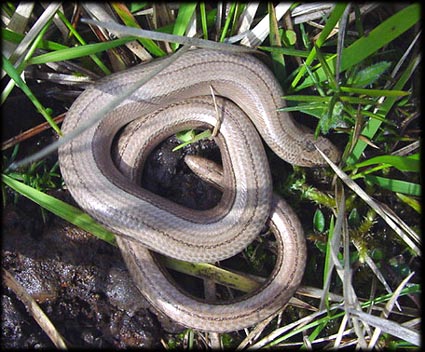
The Orvet (Anguis fragilis) is a legless squamate reptile, often confused with a snake due to its elongated, cylindrical body. It is actually a lizard, as revealed by its moving eyelids and visible outer ear. Discreet and burrowing, it lives hidden under stones, piles of wood or plant litter. Its name “fragilis” refers to its capacity for caudal autotomy, the tail easily detaching in the event of an attack. Widespread in Europe and part of North Africa, it is harmless to humans and is useful to the gardener by consuming slugs and worms.
The body of the Orvet is smooth, shiny, gray-brown to coppery in color depending on the individual. It has no visible legs, unlike other lizards, which accentuates the resemblance to a snake. Its scales are small, smooth and regularly arranged, giving it a characteristic metallic appearance.
Characteristics
Indicative values: they vary by subspecies, sex and region.
Habitat and distribution
The species favors cool, humid environments offering hiding places: forest edges, meadows, gardens, embankments and bushy areas. She particularly appreciates piles of compost, wood or stones which offer her warmth and humidity. It is found both in the plains and in mid-mountains.
CURRENT RANGE
Orvet is widely distributed in Europe, from Portugal to western Russia, as well as in northwest Africa. It is absent from the driest regions. Its presence in Tunisia is not significantly documented, the species remaining essentially linked to temperate and humid climates.
Behaviour
A discreet and burrowing animal, the Orvet spends most of its time hidden under stones, stumps or in soft soil. It is mainly twilight and nocturnal, emerging mainly with humidity. When threatened, it can voluntarily sever its tail to escape a predator, it continuing to wave to distract attention. It is a slow and peaceful animal, lacking venom and unable to bite seriously.
Reproduction
The Orvet is ovoviviparous: the eggs develop inside the body of the female and the young are born alive, surrounded by a thin membrane which they quickly tear. A litter generally has between 6 and 12 young, delivered at the end of summer. Newborns are independent from birth and receive no parental care.
Peculiarities
Although it strongly resembles a snake, the Orvet is a true legless lizard, with moving eyelids that allow it to blink. Its ability to lose and then partially regenerate its tail is a striking characteristic. Some individuals can live exceptionally long for a reptile of this size.
Threats and conservation
The main threats to the Orvet are habitat destruction, including the loss of hedgerows and bushy areas, and collisions with agricultural machinery and mowers. It is also regularly killed by mistake, being mistaken for a viper even though it is completely harmless. The use of pesticides also reduces its food resources.
Numbers and trends vary across sources and regions. See the IUCN assessment for the latest reference data.
Gallery
1 documented photographs.
References
Profile updated 02 September 2026 · Reviewed by the TunisieVet editorial team.
Comments (0)
No comments yet.
CONSERVATION STATUS
Least concern (LC)
IUCN source, latest published assessment.
Species health
Documented diseases for this species.
This information is provided for educational purposes only and is not a substitute for a veterinary consultation. If you have any concerns about your animal's health, consult a veterinarian.
Similar animals
Other species documented in Animalpedia.

TunisieVet in your pocket 📱🐾 Access your veterinary services wherever you are. [ Download the app ]
Learn more