
Presentation
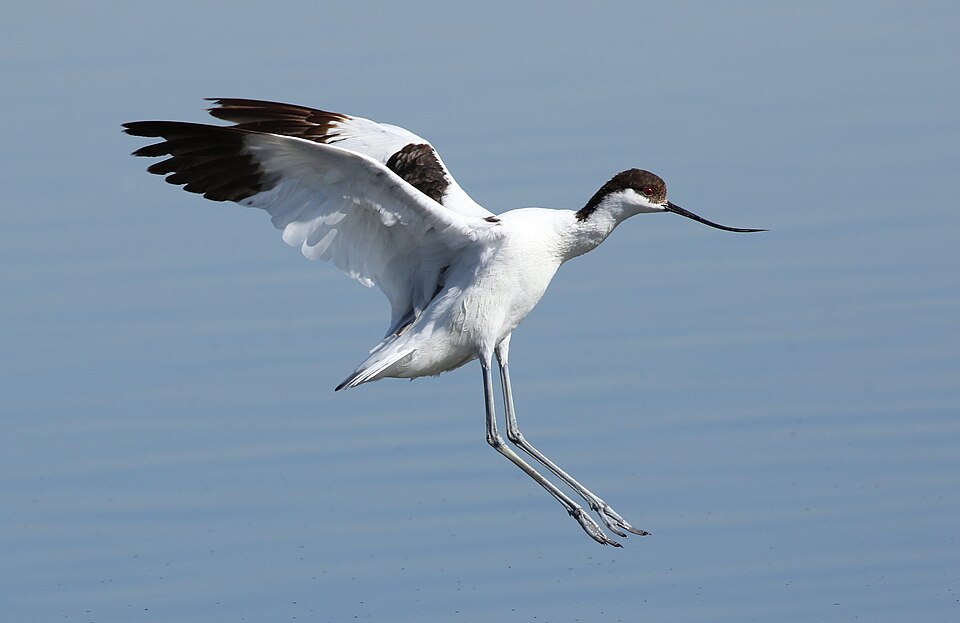
The Pied Avocet is a wading bird identified by its long, slender, upturned bill and striking white-and-black plumage. It inhabits coastal lagoons, salt marshes, and shallow wetlands, where it feeds by sweeping its bill side to side through the water. Its long blue-grey legs enable it to wade through mud and brackish waters. A highly gregarious species, it often nests in dense colonies alongside other waders. In Tunisia, it is found particularly in the wetlands of the north and south-east. Its slender silhouette and characteristic feeding behaviour make it an easy species to identify.
The Avocet measures 42 to 45 cm in length with a wingspan of approximately 77 cm. Its plumage is white with black markings on the head, back, and wings. The slender black upturned bill is the species' most distinctive feature, as are its long blue-grey webbed legs.
Characteristics
Indicative values: they vary by subspecies, sex and region.
Habitat and distribution
Avocets frequent coastal wetlands such as lagoons, salt marshes, mudflats, and estuaries. They favour shallow brackish or saltwater areas rich in invertebrates. They may also be found on inland waterbodies such as certain salt lakes.
CURRENT RANGE
The species breeds in Europe, Central Asia, and North Africa. European and Asian populations migrate south in winter to sub-Saharan Africa, the Middle East, and southern Asia. In North Africa, including Tunisia, it is present as a breeding or wintering bird depending on the region.
Behaviour
A highly social species, it lives and nests in often dense colonies. It defends its nest vigorously against intruders and predators, sometimes using distraction displays. Northern populations migrate to milder areas during winter.
Reproduction
The female typically lays 3 to 4 eggs in a shallow nest scraped directly into the ground near water. Incubation is shared by both parents and takes about 23 to 25 days. The chicks are precocial and can feed themselves shortly after hatching, though they remain under parental supervision.
Peculiarities
The upturned curved bill, unique among waders in its region, is the species' most distinctive feature. This bill allows it a particular feeding technique involving sideways sweeping through the water.
Threats and conservation
The degradation and loss of coastal wetlands, particularly through urbanization and salt marsh exploitation, is the main threat. Human disturbance during the breeding season can also affect breeding success. Coastal water pollution represents an additional threat.
Numbers and trends vary across sources and regions. See the IUCN assessment for the latest reference data.
Gallery
1 documented photographs.
References
Profile updated 08 September 2026 · Reviewed by the TunisieVet editorial team.
Comments (0)
No comments yet.
CONSERVATION STATUS
Least concern (LC)
IUCN source, latest published assessment.
Species health
Documented diseases for this species.
Find a veterinarianThis information is provided for educational purposes only and is not a substitute for a veterinary consultation. If you have any concerns about your animal's health, consult a veterinarian.
Similar animals
Other species documented in Animalpedia.

TunisieVet in your pocket 📱🐾 Access your veterinary services wherever you are. [ Download the app ]
Learn more