
Presentation
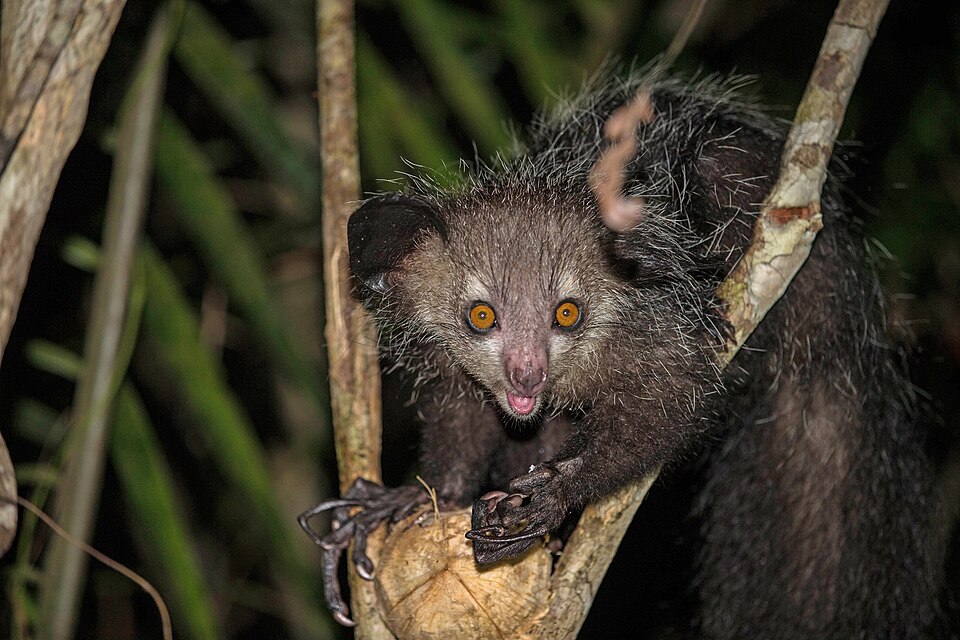
The aye-aye is a nocturnal primate found only in Madagascar and is the sole surviving member of the Daubentoniidae family. It is distinguished by its coarse, dark brown-black fur, large membranous ears, and bulging eyes adapted for night vision. Its most distinctive feature is an extremely thin and elongated middle finger on its hand, which it uses to extract insect larvae from wood. Long feared by local populations who associated it with ill omens, it has often been persecuted. Today it holds a unique place among lemurs due to its singular anatomy and secretive lifestyle. The species is now threatened by deforestation and traditional persecution.
The aye-aye has long, continuously growing incisor teeth similar to those of rodents, along with a skeletal middle finger that is highly mobile. Its large naked ears allow it to detect the movement of larvae beneath the bark through passive echolocation. Its coat is dense and dark, sometimes scattered with white hairs on the back.
Characteristics
Indicative values: they vary by subspecies, sex and region.
Habitat and distribution
The aye-aye lives in humid tropical forests in eastern Madagascar, as well as in certain dry forests and mangrove areas around the island's perimeter. It inhabits both primary forest and degraded or secondary areas, provided that sufficient tree cover remains.
CURRENT RANGE
The species is endemic to Madagascar and occurs in a fragmented pattern across much of the island, primarily in coastal and interior forest areas. Its range has shrunk significantly due to progressive loss of natural forests.
Behaviour
This animal is strictly nocturnal and arboreal, spending most of its time in the canopy. It is generally solitary, with each individual occupying a territory that it defends or partially shares depending on available resources. It builds spherical nests of branches and leaves in trees to rest during the day.
Reproduction
Females typically give birth to a single offspring after a gestation period of about five months. The young remains dependent on its mother for several months, and some learning skills take up to two years to master. Sexual maturity is reached between two and three years of age.
Peculiarities
The aye-aye's extremely thin and flexible middle finger is unique among primates and serves as a tool for percussion and extraction. Local cultural beliefs sometimes associate it with an omen of death, contributing to its persecution in certain regions of Madagascar.
Threats and conservation
Deforestation from slash-and-burn agriculture continuously reduces its natural habitat. Direct persecution, driven by harmful traditional beliefs, leads to the killing of many individuals. Occasional hunting for bushmeat poses an additional localized threat.
Numbers and trends vary across sources and regions. See the IUCN assessment for the latest reference data.
Gallery
1 documented photographs.
References
Profile updated 02 September 2026 · Reviewed by the TunisieVet editorial team.
Comments (0)
No comments yet.
CONSERVATION STATUS
Endangered (EN)
IUCN source, latest published assessment.
Species health
Documented diseases for this species.
This information is provided for educational purposes only and is not a substitute for a veterinary consultation. If you have any concerns about your animal's health, consult a veterinarian.
To discover around: Aye-aye
Videos, facts, stories and records linked to this species.
Similar animals
Other species documented in Animalpedia.

TunisieVet in your pocket 📱🐾 Access your veterinary services wherever you are. [ Download the app ]
Learn more