
Presentation
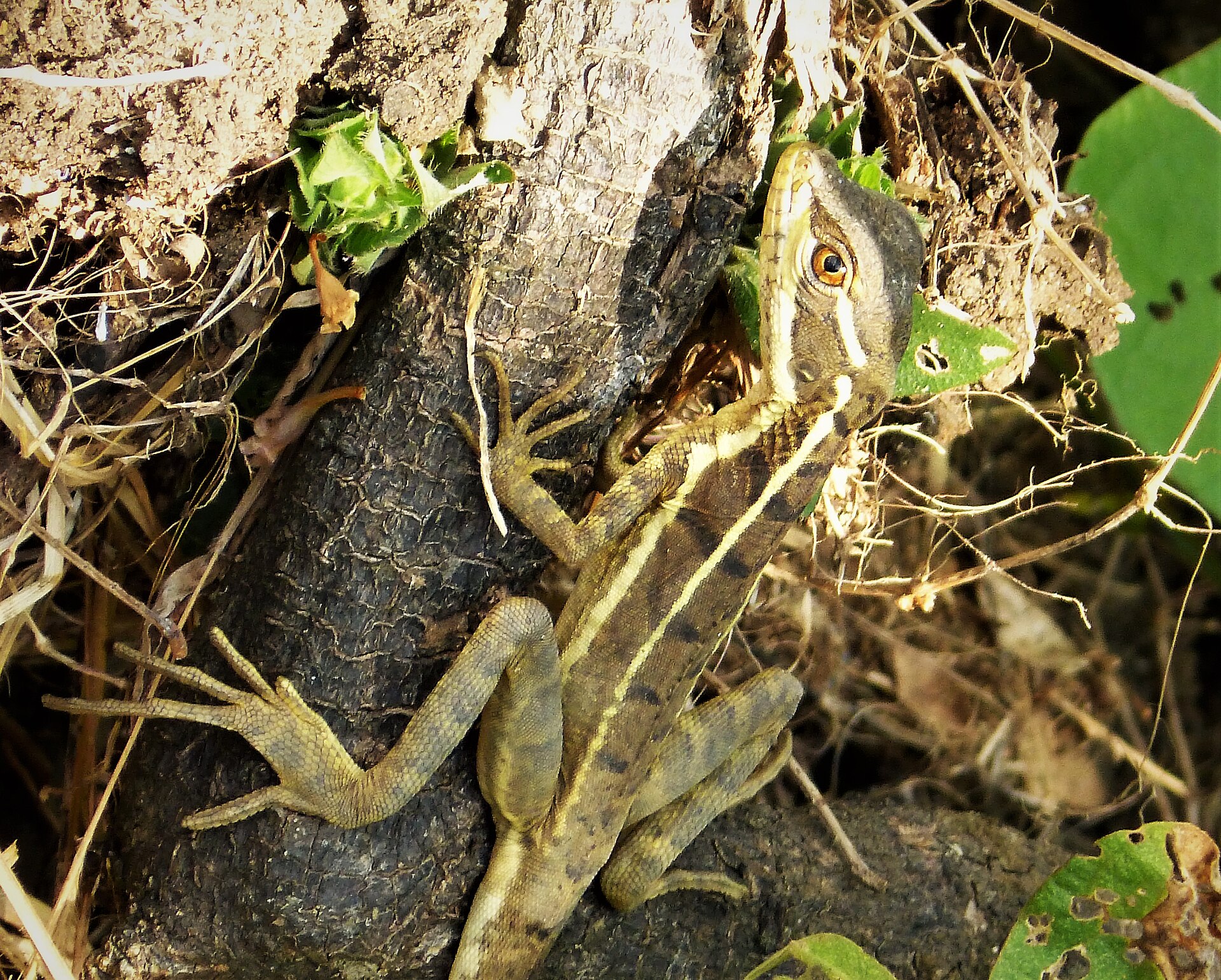
The Basil is an arboreal lizard from Central and South America, known for its ability to run on water using its fringed hind legs. It belongs to the Corytophanidae family and is distinguished by a prominent dorsal crest, particularly developed in males. This diurnal reptile generally lives near waterways, in which it takes refuge in case of danger. Several species exist, of which the green Basil (Basiliscus plumifrons) is the best known in captivity. It is sometimes nicknamed "Jesus Christ lizard" because of its ability to move briefly on the surface of the water. Its size and bright colors make it an animal appreciated by terrariophiles.
The Basil has an elongated body covered in scales, a long, tapered tail, and powerful hind legs suitable for fast running. Males have fleshy crests on their head, back and tail, which are absent or poorly developed in females. Coloration varies from bright green to brown depending on the species, often decorated with patterns and spots. Its outstretched hind toes allow it to run briefly on water without sinking.
Characteristics
Indicative values: they vary by subspecies, sex and region.
Habitat and distribution
The Basil favors tropical rainforests located near rivers, streams and marshy areas. It seeks out dense vegetation along streams, which provides both perches and a rapid aquatic escape route. This dependence on water explains its distribution limited to well-irrigated tropical forest environments.
CURRENT RANGE
Basil is native to Central America and northern South America, from Mexico to Ecuador and Colombia depending on the species. Some populations were introduced to Florida, United States, where they became permanently established. However, its natural distribution remains confined to the tropical regions of the American continent.
Behaviour
The Basil is a diurnal, active and territorial animal, particularly in males which defend their area against rivals. An excellent climber, it moves in trees as well as on the ground and in water, where it can swim and dive to escape predators. Its ability to run on water is its most characteristic escape mechanism from danger. It generally remains solitary outside the breeding season.
Reproduction
The reproduction of Basil is oviparous, the female laying several clutches of 10 to 20 eggs per year in loose or sandy soil. Incubation generally lasts between two and three months depending on ambient temperature. The young are independent from hatching and receive no parental care. Sexual maturity is reached around the age of one year to eighteen months.
Peculiarities
The Basil is famous for its unique ability to run on the surface of the water for several meters, a feat made possible by the speed of its strides and the structure of its legs. This feat earned him the nickname “Jesus Christ lizard” in several languages. The male's dorsal crest, reminiscent of a helmet, is the origin of its scientific name inspired by the mythological Basil.
Threats and conservation
Basil is locally threatened by deforestation and degradation of riparian habitats in Central America. The pet trade puts pressure on some wild populations, although the species also breeds easily in captivity. Overall, its populations remain stable and the species is not considered threatened.
Numbers and trends vary across sources and regions. See the IUCN assessment for the latest reference data.
Gallery
1 documented photographs.
References
Profile updated 01 September 2026 · Reviewed by the TunisieVet editorial team.
Comments (0)
No comments yet.
CONSERVATION STATUS
Least concern (LC)
IUCN source, latest published assessment.
Species health
Documented diseases for this species.
This information is provided for educational purposes only and is not a substitute for a veterinary consultation. If you have any concerns about your animal's health, consult a veterinarian.
To discover around: Basil
Videos, facts, stories and records linked to this species.
RECORD
up to approximately 1.5 m/s at the surface
The only lizard capable of running on water
Measured in young basilisks fleeing a predator over short distances.
Similar animals
Other species documented in Animalpedia.

TunisieVet in your pocket 📱🐾 Access your veterinary services wherever you are. [ Download the app ]
Learn more