Presentation
The nene (Branta sandvicensis) is a wild goose endemic to the Hawaiian archipelago. It is the official state bird of Hawaii and represents local conservation efforts. Less aquatic than most duck family species, it has adapted to life on rough volcanic terrain. The species came close to extinction in the 20th century before benefiting from successful reintroduction programs. It is distinguished by its characteristic striped plumage and partially webbed feet adapted for walking on lava.
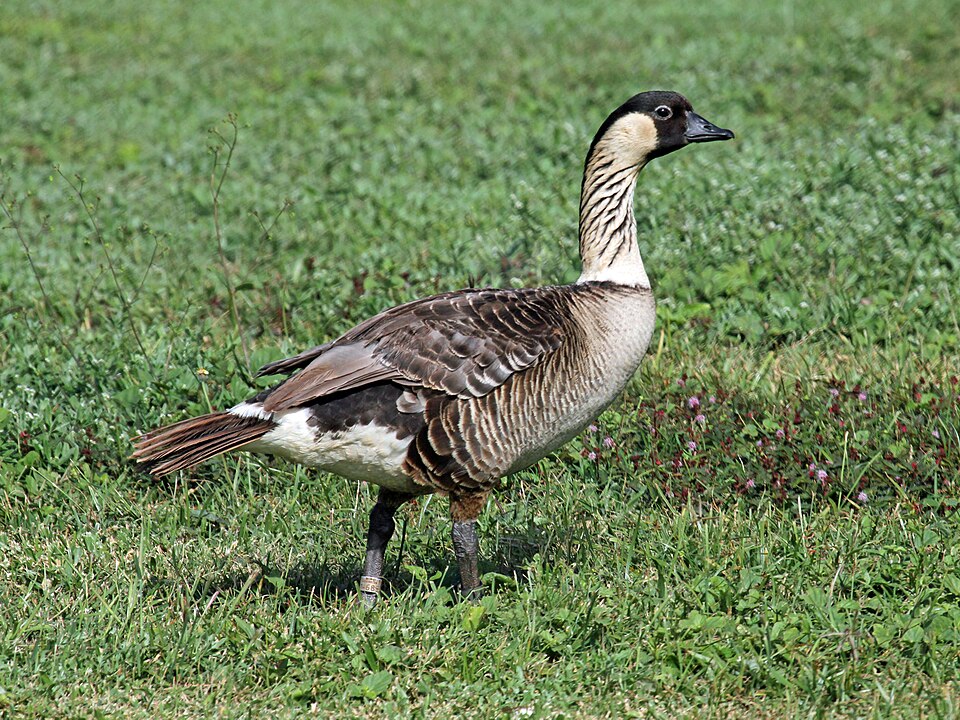
The nene measures approximately 22 to 28 inches long with a modest wingspan compared to other geese. Its neck and head are black, streaked with cream-colored feathers on the cheeks and back of the neck. The body displays brownish-gray striped plumage, and its clawed feet, less webbed than in other geese, facilitate movement over volcanic rocks. The bill is short and black, adapted for a terrestrial diet.
Characteristics
Indicative values: they vary by subspecies, sex and region.
Habitat and distribution
The species inhabits volcanic slopes, lava flows, high-altitude grasslands, and sparse scrubland on the Hawaiian islands. It favours areas with low vegetation that provide food and shelter. Some populations occupy coastal habitats or dunes.
CURRENT RANGE
The Hawaiian goose is endemic to the Hawaiian archipelago, notably the islands of Hawaiʻi (Big Island), Maui, Kauai, and Molokai. It occurs naturally nowhere else in the world. Reintroduced populations exist thanks to conservation programmes carried out on several islands.
Behaviour
The nene lives in pairs or small family groups and forms long-lasting pair bonds. It is less gregarious than other goose species and spends most of its time on the ground rather than in flight or on water. Territorial behavior becomes more pronounced during breeding season. The species produces distinctive nasal calls to communicate between mates.
Reproduction
Breeding season typically runs from autumn to winter, an unusual period for high-altitude birds. The female lays between 2 and 5 eggs in a ground nest lined with vegetation. Incubation lasts roughly one month, and both parents participate in rearing the young. Goslings become independent after a few months but often remain close to the family group.
Peculiarities
Unlike most geese, the Hawaiian goose is poorly adapted to water and lives mainly on dry, volcanic terrain. It has lost some of the webbing on its feet over the course of its island evolution, a trait rare among waterfowl. Its status as Hawaii's official state bird makes it a powerful symbol of local conservation.
Threats and conservation
The species was threatened by the introduction of predators (mongooses, cats, rats) and by historical hunting until it nearly became extinct in the 1950s. Habitat loss from urbanisation and agriculture remains an ongoing pressure. Captive-breeding programmes and reintroduction efforts have allowed a gradual population recovery, but the population remains dependent on active management.
Numbers and trends vary across sources and regions. See the IUCN assessment for the latest reference data.
Gallery
1 documented photographs.
References
Profile updated 03 September 2026 · Reviewed by the TunisieVet editorial team.
Comments (0)
No comments yet.
CONSERVATION STATUS
Near threatened (NT)
IUCN source, latest published assessment.
Species health
Documented diseases for this species.
Find a veterinarianThis information is provided for educational purposes only and is not a substitute for a veterinary consultation. If you have any concerns about your animal's health, consult a veterinarian.
Similar animals
Other species documented in Animalpedia.

Be among the first to use our app. Sign up and get early Google Play access.
Discover