
Presentation
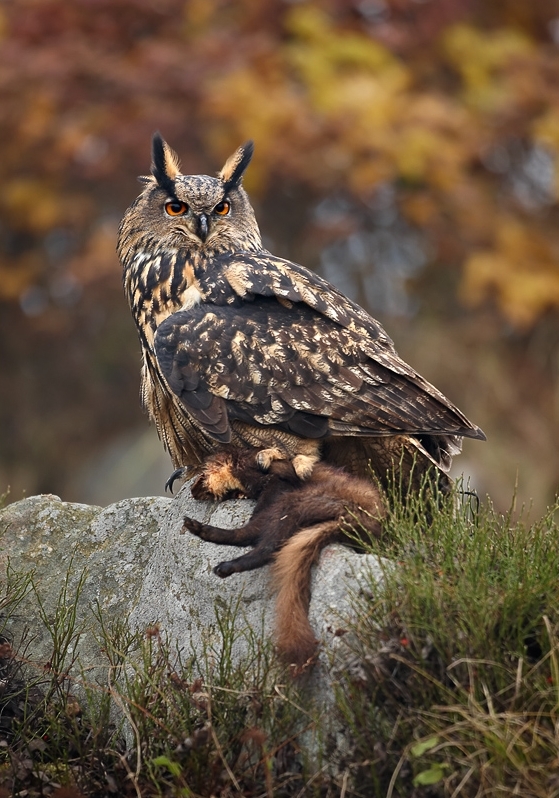
The Eurasian eagle-owl is the largest nocturnal bird of prey in Eurasia. This impressive bird of prey is distinguished by its massive silhouette, large visible ears and characteristic orange eyes. An excellent nocturnal predator, it reigns over the forest and mountain ecosystems where it hunts.
The Eurasian eagle-owl's gray-brown plumage is finely spotted, providing excellent camouflage in its environment. Its broad, rounded wings allow it to fly silently and maneuverably. The characteristic ear tufts and frontal eyes give this raptor an intense and recognizable expression.
Characteristics
Indicative values: they vary by subspecies, sex and region.
Habitat and distribution
Eurasian eagle-owl frequents dense forests and mountainous regions, including rocky cliffs and escarpments. It appreciates environments where woodland and open areas for hunting coexist. He avoids overly urban and anthropized environments, preferring wild and preserved regions.
CURRENT RANGE
The Eurasian eagle-owl is widely distributed in Europe, North Asia and Central Asia. Its range extends from Portugal to Scandinavia and as far as Japan. European populations are often sedentary or partially migratory. It is not present in Tunisia in an established manner.
Behaviour
The Eurasian eagle-owl is strictly nocturnal, hunting under cover of darkness with remarkable precision. Territorial and solitary, it occupies a home range that can extend over several kilometers. Its exceptional hearing allows it to locate prey even in total darkness.
Reproduction
Reproduction of Eurasian eagle-owl begins at the end of winter. The female lays 1 to 4 eggs in a rock cavity or an abandoned nest of another raptor. Incubation lasts about 30 days, and the young leave the nest after 5 to 6 weeks. Parents fiercely protect their nesting territory.
Peculiarities
The Eurasian eagle-owl has carefully selected hearing: its ears are asymmetrical, allowing precise three-dimensional localization of prey. Its powerful and deep cry, audible several kilometers away, is used for territorial defense. It can hunt prey as large as itself, including other birds of prey.
Threats and conservation
Although classified as Least Concern, Eurasian eagle-owl faces threats from habitat loss, including degradation of old-growth forests and rocky areas. Collisions with vehicles and power lines also pose significant risks in some areas.
Numbers and trends vary across sources and regions. See the IUCN assessment for the latest reference data.
Gallery
1 documented photographs.
References
UICN — Liste rouge des espèces menacées
Profile updated 28 August 2026 · Reviewed by the TunisieVet editorial team.
Comments (0)
No comments yet.
CONSERVATION STATUS
Least concern (LC)
IUCN source, latest published assessment.
Species health
Documented diseases for this species.
This information is provided for educational purposes only and is not a substitute for a veterinary consultation. If you have any concerns about your animal's health, consult a veterinarian.
Related species
To discover around: Eurasian eagle-owl
Videos, facts, stories and records linked to this species.
Similar animals
Other species documented in Animalpedia.

TunisieVet in your pocket 📱🐾 Access your veterinary services wherever you are. [ Download the app ]
Learn more