
Presentation
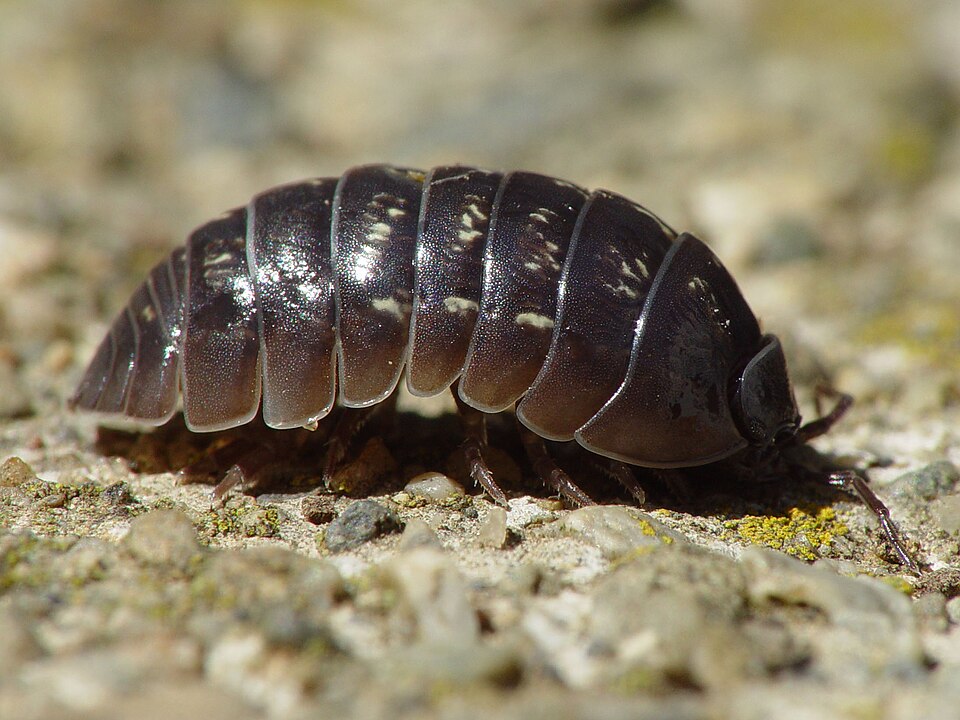
The woodlouse is a small terrestrial crustacean belonging to the order Isopoda, often mistaken for an insect. Its segmented, flattened body is protected by a chalky exoskeleton divided into articulated plates, giving it an appearance reminiscent of a tiny armadillo. Some species, such as the common woodlouse, can roll into a ball when threatened. Living mainly in damp, dark environments, it plays a discreet yet essential role in the decomposition of organic matter. Found on all continents, it is one of the few crustaceans to have completely colonized the terrestrial environment. It is entirely harmless to humans and neither bites nor stings.
The woodlouse body measures between 1 and 2 cm and has seven pairs of legs. Its segmented exoskeleton, ranging in color from grey to dark brown, provides good mechanical protection. It breathes through organs called pseudotrachea, which requires it to live in damp environments to prevent desiccation.
Characteristics
Indicative values: they vary by subspecies, sex and region.
Habitat and distribution
Woodlice prefer damp, dark environments rich in decomposing organic matter: under stones, flower pots, piles of wood, or leaf litter. They are found in gardens and cellars as well as in forests and natural wetlands. They avoid environments that are too dry, which threaten their survival through dehydration.
CURRENT RANGE
Woodlice are present on all continents except Antarctica, thanks to their great capacity for adaptation and dispersal favored by human activity. Species native to Europe and the Mediterranean basin have spread widely throughout the world. In North Africa, several native species coexist with introduced species.
Behaviour
A nocturnal and light-averse animal, the woodlouse avoids light and hides during the day under stones, bark, or plant debris. It typically lives in groups of varying density in damp areas. When facing danger, some species roll into a compact ball for protection, a behavior known as conglobation.
Reproduction
The female carries her eggs and then her young in a ventral pouch called a marsupium, filled with fluid, for several weeks. Young woodlice, called mancas, are born fully formed but lack one pair of legs, which they will develop after their first molt. Sexual maturity is reached within a few months, and the female can produce several broods per year.
Peculiarities
Unlike most crustaceans, the woodlouse has achieved complete adaptation to terrestrial life while maintaining respiration similar to that of its aquatic ancestors. Some species are increasingly raised as small terrarium pets because of their ease of care and their useful role as cleaners.
Threats and conservation
Woodlice are not globally threatened, and their populations are considered stable. Pesticide use and destruction of organic litter in gardens can locally reduce their numbers. They have no specific legal protection due to their abundance.
Numbers and trends vary across sources and regions. See the IUCN assessment for the latest reference data.
Gallery
1 documented photographs.
References
Profile updated 13 September 2026 · Reviewed by the TunisieVet editorial team.
Comments (0)
No comments yet.
CONSERVATION STATUS
Least concern (LC)
IUCN source, latest published assessment.
Similar animals
Other species documented in Animalpedia.
