
Presentation
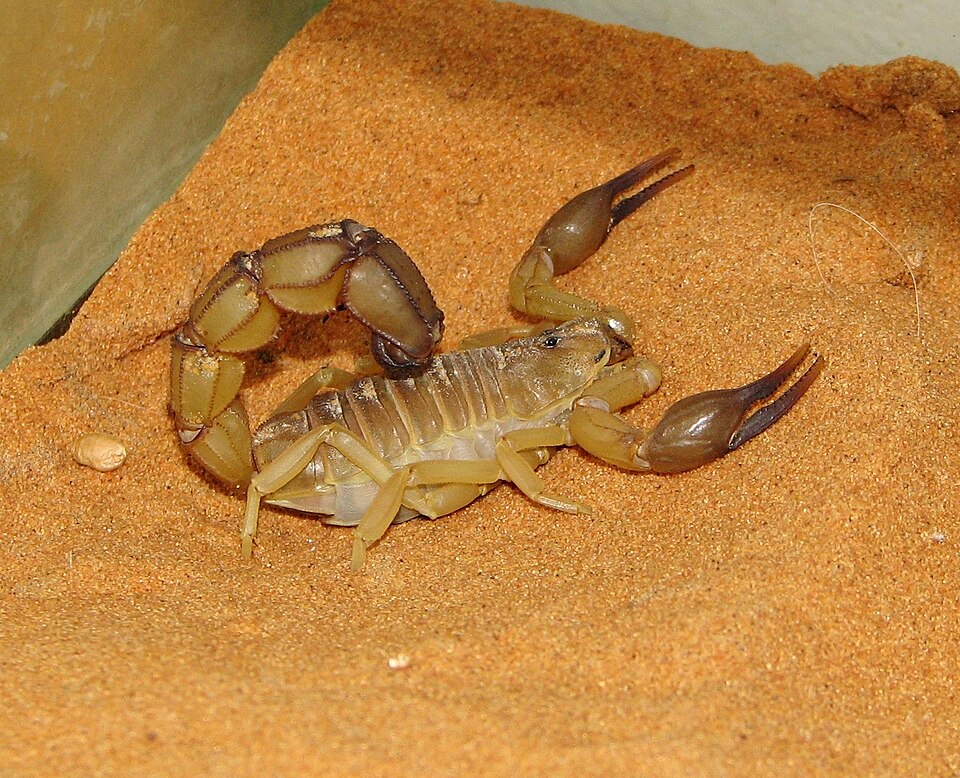
The Deathstalker scorpion is one of the most dangerous scorpion species in North Africa and the Middle East. Recognizable by its pale yellow to golden color, this small scorpion has a highly toxic venom which makes it formidable despite its modest dimensions.
The body is uniform yellow in color, with a short, stocky abdomen (metasome). The species is distinguished by extremely potent venom and a thick, robust tail containing the venomous glands. The pedipalps are a characteristic structure of Buthidae.
Did you know?
How do scorpions survive with almost no water?
Characteristics
Indicative values: they vary by subspecies, sex and region.
Habitat and distribution
The Deathstalker scorpion is ideally suited to arid desert environments. It lives in rocky, sandy areas and particularly under stones, in rock crevices and in debris of all kinds. It can also settle near human habitations in desert environments.
CURRENT RANGE
The species is widely distributed in North Africa and the Middle East. It is found in particular in Algeria, Libya, Egypt, Sudan and Saudi Arabia. It is one of the most widespread species in the North African desert regions.
Behaviour
A nocturnal and solitary species, the Deathstalker scorpion is very aggressive and unpredictable. It adopts a characteristic defensive posture when it feels threatened, with its tail raised above its body. Active especially in the hot season, it seeks shelter in crevices and debris.
Reproduction
The Deathstalker scorpion is viviparous and practices parturition. After mating, the female carries the eggs until they hatch, then keeps the young on her back after they are born. Gestation lasts several months and the female can produce one or more litters per season.
Peculiarities
Deathstalker scorpion has an extraordinarily toxic venom containing potent neurotoxins. Its sting can be fatal for humans, although deaths remain rare thanks to modern antivenom treatments. Its aggressive behavior and small size make it particularly difficult to detect and avoid.
Threats and conservation
The species is not globally threatened and remains abundant in its natural habitat. However, it can come into direct conflict with human populations in desert environments, which often leads to its intentional elimination.
Numbers and trends vary across sources and regions. See the IUCN assessment for the latest reference data.
Gallery
1 documented photographs.
References
Profile updated 31 August 2026 · Reviewed by the TunisieVet editorial team.
Comments (0)
No comments yet.
CONSERVATION STATUS
Not evaluated (NE)
IUCN source, latest published assessment.
Species health
Documented diseases for this species.
Find a veterinarianThis information is provided for educational purposes only and is not a substitute for a veterinary consultation. If you have any concerns about your animal's health, consult a veterinarian.
To discover around: Deathstalker scorpion
Videos, facts, stories and records linked to this species.
Similar animals
Other species documented in Animalpedia.

TunisieVet in your pocket 📱🐾 Access your veterinary services wherever you are. [ Download the app ]
Learn more