
Presentation
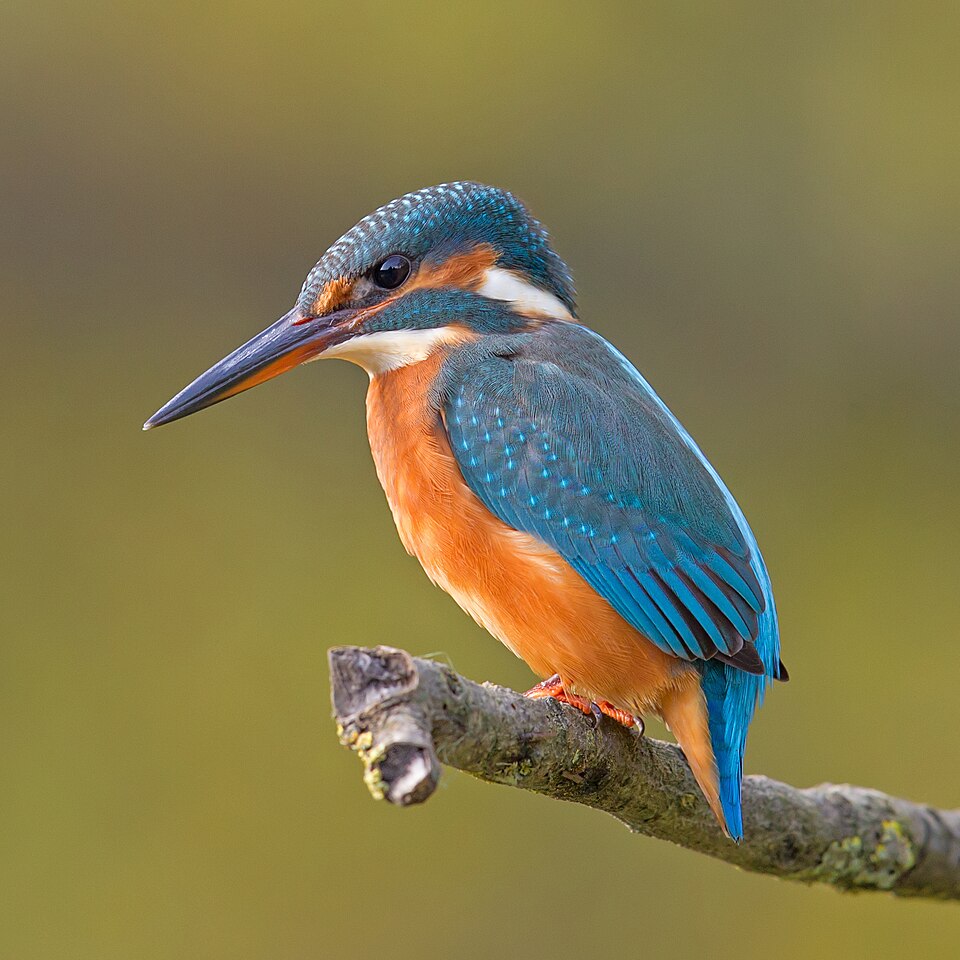
The Eurasian Kingfisher (Alcedo atthis) is a small fish-eating bird recognizable by its bright turquoise and orange plumage. It frequents rivers, ponds, and wetlands where it catches small fish by diving from a perch. Present in Tunisia, it inhabits the country's wadis, reservoirs, and wetland areas, particularly during migration and wintering periods. Discreet yet colorful, it is often spotted by its sharp, piercing call rather than by direct observation. The species is sensitive to pollution and degradation of aquatic habitats. It is protected in several countries, including Tunisia.
The Eurasian Kingfisher is recognized by its striking blue-green plumage on the back and orange on the belly. Its body is stocky, tail short, and bill long, strong, and pointed—well adapted for capturing fish. It measures around fifteen centimeters and weighs only a few tens of grams. Its direct and rapid flight, often skimming the water surface, is characteristic.
Characteristics
Indicative values: they vary by subspecies, sex and region.
Habitat and distribution
The kingfisher frequents the banks of rivers, streams, lakes and ponds with clear, fish-rich waters. It needs loose banks to dig its nesting burrow and perches overhanging the water for hunting. In Tunisia, it is found around wadis, dams and coastal wetlands.
CURRENT RANGE
The species is widely distributed across Europe, North Africa and much of Asia. In North Africa, it is present in Tunisia, Algeria and Morocco, mainly along waterways and wetlands. Some populations are migratory, moving to warmer regions in winter.
Behaviour
The Eurasian Kingfisher is a solitary and territorial bird, vigorously defending its fishing territory along waterways. It remains motionless on a branch or observation post overlooking the water, watching for prey before diving abruptly. Its flight is rapid and straight, often accompanied by a sharp, piercing call. Outside the breeding season, both sexes live separately on their own territories.
Reproduction
The female typically lays six to seven white eggs in a burrow dug into a sandy or clay bank. Both parents share incubation duties, which last around three weeks, and feed the young. A pair may raise several broods in a year if conditions are favorable.
Peculiarities
The kingfisher digs a burrow in a loose bank for egg-laying, an uncommon trait among brightly colored birds. Its ability to locate fish underwater despite light refraction is remarkable and has been the subject of scientific study. The brilliance of its plumage comes not from pigments but from the structure of its feathers, which diffract light.
Threats and conservation
Water pollution, degradation of natural banks and wetland drying threaten the species locally. Severe winters can cause high mortality by restricting access to prey. Destruction of nesting sites through river engineering is an additional threat.
Numbers and trends vary across sources and regions. See the IUCN assessment for the latest reference data.
Gallery
1 documented photographs.
References
Profile updated 06 September 2026 · Reviewed by the TunisieVet editorial team.
Comments (0)
No comments yet.
CONSERVATION STATUS
Least concern (LC)
IUCN source, latest published assessment.
Species health
Documented diseases for this species.
Find a veterinarianThis information is provided for educational purposes only and is not a substitute for a veterinary consultation. If you have any concerns about your animal's health, consult a veterinarian.
To discover around: Common Kingfisher
Videos, facts, stories and records linked to this species.
Similar animals
Other species documented in Animalpedia.

TunisieVet in your pocket 📱🐾 Access your veterinary services wherever you are. [ Download the app ]
Learn more