
Presentation
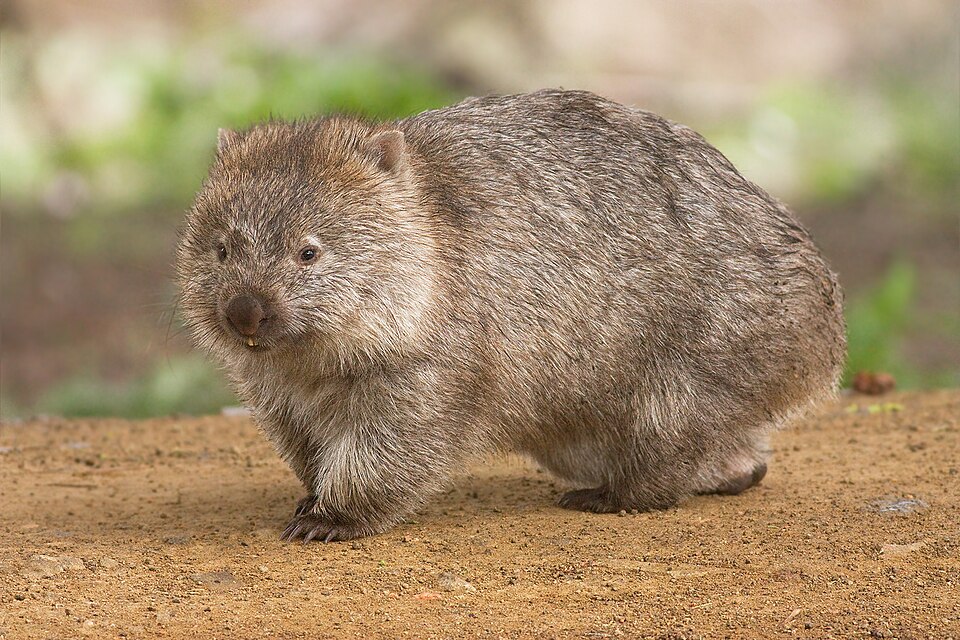
The Common wombat is a stocky and robust marsupial, native to Australia, recognizable by its massive body, its short powerful legs and its almost total absence of a tail. Its dense, brown to gray fur and hairless nose distinguish it from other wombat species. A burrowing animal par excellence, it digs vast burrows using robust claws and musculature adapted to working the soil. Solitary and mainly active at night, it spends most of the day sheltered underground. Its slow metabolism and very efficient digestion allow it to survive in environments where vegetation is poor. It is also known for the particularity of its cubic droppings, used to mark its territory.
The Common wombat has a compact, cylindrical body, a large, flat head, and short limbs with powerful claws suitable for digging. Its very thick skin on its hindquarters serves as protection against predators when it takes refuge in its burrow. Its teeth, continuously growing like those of rodents, adapt to a fibrous and abrasive diet.
Characteristics
Indicative values: they vary by subspecies, sex and region.
Habitat and distribution
Common wombat occurs in sclerophyll forests, coastal grasslands and mountainous areas of southeastern Australia and Tasmania. It favors soils that are sufficiently loose to allow the digging of deep burrows. It is found both in the plains and at altitude, even in cool and humid areas.
CURRENT RANGE
The species is endemic to eastern and southeastern Australia, including Tasmania and some nearby islands such as Flinders Island. It is absent from the arid center of the continent, preferring more temperate and forested regions.
Behaviour
An essentially nocturnal and solitary animal, the Common wombat defends a territory which it marks with its cubic-shaped excrement deposited on high points. It digs complex networks of burrows that can extend over several tens of meters, which it rarely shares with other individuals. Although clumsy in appearance, it can reach surprising speeds over short distances to escape danger. If there is a threat to its burrow, it uses its armored hindquarters to block the entrance and protect itself.
Reproduction
The female gives birth to a single young after a short gestation, which completes its development in a marsupial pouch facing backwards. The young remain in the pouch for several months before beginning to explore outside the burrow. Complete weaning generally occurs around one year of age, and sexual maturity is reached after two to three years.
Peculiarities
The Common wombat is one of the only animals known to produce cubic-shaped excrement, a particularity which would limit their rolling once deposited high up for territorial marking. Its thick, cartilaginous skin on the back and hindquarters constitutes a natural defense against predator bites.
Threats and conservation
Major threats include road collisions, competition with livestock for food resources, and a parasitic skin disease, sarcoptic mange, which can decimate local populations. Large-scale wildfires, such as those seen in Australia, also pose a risk to the species and its habitat.
Numbers and trends vary across sources and regions. See the IUCN assessment for the latest reference data.
Gallery
1 documented photographs.
References
Profile updated 18 August 2026 · Reviewed by the TunisieVet editorial team.
Comments (0)
No comments yet.
CONSERVATION STATUS
Least concern (LC)
IUCN source, latest published assessment.
Species health
Documented diseases for this species.
See the 8 diseases of this species Find a veterinarianThis information is provided for educational purposes only and is not a substitute for a veterinary consultation. If you have any concerns about your animal's health, consult a veterinarian.
Related species
To discover around: Common wombat
Videos, facts, stories and records linked to this species.
RECORD
Flat-faced droppings
Cubic droppings
Unique form in the animal kingdom, resulting from an intestine with variable elasticity, o...
Similar animals
Other species documented in Animalpedia.

TunisieVet in your pocket 📱🐾 Access your veterinary services wherever you are. [ Download the app ]
Learn more