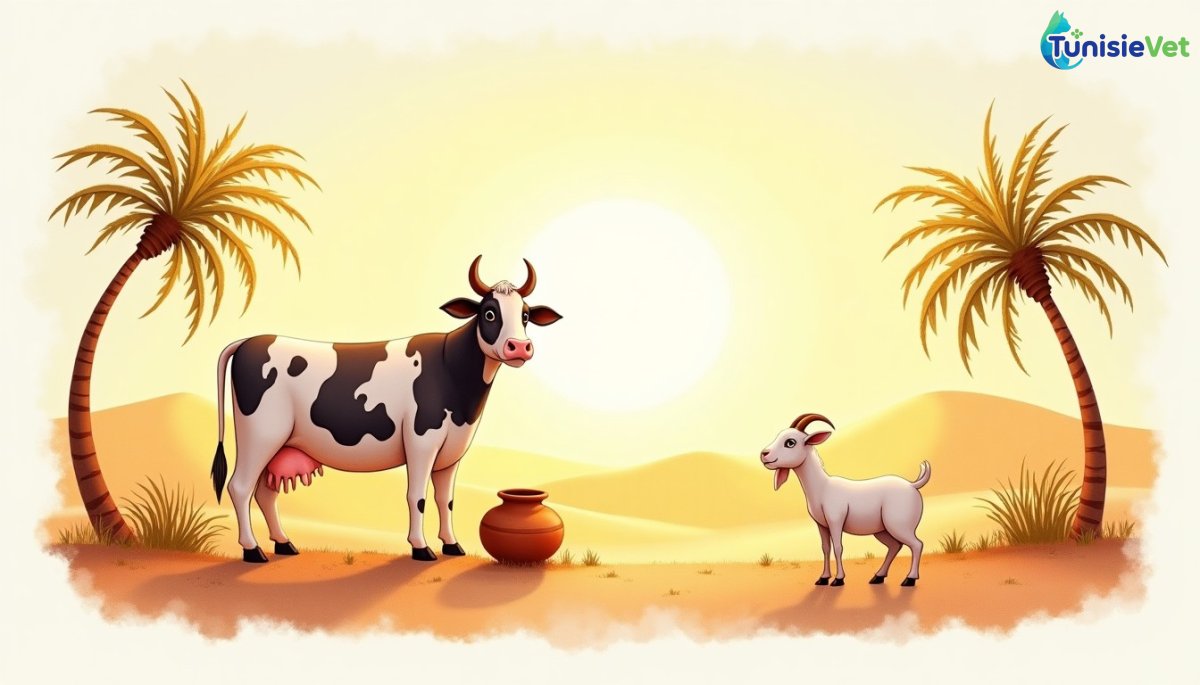
Within the livestock that people raise lies a sign for those who reflect: between dung and blood, Allah brings forth pure milk, sweet to drink. The Qur'an presents this as proof of His wisdom.
3 min read · Published 19 hours ago · 0 views
Among the blessings that the Qur'an invites believers to contemplate is one so familiar that its wonder is often forgotten: the milk of livestock. Every day, millions of people drink this white and nourishing liquid without considering the miracle that produces it. The Qur'an, however, draws attention to this phenomenon as a genuine sign (ayah) of divine power.
A Sign in Surah An-Nahl
It is in Surah An-Nahl ("The Bees"), which already mentions honey produced by bees, that Allah also speaks of the milk of livestock as proof of His wisdom. The verse describes how this milk is formed: it emerges from the residue of digestion and blood, appearing pure and pleasant to drink.
"There is indeed a lesson for you in livestock: We give you drink from what is in their bellies, between the residue of food and blood, pure milk, pleasant to drink for those who drink it."
(Surah An-Nahl, verse 66)
This verse invites reflection: how can the same belly, containing both digested food and circulating blood, produce milk of perfect purity and whiteness? For Qur'anic scholars, this contrast between apparent impurity and the purity that results illustrates the delicacy of creation, entrusted to the will of the Creator.
Milk: Nourishment and Symbol
Milk holds a special place in Islamic tradition, beyond its mention in the Qur'an alone. It is reported that the Prophet ﷺ valued milk and considered it a complete and blessed drink. In a hadith recorded in Sahih al-Bukhari, concerning an episode of the night journey, milk is presented as a symbol of pure nature (fitra), when the Prophet ﷺ chose to drink milk rather than wine that was also offered to him.
This image of milk as a drink of purity is also found in descriptions of Paradise, where rivers of milk of unchanging taste are mentioned in the Qur'an, notably in Surah Muhammad. Thus, earthly milk, the fruit of the patient labor of livestock, also becomes an image of the felicity promised to believers.
A Lesson for Those Who Observe Animals
Beyond its nutritional aspect, this verse invites believers to look carefully at the animals around them. The cow, goat, sheep, or camel are not merely resources to be exploited: they are, according to the Qur'an, the means through which Allah brings a daily blessing to human beings. To recognize this is also to acknowledge the dignity of these creatures who, through their very bodies, participate in maintaining human life.
From this verse comes a simple yet profound invitation: to care for the animals one raises, to ensure they have healthy food, sufficient space, and treatment marked by gentleness. For it is in respecting these creatures, upon whom so many blessings depend, that a person truly honors the meaning of creation as the Qur'an presents it for contemplation.