
Presentation
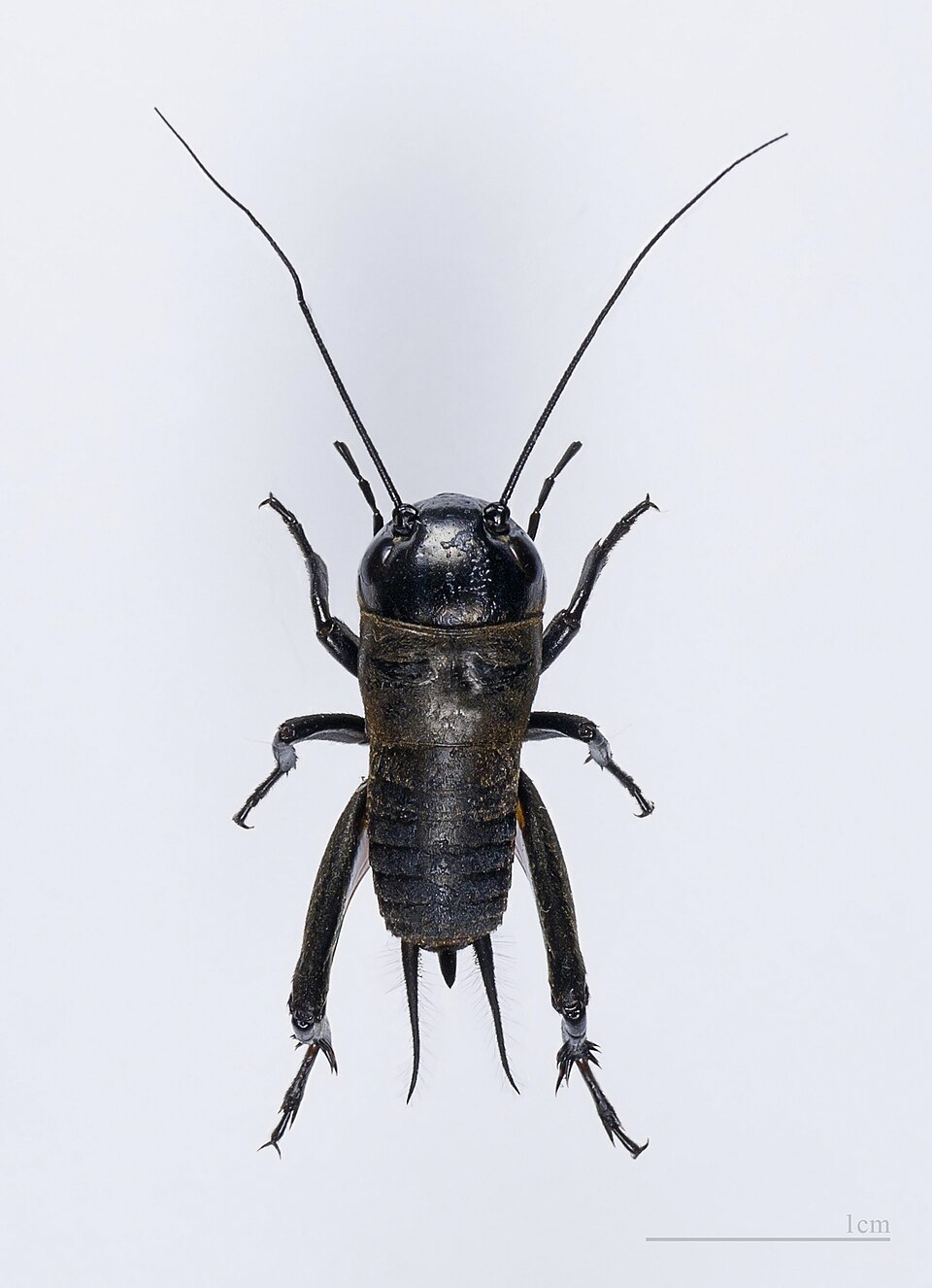
The cricket is a jumping insect belonging to the order Orthoptera, known for the song produced by males. It has a robust body, long slender antennae, and hind legs adapted for jumping. Crickets are found in meadows, fields, gardens and sometimes in homes. The house cricket and the field cricket are the most well-known species in North Africa. They play an important ecological role as decomposers and prey for many predators.
The cricket's body is dorsoventrally flattened, ranging in color from brown to black depending on the species. Males possess modified wing covers that they rub together to produce a characteristic song called stridulation. The hind legs are long and muscular, enabling powerful jumps to escape from predators.
Characteristics
Indicative values: they vary by subspecies, sex and region.
Habitat and distribution
Crickets inhabit meadows, cultivated fields, gardens, and sometimes urban areas where they shelter in cracks and damp crevices. Some species also adapt to semi-arid and steppe environments in North Africa.
CURRENT RANGE
Crickets are found on almost every continent except polar regions. They occur in Europe, Africa, Asia, and the Americas, in varied habitats ranging from temperate zones to semi-arid regions.
Behaviour
The cricket is primarily nocturnal and solitary, except during the breeding season. Males sing to attract females and defend their territory against rivals. They sometimes dig shallow burrows to protect themselves from heat and predators.
Reproduction
The female lays her eggs in the soil using a long organ called an ovipositor. The eggs hatch after several weeks, producing larvae that resemble miniature wingless adults. Complete development to the adult stage involves several successive molts.
Peculiarities
Cricket song, produced only by males, varies with ambient temperature: the warmer it is, the faster the stridulation. This feature has even led to the development of empirical methods for estimating temperature based on the frequency of the song.
Threats and conservation
Crickets are not threatened globally and their populations are generally stable. They may, however, be affected locally by the use of agricultural pesticides and the destruction of their natural habitat.
Numbers and trends vary across sources and regions. See the IUCN assessment for the latest reference data.
Gallery
1 documented photographs.
References
Profile updated 24 August 2026 · Reviewed by the TunisieVet editorial team.
Comments (0)
No comments yet.
CONSERVATION STATUS
Least concern (LC)
IUCN source, latest published assessment.
Species health
Documented diseases for this species.
Find a veterinarianThis information is provided for educational purposes only and is not a substitute for a veterinary consultation. If you have any concerns about your animal's health, consult a veterinarian.
To discover around: Cricket
Videos, facts, stories and records linked to this species.
Similar animals
Other species documented in Animalpedia.
