
Presentation
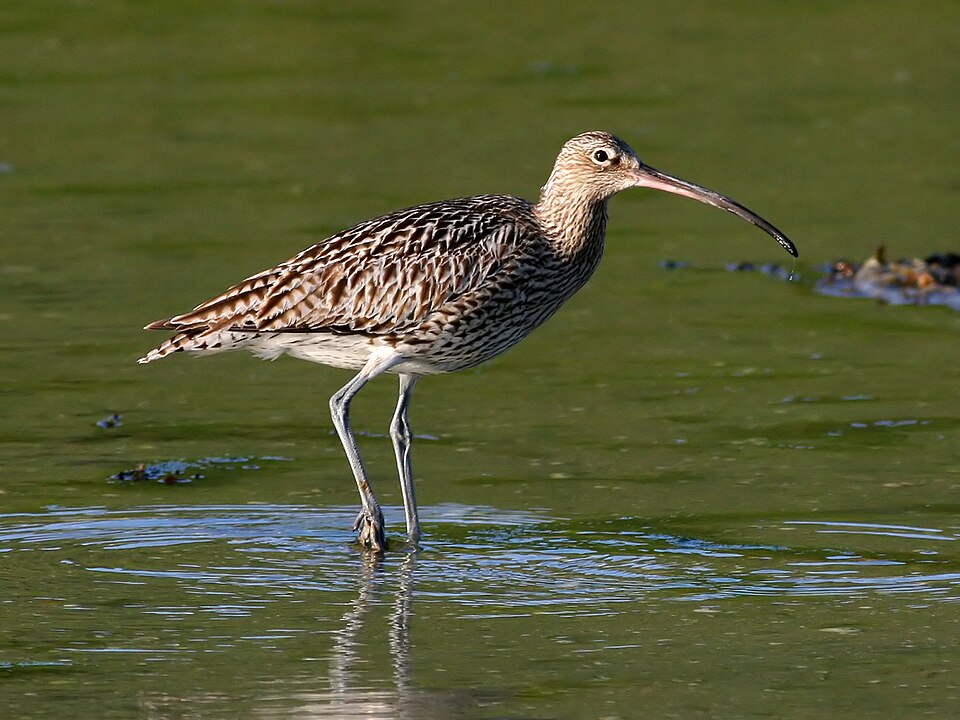
The curlew is a large wading bird recognizable by its long, downward-curved bill, which it uses to probe mud and sand in search of prey. Its brown-beige plumage, finely streaked, provides effective camouflage in wetlands and mudflats. It produces a distinctive, piping and melancholic cry, often heard before the bird itself becomes visible. Found on the coasts and wetlands of Europe, Asia, and North Africa, it frequents both coastal areas in winter and wet moorlands and grasslands during breeding season. In Tunisia, it is observed mainly during migration and wintering on coastal lagoons. It is a species sensitive to degradation of its natural habitats.
The curlew is distinguished by its long, slender bill curved downward, more pronounced in females than males. Its body is stocky, with long grayish legs and streaked plumage in brown and beige that provides excellent camouflage. In flight, a distinctive white triangular patch on the rump is visible.
Characteristics
Indicative values: they vary by subspecies, sex and region.
Habitat and distribution
The curlew nests in heathlands, wet meadows, peatlands and grassy steppes of temperate regions. Outside the breeding season, it frequents coastal mudflats, estuaries, lagoons and coastal wetlands where it finds abundant food. These varied habitats reflect its seasonal lifecycle between inland breeding sites and coastal wintering grounds.
CURRENT RANGE
The species breeds in temperate Europe and Asia, then migrates to North Africa, the Middle East and Western Europe to winter. Tunisia hosts wintering and migratory populations, notably in coastal wetlands such as Lake Tunis and the lagoons of the southeastern region. Its global numbers are declining in several parts of Europe.
Behaviour
Outside breeding season, it is a gregarious bird, often forming groups on mudflats and estuaries. It is rather shy and inconspicuous, taking flight quickly at any disturbance while uttering its characteristic call. Migration typically occurs in flocks, sometimes over long distances between breeding sites and wintering grounds.
Reproduction
The female typically lays four eggs in a rudimentary nest on the ground, often in a depression lined with grasses. Incubation, carried out by both parents, lasts approximately one month. The chicks are precocial and leave the nest shortly after hatching, following their parents to feed.
Peculiarities
The curlew's bill, which is particularly long and downcurved, is a remarkable adaptation for feeding in muddy habitats. Its clear, far-carrying call is often used to identify the species from a distance, even at night during migration passages.
Threats and conservation
Degradation and drainage of wetlands, both on breeding and wintering sites, pose a serious threat to curlew populations. Hunting, human disturbance and agricultural intensification of breeding meadows also contribute to its decline. The species is now classified as near threatened globally.
Numbers and trends vary across sources and regions. See the IUCN assessment for the latest reference data.
Gallery
1 documented photographs.
References
Profile updated 08 September 2026 · Reviewed by the TunisieVet editorial team.
Comments (0)
No comments yet.
CONSERVATION STATUS
Near threatened (NT)
IUCN source, latest published assessment.
Species health
Documented diseases for this species.
Find a veterinarianThis information is provided for educational purposes only and is not a substitute for a veterinary consultation. If you have any concerns about your animal's health, consult a veterinarian.
Similar animals
Other species documented in Animalpedia.

TunisieVet in your pocket 📱🐾 Access your veterinary services wherever you are. [ Download the app ]
Learn more