
Presentation
The silk moth is a butterfly of the Bombycidae family, fully domesticated for several millennia in China and unable to survive in the wild. The caterpillar of this butterfly, called the silkworm, produces silk thread by weaving a protective cocoon before its metamorphosis. The species has been selectively bred for centuries for the quality and quantity of silk produced, to the point of losing the ability to fly in adulthood. It forms the historical foundation of sericulture, a craft and industrial activity practiced in many regions of the world. The adult butterfly, whitish and stocky, does not feed and lives only a few days, just long enough to reproduce. The silk moth is nowadays also studied as a model organism in genetics and developmental biology.
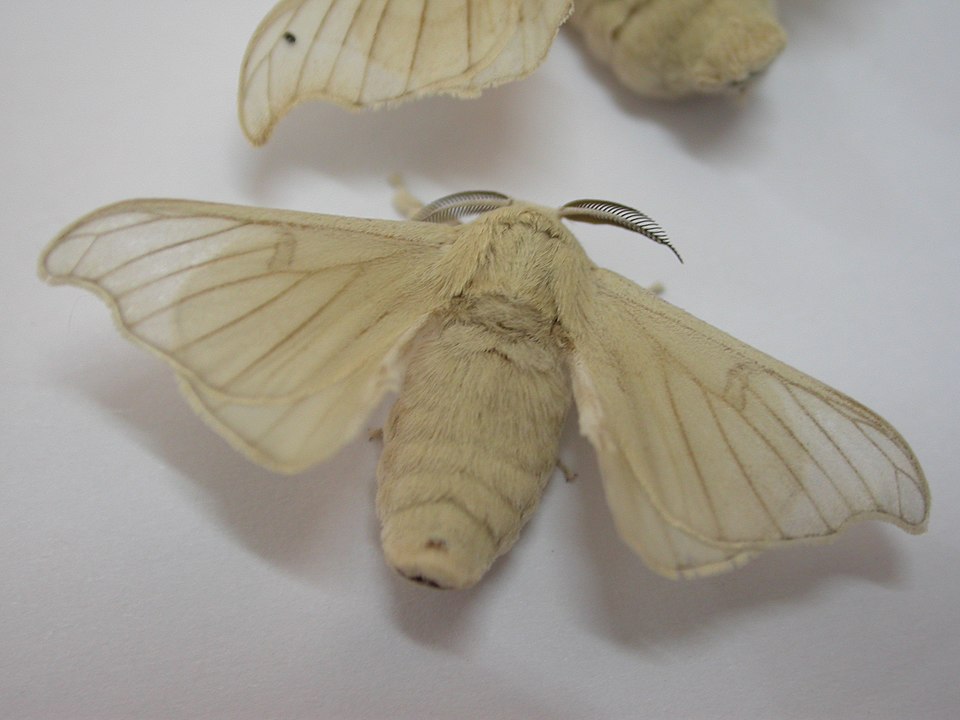
The adult butterfly is cream-white in color, with a stocky body covered in fine scales and reduced wings that no longer allow for flight. The caterpillar, or silkworm, is cylindrical and whitish, with a small dorsal horn at the rear of its body. It grows rapidly through several molts before spinning its silk cocoon.
Characteristics
Indicative values: they vary by subspecies, sex and region.
Habitat and distribution
The silkworm no longer exists in the wild and lives solely in captivity, in silkworm farms or facilities dedicated to sericulture. Its habitat is therefore entirely artificial, dependent on the presence of mulberry trees to feed the caterpillars.
CURRENT RANGE
Originally from China, where it was domesticated thousands of years ago, the silkworm subsequently spread with sericulture to Asia, the Mediterranean region of Europe, and then to other parts of the world. It is today raised in many silk-producing countries, particularly in East and South Asia.
Behaviour
The silk moth is a completely domesticated insect, dependent on human intervention for its rearing and reproduction. The caterpillar spends most of its time eating and spinning silk before transforming into a chrysalis. The adult, incapable of flight, moves little and devotes itself solely to mating and egg-laying.
Reproduction
The female lays several hundred eggs shortly after mating, then dies quickly. The eggs hatch into caterpillars that pass through several larval stages before spinning a silk cocoon where metamorphosis into a chrysalis occurs. The adult emerges from the cocoon after about ten days, with a lifespan limited to just a few days.
Peculiarities
The silkworm is one of the few insects that is fully domesticated, much like the honeybee. It has lost the ability to fly and survive without human help. Its genome has been completely sequenced and it serves as a scientific model for studying insect metamorphosis.
Threats and conservation
The domestic species is not threatened as such since it depends entirely on human rearing. Traditional sericulture is however declining in some regions due to competition from synthetic fibres and diminishing demand for handcrafted natural silk.
Numbers and trends vary across sources and regions. See the IUCN assessment for the latest reference data.
Gallery
1 documented photographs.
References
Profile updated 09 September 2026 · Reviewed by the TunisieVet editorial team.
Comments (0)
No comments yet.
CONSERVATION STATUS
Least concern (LC)
IUCN source, latest published assessment.
Species health
Documented diseases for this species.
Find a veterinarianThis information is provided for educational purposes only and is not a substitute for a veterinary consultation. If you have any concerns about your animal's health, consult a veterinarian.
Similar animals
Other species documented in Animalpedia.

TunisieVet in your pocket 📱🐾 Access your veterinary services wherever you are. [ Download the app ]
Learn more