
Presentation
The fruit fly, often called the vinegar fly, is a small dipteran insect measuring just a few millimeters long. It is known worldwide as a model organism in genetics and developmental biology, particularly under the scientific name Drosophila melanogaster. This fly is commonly found around ripe or decomposing fruit, in kitchens and orchards. Though small, it has played a major role in scientific research for over a century. It is not considered a serious pest but may be perceived as an invasive household insect.
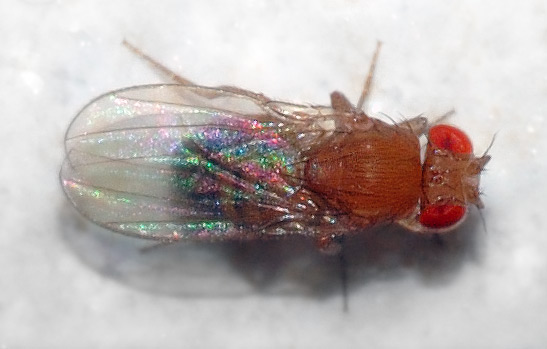
The fruit fly has a brown-yellowish body measuring between 2 and 4 mm, with characteristic red eyes in the wild form. Its transparent wings allow for rapid and erratic flight. Its short life cycle and well-mapped genome make it a preferred model for studying inheritance.
Characteristics
Indicative values: they vary by subspecies, sex and region.
Habitat and distribution
The fruit fly inhabits environments where decaying fruit is found, whether in orchards, markets, or human dwellings. It adapts easily to urban environments, particularly in kitchens and organic waste bins. It is found in both rural and urban areas, as long as fermentable substrates are available.
CURRENT RANGE
The fruit fly is present on all inhabited continents, thanks to its capacity for adaptation and its close association with human activities. It is particularly common in temperate and warm regions. Its ubiquity makes it a cosmopolitan species well known to scientists worldwide.
Behaviour
The fruit fly is a gregarious species, often seen in small groups around sources of sweet or fermented food. It is attracted to fermentation odors and can fly short distances to locate them. Its activity is mainly diurnal, and it displays rapid, opportunistic reproductive behavior.
Reproduction
A female lays several hundred eggs during her lifetime, usually deposited on decaying fruit. The complete development cycle from egg to adult takes only about ten days under favorable conditions. This rapid reproduction rate partly explains its intensive use in laboratory research.
Peculiarities
The fruit fly is one of the most studied organisms in genetics, having contributed to several major discoveries rewarded with Nobel Prizes. Its genome has been fully sequenced, facilitating numerous biomedical research projects. Despite its small size, it shares a notable proportion of genes with humans.
Threats and conservation
The fruit fly is not subject to particular threats as a species, its population being abundant and stable. It is sometimes controlled as a domestic pest using traps or repellent products. No conservation program concerns it, unlike other more fragile species.
Numbers and trends vary across sources and regions. See the IUCN assessment for the latest reference data.
Gallery
1 documented photographs.
References
Profile updated 26 August 2026 · Reviewed by the TunisieVet editorial team.
Comments (0)
No comments yet.
CONSERVATION STATUS
Least concern (LC)
IUCN source, latest published assessment.
Similar animals
Other species documented in Animalpedia.

🚀 SWConsulting — Turning Your Ideas into Digital Solutions Do you have an idea, a project, or a business process that needs to be digitalized? SWConsulting supports businesses from concept to deployment, delivering custom, reliable, and scalable digital solutions tailored to their real needs. 💻 Web & Mobile Development ⚙️ Business Applications & SaaS 🤖 Artificial Intelligence & Automation 📊 Custom CRM & Management Tools 🛒 E-commerce & Marketplaces 🔗 APIs & System Integrations Our goal is simple: turn your business needs into practical digital solutions that help you improve efficiency, automate processes, and grow your business. Have a project in mind? Let’s talk. 🚀 SWConsulting — Digital Solutions, Real Impact.
WhatsApp