
Presentation
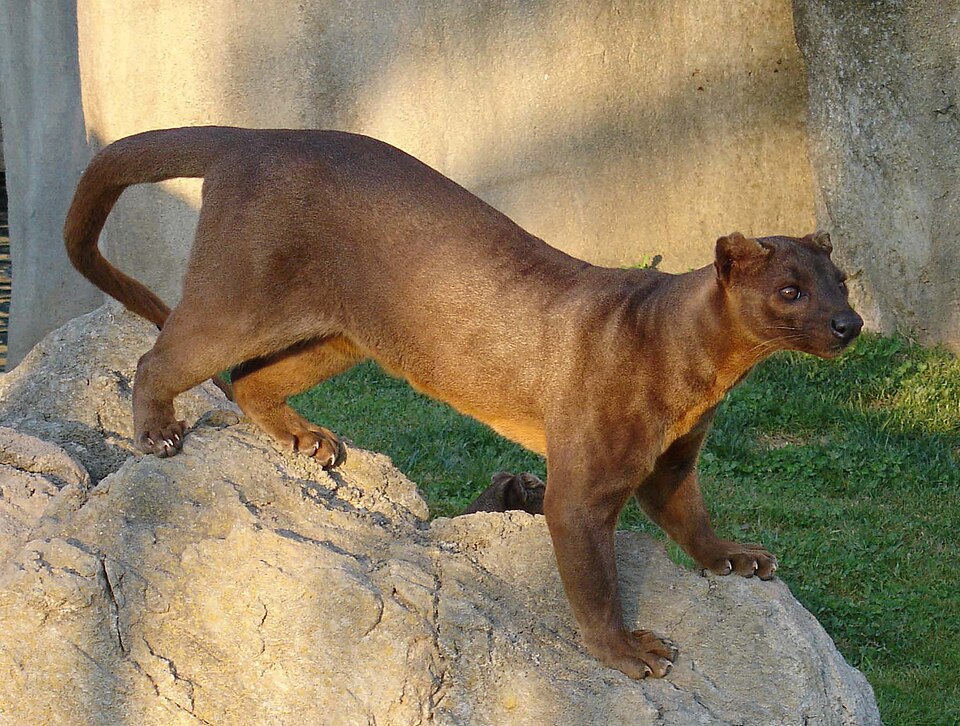
The Fossa (Cryptoprocta ferox) is a carnivorous mammal endemic to Madagascar, often presented as the largest terrestrial predator on the island. Its elongated silhouette, its long tail and its muscular limbs give it an intermediate appearance between the cat and the mongoose, although it belongs to the Eupleridae family. It mainly hunts lemurs, making it an essential regulator of Malagasy primate populations. An excellent climber, it moves with agility in the canopy thanks to semi-retractable claws and a very mobile ankle. Solitary and discreet, it is rarely observed despite its role as a local super-predator. Its survival is closely linked to that of Madagascar's primary forests, which are today highly threatened.
The Fossa has an elongated, muscular body, a relatively small head, and a tail almost as long as the body, useful for balance. Its short coat is uniform reddish-brown, without marked patterns. Its hind legs can swivel, allowing it to descend headfirst from trees like a feline.
Characteristics
Indicative values: they vary by subspecies, sex and region.
Habitat and distribution
The Fossa lives exclusively in the dense forests of Madagascar, whether tropical humid in the east or dry deciduous in the west. It requires continuous forest cover to hunt and move between trees. The fragmentation of these forests strongly limits its available territory.
CURRENT RANGE
The species is endemic to Madagascar and absent from any other natural territory. Its distribution follows the remaining forest areas of the island, today fragmented by deforestation. It is completely absent from continental Africa despite misleading similarities with certain African carnivores.
Behaviour
A solitary and territorial animal, the Fossa marks its territory using scent glands. It is active both day and night depending on the availability of prey and hunting pressure. Its breeding behavior is atypical, with temporary gatherings around the same tree during the mating season.
Reproduction
The female attracts several males to a fixed mating site for several days, a rare behavior among carnivores. Gestation lasts about three months and gives birth to two to four young, blind and dependent. The young stay with their mother for more than a year before gaining complete independence.
Peculiarities
Fossa is often referred to as the “missing link” between felines and mongooses due to its hybrid morphology. Its reproductive behavior, with several males taking turns near the same female, is unique among Malagasy carnivores. It constitutes an emblematic example of isolated island evolution.
Threats and conservation
Massive deforestation in Madagascar is continually reducing its natural habitat. It is also persecuted by local populations who consider it a threat to domestic poultry. Forest fragmentation isolates populations, increasing the risk of genetic depression.
Numbers and trends vary across sources and regions. See the IUCN assessment for the latest reference data.
Gallery
1 documented photographs.
References
Profile updated 25 August 2026 · Reviewed by the TunisieVet editorial team.
Comments (0)
No comments yet.
CONSERVATION STATUS
Vulnerable (VU)
IUCN source, latest published assessment.
Species health
Documented diseases for this species.
See the 8 diseases of this species Find a veterinarianThis information is provided for educational purposes only and is not a substitute for a veterinary consultation. If you have any concerns about your animal's health, consult a veterinarian.
Similar animals
Other species documented in Animalpedia.

TunisieVet in your pocket 📱🐾 Access your veterinary services wherever you are. [ Download the app ]
Learn more