
Presentation
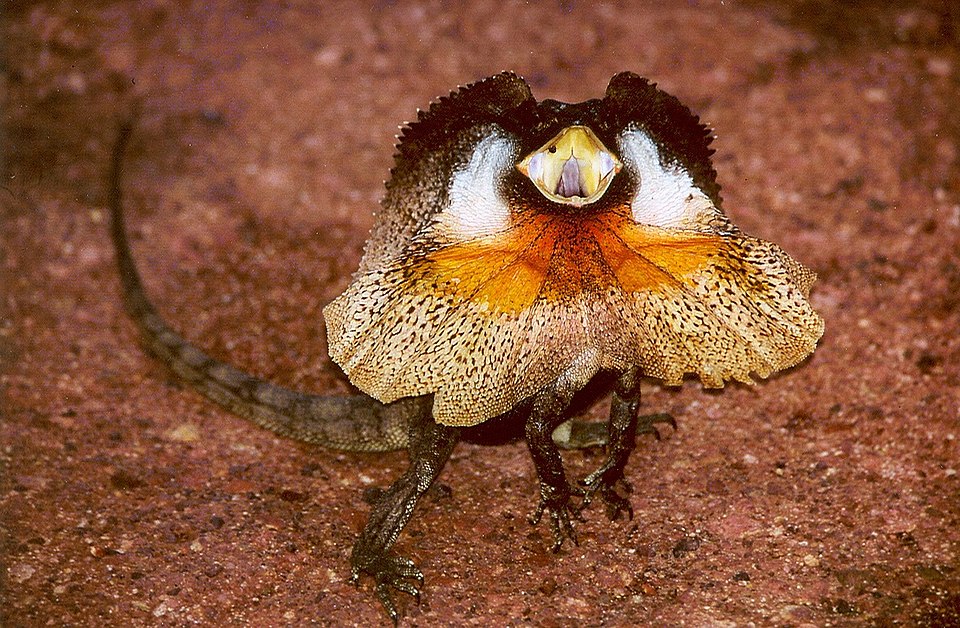
The Frilled Lizard (Chlamydosaurus kingii) is a large arboreal agama native to Australia and southern New Guinea. It is distinguished by a large membrane of skin folded around its neck, which it deploys in a fan during defensive or territorial displays. This collar, combined with a bipedal posture and a wide open mouth, gives the animal an impressive appearance intended to deter predators. Apart from these demonstrations, the lizard leads a discreet life, spending most of its time on tree trunks. It is also known for its ability to run on its hind legs alone when fleeing danger.
Elongated body covered with grayish to brownish scales, providing effective camouflage on the bark. The collar, supported by cartilages connected to the hyoid bone, can reach around thirty centimeters in diameter once deployed. The hind limbs are powerful and adapted for rapid bipedal running.
Characteristics
Indicative values: they vary by subspecies, sex and region.
Habitat and distribution
The Frilled Lizard frequents dry tropical forests, wooded savannahs and woodland areas with warm, seasonal climates. It favors trees offering good camouflage and quick access to the ground for hunting. Areas close to seasonal water points are often favored during the dry season.
CURRENT RANGE
The species is native to northern Australia and southern New Guinea. It occupies a tropical and subtropical geographical band characterized by a marked alternation of dry and wet seasons. It does not occur naturally elsewhere in the world.
Behaviour
An arboreal and diurnal species, it descends to the ground to hunt or move between trees. Faced with a threat, it deploys its collar, hisses and can charge before fleeing by running on its hind legs. Outside of the breeding season, individuals are rather solitary and territorial.
Reproduction
The breeding season generally occurs at the end of the rainy season. The female lays 8 to 23 eggs in a nest dug on the ground, in loose, moist substrate. Incubation lasts two to three months, without parental care after laying eggs.
Peculiarities
The retractable collar, unique among lizards in its size and use, constitutes the most striking characteristic of the species. Its ability to run in a bipedal position, with its forelimbs raised, is also remarkable. It has inspired various cultural representations, notably in heraldry and in popular Australian media.
Threats and conservation
The species is locally threatened by habitat loss linked to bushfires and land conversion. Predation by introduced species, such as cats and foxes, as well as the presence of toxic cane toads ingested by mistake, weigh on certain populations. The trade as exotic pets exists but remains regulated in its original area.
Numbers and trends vary across sources and regions. See the IUCN assessment for the latest reference data.
Gallery
1 documented photographs.
References
Profile updated 02 September 2026 · Reviewed by the TunisieVet editorial team.
Comments (0)
No comments yet.
CONSERVATION STATUS
Least concern (LC)
IUCN source, latest published assessment.
Species health
Documented diseases for this species.
This information is provided for educational purposes only and is not a substitute for a veterinary consultation. If you have any concerns about your animal's health, consult a veterinarian.
To discover around: Frilled Lizard
Videos, facts, stories and records linked to this species.
Similar animals
Other species documented in Animalpedia.

TunisieVet in your pocket 📱🐾 Access your veterinary services wherever you are. [ Download the app ]
Learn more