
Presentation
The Leopard gecko is a small nocturnal lizard recognizable by its pale yellow coat dotted with black or brown spots. Unlike most geckos, it has movable eyelids and ordinary claws, making it particularly adapted to life on land. It is one of the most popular gecko species in captivity due to its ease of keeping and docile temperament.
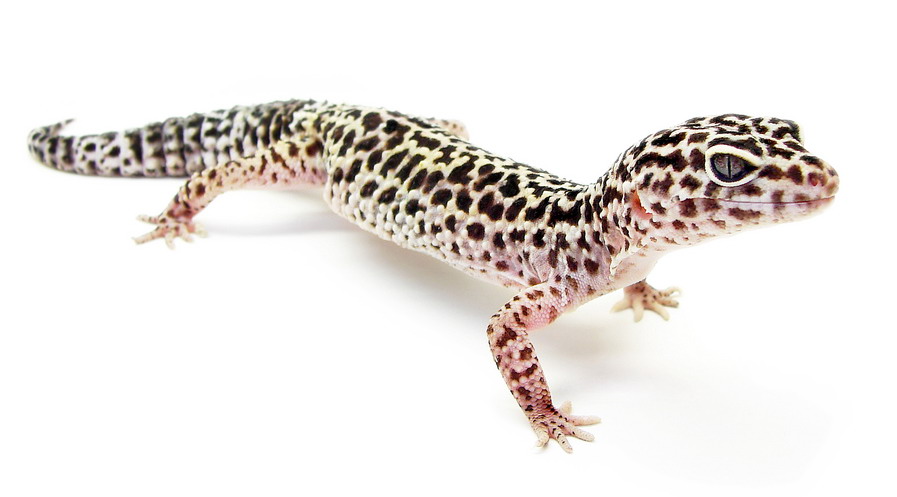
The Leopard gecko is a small, slender reptile with characteristic spots. Its smooth skin has black or brown markings which can vary from one individual to another. It has a thick, fleshy tail that serves to store energy reserves, and its large, expressive eyes are an adaptation to nocturnal life. Its compact body and short legs allow it to move agilely on the ground.
Did you know?
Why can lizards lose their tails?
Characteristics
Indicative values: they vary by subspecies, sex and region.
Habitat and distribution
The Leopard gecko inhabits the deserts and arid steppes of Southwest Asia, where it takes refuge under stones, bushes or in burrows abandoned during the day. It prefers rocky areas with sparse vegetation, where temperatures vary greatly between day and night. This desert habitat offers little open water, but the gecko has adapted admirably.
CURRENT RANGE
Leopard gecko is native to the Indian subcontinent and southwest Asia, including Pakistan, Afghanistan, Iran, and northwest India. Its natural range extends mainly into semi-arid and desert regions. Although absent in the wild in North Africa, the species is widely distributed worldwide in captivity for zoological collections and amateur breeding.
Behaviour
It is a nocturnal and solitary animal, active mainly at sunset and sunrise. The Leopard gecko is generally calm and not very aggressive, but it may bite or leave its tail if it is grabbed — a process called autotomy that allows it to escape from predators. In captivity, it quickly develops a relationship of trust with its caregiver and tolerates handling well.
Reproduction
The Leopard gecko is oviparous and typically lays two to four eggs during the breeding season. The eggs are laid in a moist, hidden place, and incubation lasts about six to eight weeks depending on temperature. Juveniles emerge with the same characteristic patterns as adults, but with duller colors. Sexual maturity is generally reached around 18 to 24 months of age.
Peculiarities
A notable characteristic of the Leopard gecko is its ability to voluntarily detach its tail (autotomy) when grabbed, which confuses the predator and allows it to escape. The detached tail continues to move, further distracting the enemy. Another fascinating feature: unlike most geckos, it hunts primarily by sight rather than by detecting vibrations. Its mobile eyelids and lack of adhesive strips under its legs distinguish it from other geckos.
Threats and conservation
The Leopard gecko does not face any major threats in the wild. Although its population is stable and its conservation status is Least Concern, the pet trade has reduced local populations in some areas. Habitat destruction and climate change may marginally affect the desert areas it inhabits, but the species remains not very vulnerable overall.
Numbers and trends vary across sources and regions. See the IUCN assessment for the latest reference data.
Gallery
1 documented photographs.
References
UICN — Liste rouge des espèces menacées
Profile updated 17 August 2026 · Reviewed by the TunisieVet editorial team.
Comments (0)
No comments yet.
CONSERVATION STATUS
Least concern (LC)
IUCN source, latest published assessment.
Species health
Documented diseases for this species.
This information is provided for educational purposes only and is not a substitute for a veterinary consultation. If you have any concerns about your animal's health, consult a veterinarian.
To discover around: Leopard gecko
Videos, facts, stories and records linked to this species.
Similar animals
Other species documented in Animalpedia.

TunisieVet in your pocket 📱🐾 Access your veterinary services wherever you are. [ Download the app ]
Learn more