
Presentation
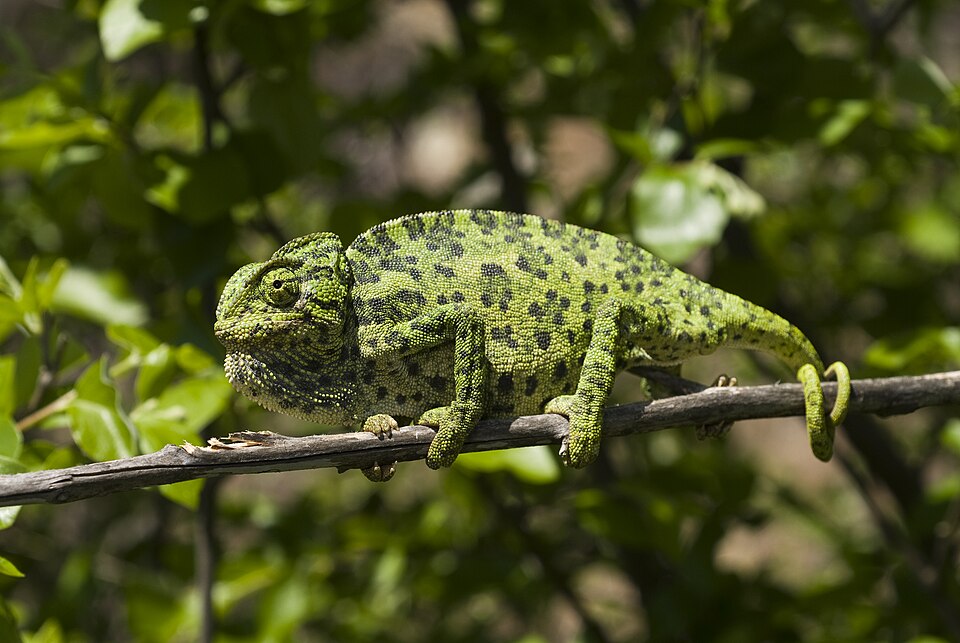
The Mediterranean chameleon is a remarkable small reptile characterized by its ability to change color depending on its environment and emotional state. This unique lizard has independent eyes, a prehensile tail and an extremely long tongue allowing it to capture prey with precision.
The Mediterranean chameleon sports scaly skin capable of green, brown, yellow, or gray hues depending on conditions. Its head is compressed laterally with a dorsal helmet, and its body is slightly compressed laterally. The independent moving eyes and the curled tail constitute its major distinctive features.
Did you know?
How does the chameleon protect itself from its predators?
Characteristics
Indicative values: they vary by subspecies, sex and region.
Habitat and distribution
The Mediterranean chameleon frequents open forests, bushy coastal areas and semi-open habitats where there is sufficient vegetation. It particularly likes Mediterranean regions with marked dry periods, avoiding environments that are too dense or too desert.
CURRENT RANGE
Mediterranean chameleon is present in North Africa and the Western Mediterranean, notably in Tunisia, Algeria, Morocco and Libya. It is also reported in peninsular Iberia and in the south of the Italian Peninsula, testifying to its adaptation to Mediterranean regions.
Behaviour
The Mediterranean chameleon is a solitary and territorial animal, mainly diurnal. It spends the majority of its time motionless on branches, patiently waiting for its prey. When it feels threatened, it can inflate its body and change color quickly to intimidate predators.
Reproduction
Mediterranean chameleon is oviparous and exhibits marked sexual dimorphism, with males generally being more colorful and aggressive than females. Reproduction takes place in spring, and the female lays between 10 and 40 eggs in the ground or in cavities, which hatch after 6 to 10 months.
Peculiarities
Mediterranean chameleon's color-changing ability is controlled by chromatophores under the skin, allowing rapid adaptation to environment and emotions. Its eyes can move independently, providing an exceptional visual field, while its prehensile tail acts as a fifth limb to maintain balance.
Threats and conservation
The Mediterranean chameleon does not currently face any major threats. Its stable conservation status and its adaptive capacity in various Mediterranean environments allow it to maintain its populations.
Numbers and trends vary across sources and regions. See the IUCN assessment for the latest reference data.
Gallery
1 documented photographs.
References
UICN — Liste rouge des espèces menacées
Profile updated 01 September 2026 · Reviewed by the TunisieVet editorial team.
Comments (0)
No comments yet.
CONSERVATION STATUS
Least concern (LC)
IUCN source, latest published assessment.
Species health
Documented diseases for this species.
This information is provided for educational purposes only and is not a substitute for a veterinary consultation. If you have any concerns about your animal's health, consult a veterinarian.
To discover around: Mediterranean chameleon
Videos, facts, stories and records linked to this species.
Similar animals
Other species documented in Animalpedia.

TunisieVet in your pocket 📱🐾 Access your veterinary services wherever you are. [ Download the app ]
Learn more