
Presentation
The King cobra is the longest venomous snake in the world. It is an impressive and feared reptile, characterized by its ability to raise its body and deploy its famous hood when it feels threatened. Despite its dangerous reputation, it is rather discreet and generally avoids humans. Its scientific name Ophiophagus literally means "snake eater", which reflects its unique diet.
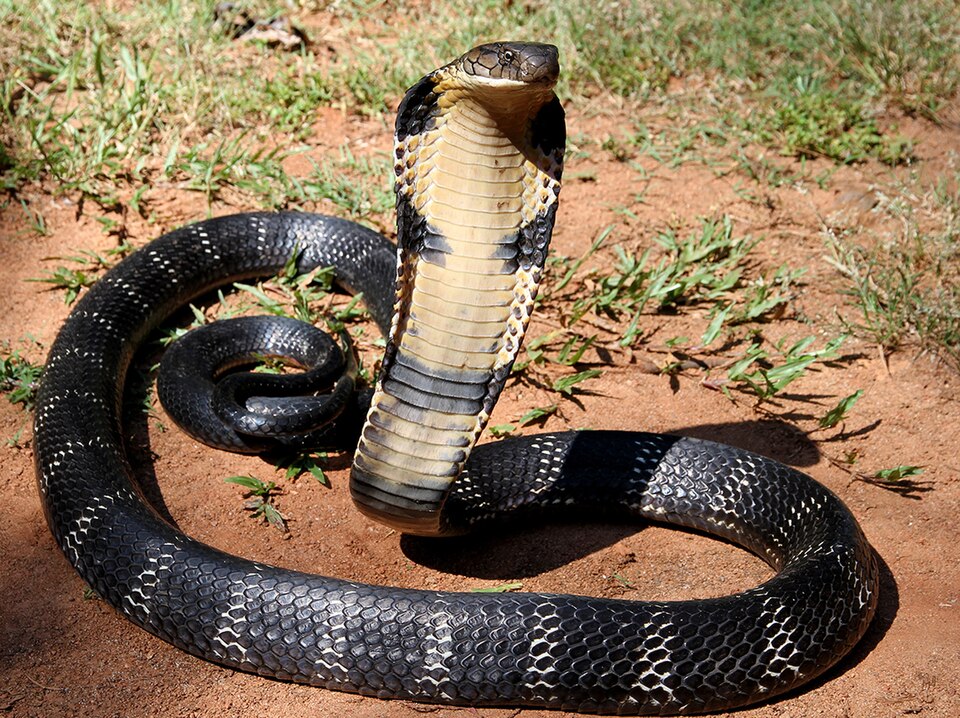
The King cobra has an elongated, muscular body covered in smooth, dark brown to black scales, often with yellow or white markings. Its head is relatively small compared to its massive body. Its eyes are medium sized with a round pupil. When it defends itself, it raises the front of its body and expands its characteristic heart-shaped hood, making its body bulkier to intimidate predators.
Characteristics
Indicative values: they vary by subspecies, sex and region.
Habitat and distribution
The King cobra inhabits the dense tropical forests of South and Southeast Asia, where it finds refuge in woodlands and lowland forests. It is often found near streams and wetlands, as these environments provide an abundance of prey (other snakes) and necessary humidity. It can also colonize agricultural plantations and areas at the edge of forests. Unlike many snakes, it can adapt to relatively high altitudes.
CURRENT RANGE
King cobra is found exclusively in South and Southeast Asia. Its range extends from India and Bangladesh, where it is most common, through the countries of Southeast Asia: Burma, Thailand, Cambodia, Laos, Malaysia and Indonesia (up to the Philippines). The largest populations are found in India, particularly in the coastal regions of Kerala and in the forest areas of the northeast. It is absent from Tunisia and the rest of North Africa.
Behaviour
The King cobra is generally solitary and territorial. Although it is venomous and potentially dangerous, it is rather shy and prefers to flee when it encounters humans. It is active mainly during the day (diurnal), although it may be active at other times depending on conditions. During breeding periods, males become more aggressive and fight among themselves for access to females. Despite its imposing size, it can move with agility in trees and on the ground.
Reproduction
The King cobra is oviparous and breeding usually takes place during the rainy season. The female lays between 12 and 60 eggs, which she actively protects in burrows or under debris. Remarkably among snakes, king cobras demonstrate parental care: the female guards the nest and may attack any intruder who approaches it. The eggs hatch after about 60 to 80 days, and the young snakes are immediately independent.
Peculiarities
The King cobra has several notable features. It is the longest venomous snake in the world, surpassing even anacondas and pythons. Its scientific name Ophiophagus hannah means "snake eater", reflecting its unique diet. Unlike most snakes, it builds a nest for its eggs and actively guards them. It can also emit impressive hissing sounds and expand its hood to 30 cm wide to intimidate its attackers. Its venom is neurotoxic and extremely powerful.
Threats and conservation
The King cobra faces moderate but increasing threats. The loss and degradation of its forest habitat, due to deforestation, land conversion and agricultural expansion, constitute the main threat. Trafficking of wild animals for the pet and skin trade also represents significant pressure. Human persecution, motivated by fear and conflicts linked to life in urban or agricultural areas, threatens populations locally. Despite these threats, the species remains relatively stable in certain protected areas.
Numbers and trends vary across sources and regions. See the IUCN assessment for the latest reference data.
Gallery
1 documented photographs.
References
UICN — Liste rouge des espèces menacées
Profile updated 28 August 2026 · Reviewed by the TunisieVet editorial team.
Comments (0)
No comments yet.
CONSERVATION STATUS
Vulnerable (VU)
IUCN source, latest published assessment.
Species health
Documented diseases for this species.
This information is provided for educational purposes only and is not a substitute for a veterinary consultation. If you have any concerns about your animal's health, consult a veterinarian.
To discover around: King cobra
Videos, facts, stories and records linked to this species.
Similar animals
Other species documented in Animalpedia.

TunisieVet in your pocket 📱🐾 Access your veterinary services wherever you are. [ Download the app ]
Learn more