
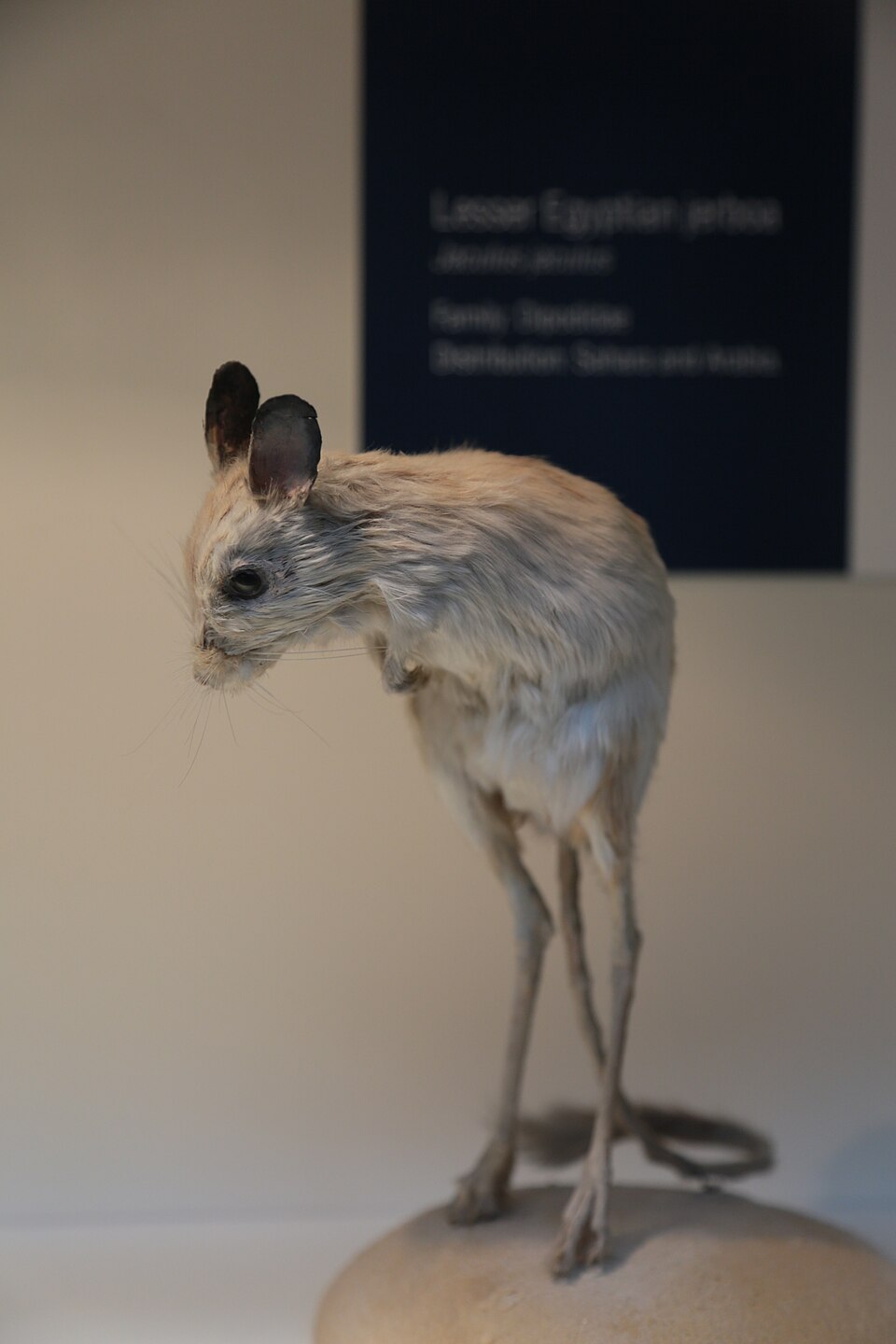
Presentation
The jerboa is a small jumping rodent marked by extremely long hind legs and a long bushy tail tipped with a brush of hair. It lives in arid and desert regions of North Africa and Asia, moving by rapid bounds on its two hind legs. Nocturnal and burrowing, it spends the day in a deep burrow to escape the heat and predators. Several species exist, varying in size and colour depending on the region. In Tunisia, it is found in the desert and steppe zones of the southern part of the country.
The jerboa has a compact body, a small head with large eyes and long ears adapted for nocturnal hearing. Its disproportionately elongated hind legs allow it powerful leaps, while its short front legs are used to manipulate food and dig. Its long tail, tipped with a tuft of hair at the end, provides balance during jumps.
Characteristics
Indicative values: they vary by subspecies, sex and region.
Habitat and distribution
Jerboas inhabit deserts, steppes, and sparsely vegetated sandy or rocky areas. They favour loose soil suitable for digging deep burrows. Their habitat provides both protection from daytime heat and concealment from predators.
CURRENT RANGE
Jerboas are found in North Africa, the Middle East, and Central Asia, in the vast arid zones of these regions. In Tunisia, they inhabit the desert and steppe regions of the centre and south. Their range generally follows the distribution of desert and semi-desert environments across the continent.
Behaviour
A solitary and essentially nocturnal animal, the jerboa stays underground during the day to avoid the extreme desert heat and predators. It moves by rapid bounds with quick changes of direction, allowing it to escape pursuers effectively. It digs complex burrows with several entrances, which it can block to regulate temperature and humidity inside.
Reproduction
Breeding typically occurs after rainfall, when vegetation becomes more abundant. Females give birth one to several times per year, with litters averaging two to six young. The young are born naked and blind in the burrow and become independent after a few weeks.
Peculiarities
The jerboa can make impressive leaps relative to its size thanks to its highly developed hind legs. It is capable of surviving long periods without drinking water directly. The tuft of hair on its tail plays an important role in balance during rapid movement.
Threats and conservation
The jerboa is locally threatened by degradation of its desert habitat due to overgrazing and urbanisation. It may also be captured for the exotic pet trade or hunted by introduced predators. Overall, most species are not considered threatened on a global scale.
Numbers and trends vary across sources and regions. See the IUCN assessment for the latest reference data.
Gallery
1 documented photographs.
References
Profile updated 04 September 2026 · Reviewed by the TunisieVet editorial team.
Comments (0)
No comments yet.
CONSERVATION STATUS
Least concern (LC)
IUCN source, latest published assessment.
Species health
Documented diseases for this species.
This information is provided for educational purposes only and is not a substitute for a veterinary consultation. If you have any concerns about your animal's health, consult a veterinarian.
Similar animals
Other species documented in Animalpedia.

TunisieVet in your pocket 📱🐾 Access your veterinary services wherever you are. [ Download the app ]
Learn more