
Presentation
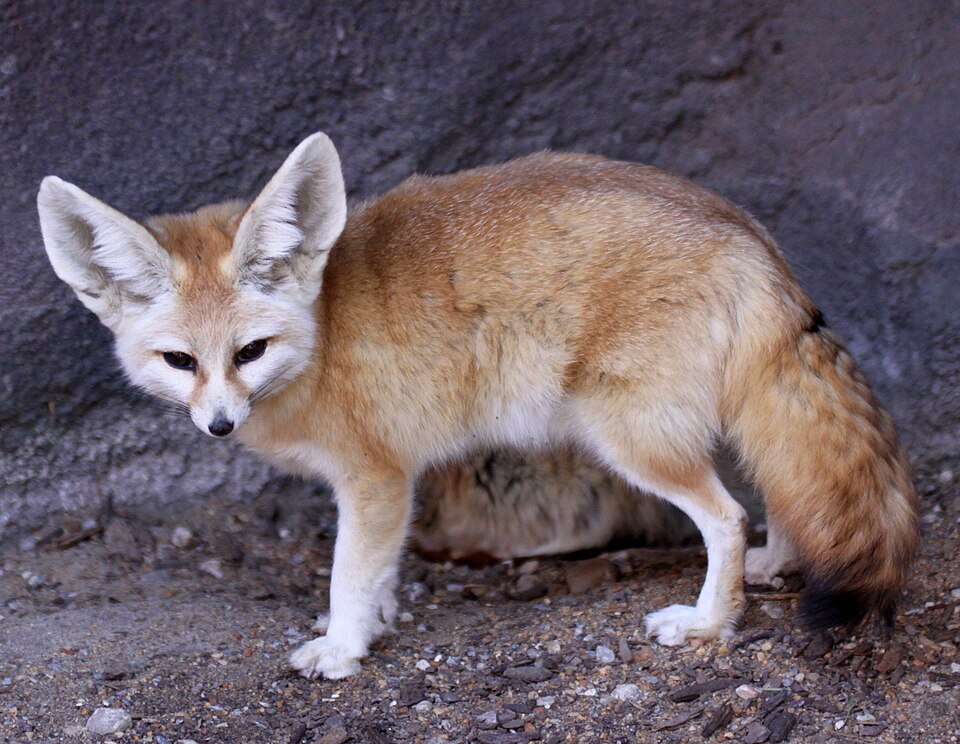
The Fennec fox is the world's smallest canid, perfectly adapted to life in the deserts of North Africa and the Middle East. With its characteristic large ears and golden fur, it represents a marvel of adaptation to the extreme conditions of the desert.
The Fennec fox has exceptionally large ears (up to 15 cm) which are used to regulate its body temperature and detect underground prey. Its fur is thick and golden, suitable for thermal insulation, while its large, hairy paws allow it to walk on hot sand without getting burned.
Did you know?
Does the fennec need to drink?
Characteristics
Indicative values: they vary by subspecies, sex and region.
Habitat and distribution
The Fennec fox inhabits arid and semi-arid deserts, particularly the sandy regions of the Sahara. It prefers dunes, rocky areas and terrain with little vegetation. Its habitat offers little open water, which has caused it to develop a remarkable ability to conserve water.
CURRENT RANGE
Fennec fox is widely distributed in North Africa and the Sahara, extending from Morocco to Egypt and beyond. It is also found in the Arabian Peninsula and beyond. Its range mainly covers desert regions, with isolated populations in some areas.
Behaviour
The Fennec fox is primarily nocturnal, active at night to avoid the extreme heat of the day. It is a solitary animal or lives in small family groups. It digs complex burrows with several entrances to protect itself from predators and maintain a stable temperature.
Reproduction
Fennec fox reaches sexual maturity at around one year of age. The breeding season extends from January to February. After a gestation of approximately 50 days, the female gives birth to one to three litters of 2 to 5 young. Both parents are involved in the care and education of the children.
Peculiarities
The Fennec fox has several unique adaptations to the desert: its large ears are highly vascularized and allow for efficient dissipation of body heat; its exceptional night vision allows it to hunt in total darkness; finally, its very efficient kidneys allow it to survive without drinking for weeks by drawing water from the food consumed.
Threats and conservation
Although not globally threatened (LC), Fennec fox faces local pressures from capture for the pet trade, desert habitat degradation, and hunting. In Tunisia, it remains protected by legislation.
Numbers and trends vary across sources and regions. See the IUCN assessment for the latest reference data.
Gallery
1 documented photographs.
References
UICN — Liste rouge des espèces menacées
Profile updated 03 September 2026 · Reviewed by the TunisieVet editorial team.
Comments (0)
No comments yet.
CONSERVATION STATUS
Least concern (LC)
IUCN source, latest published assessment.
Species health
Documented diseases for this species.
Find a veterinarianThis information is provided for educational purposes only and is not a substitute for a veterinary consultation. If you have any concerns about your animal's health, consult a veterinarian.
Related species
To discover around: Fennec fox
Videos, facts, stories and records linked to this species.
Similar animals
Other species documented in Animalpedia.

TunisieVet in your pocket 📱🐾 Access your veterinary services wherever you are. [ Download the app ]
Learn more