
Presentation
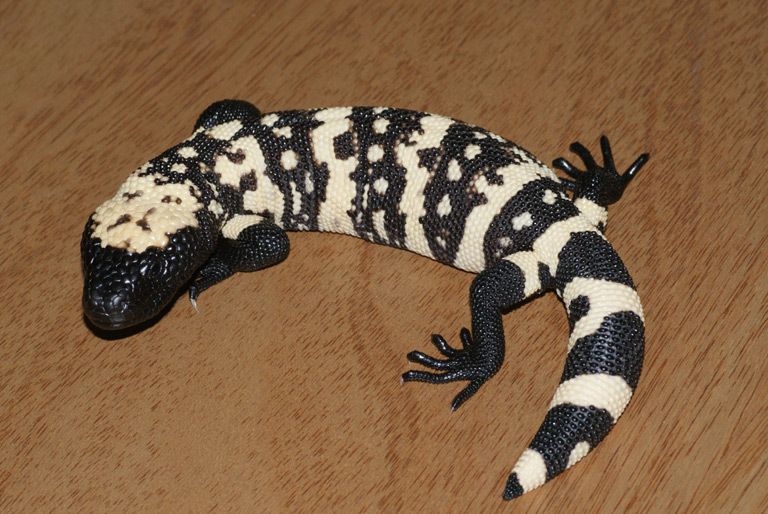
The Gila monster is a robust venomous lizard native to the southwestern United States and northwestern Mexico. Its stocky body is covered in beaded scales forming distinctive black, pink, or yellow patterns. It moves slowly on the ground and spends most of its life hidden in burrows or rocky shelters. This reptile is one of the few venomous lizards in the world, closely related to the beaded lizard. Its venom, injected through biting, serves mainly for defense rather than hunting. It is protected by law in several U.S. states due to its relative rarity.
The Gila monster has a thick tail that serves as a fat reserve, useful during long periods of inactivity. Its skin bears hard osteodermic scales resembling beads, offering protection against predators. Its venom glands are located in the lower jaw, a rare trait among lizards.
Characteristics
Indicative values: they vary by subspecies, sex and region.
Habitat and distribution
The Gila monster inhabits arid and semi-arid deserts, as well as rocky scrubland areas. It shows a preference for canyons, rocky slopes, and the edges of intermittent waterways where moisture persists. It shelters in burrows dug by other animals or in rock crevices.
CURRENT RANGE
Its range covers the Sonoran Desert, extending across Arizona, southern Nevada, southern New Mexico, and southern Utah in the United States, as well as northwestern Mexico. It inhabits varying elevations, from desert plains to low mountain zones.
Behaviour
It is a solitary animal and primarily diurnal in spring, becoming more active at dusk during warm months. It spends approximately 95 percent of its time in burrows to avoid excessive heat and dehydration. When threatened, it hisses, gapes its mouth, and can bite while gripping firmly to its aggressor.
Reproduction
Mating occurs in spring, following ritualized combat between males competing for access to females. The female lays between 2 and 12 eggs, which she buries in sand with natural incubation taking place over winter. Young hatch the following spring, already venomous and capable of fending for themselves.
Peculiarities
The Gila monster is one of the few known venomous lizards, a trait long underestimated by science. Its venom inspired the development of medications for type 2 diabetes, thanks to a hormone called exenatide. It is named after the Gila River Basin, a region where it was discovered by early settlers.
Threats and conservation
The species is threatened by destruction of its desert habitat due to urbanization and agriculture. Illegal trade in exotic pets also poses a significant pressure. Its slow reproduction and late maturity limit its capacity to recover quickly.
Numbers and trends vary across sources and regions. See the IUCN assessment for the latest reference data.
Gallery
1 documented photographs.
References
Profile updated 09 September 2026 · Reviewed by the TunisieVet editorial team.
Comments (0)
No comments yet.
CONSERVATION STATUS
Near threatened (NT)
IUCN source, latest published assessment.
Species health
Documented diseases for this species.
This information is provided for educational purposes only and is not a substitute for a veterinary consultation. If you have any concerns about your animal's health, consult a veterinarian.
To discover around: Gila monster
Videos, facts, stories and records linked to this species.
RECORD
2 venomous lizard species known
One of the world's only venomous lizards
Only the genus Heloderma, which includes the Gila monster and the beaded lizard, possesses...
Similar animals
Other species documented in Animalpedia.

TunisieVet in your pocket 📱🐾 Access your veterinary services wherever you are. [ Download the app ]
Learn more