
Presentation
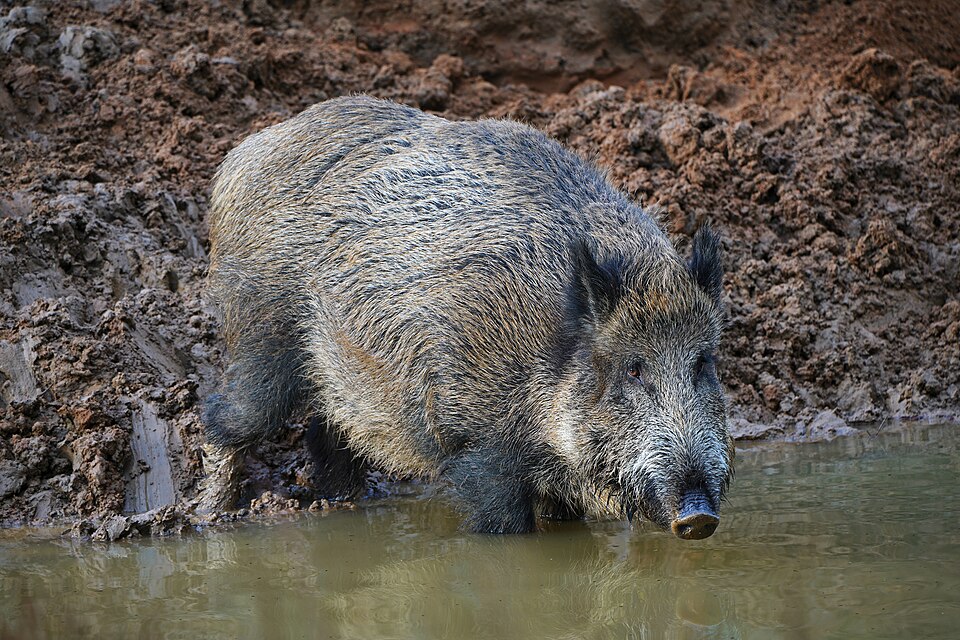
The Wild boar is a robust and powerful mammal belonging to the Suidae family. Characterized by a stocky body, a massive head and imposing tusks, it is the wild ancestor of the domestic pig. It is a very adaptable animal, capable of thriving in a wide variety of environments.
The Wild boar has a thick, coarse coat, usually brown or black, sometimes striped in young. Its head is elongated with a powerful snout, and its curved lower tusks can reach several centimeters in length. The eyes are small and its erect ears remain mobile.
Characteristics
Indicative values: they vary by subspecies, sex and region.
Habitat and distribution
The Wild boar frequents dense forests, wooded mountain areas and humid environments such as marshes and reed beds. It also tolerates thick scrubland and crops if the cover provides good cover. Very adaptable, it can survive in very diverse habitats as long as it finds shelter and food there.
CURRENT RANGE
Native to Eurasia, Wild boar is found throughout Europe, Western and Central Asia, and North Africa. Its range extends from sea level to high mountains. The species was introduced accidentally or intentionally to other continents.
Behaviour
The Wild boar are primarily nocturnal and crepuscular, forming groups called herds. Adult males are often solitary. It is an excellent burrower, digging into the ground in search of food. Very prolific, the species can cause significant damage to crops.
Reproduction
The rutting period occurs in autumn and winter. Gestation lasts approximately 115 to 120 days. The female gives birth to 4 to 8 young (or more) in the spring, which she nurses for 3 to 4 months. The young stay with the mother for about a year.
Peculiarities
The Wild boar has exceptional hearing and sense of smell, although its vision is poor. It is capable of traveling long distances to find food. Its burrowing can transform the landscape and damage agricultural soils. It is a very robust animal, capable of resisting many diseases.
Threats and conservation
The species is not globally threatened and enjoys a wide distribution. However, it is considered harmful in certain regions where its populations become too large, causing damage to crops and ecosystems.
Numbers and trends vary across sources and regions. See the IUCN assessment for the latest reference data.
Gallery
1 documented photographs.
References
UICN — Liste rouge des espèces menacées
Profile updated 02 September 2026 · Reviewed by the TunisieVet editorial team.
Comments (0)
No comments yet.
CONSERVATION STATUS
Least concern (LC)
IUCN source, latest published assessment.
Species health
Documented diseases for this species.
See the 4 diseases of this species Find a veterinarianThis information is provided for educational purposes only and is not a substitute for a veterinary consultation. If you have any concerns about your animal's health, consult a veterinarian.
Related species
To discover around: Wild boar
Videos, facts, stories and records linked to this species.
Similar animals
Other species documented in Animalpedia.

TunisieVet in your pocket 📱🐾 Access your veterinary services wherever you are. [ Download the app ]
Learn more