
Presentation
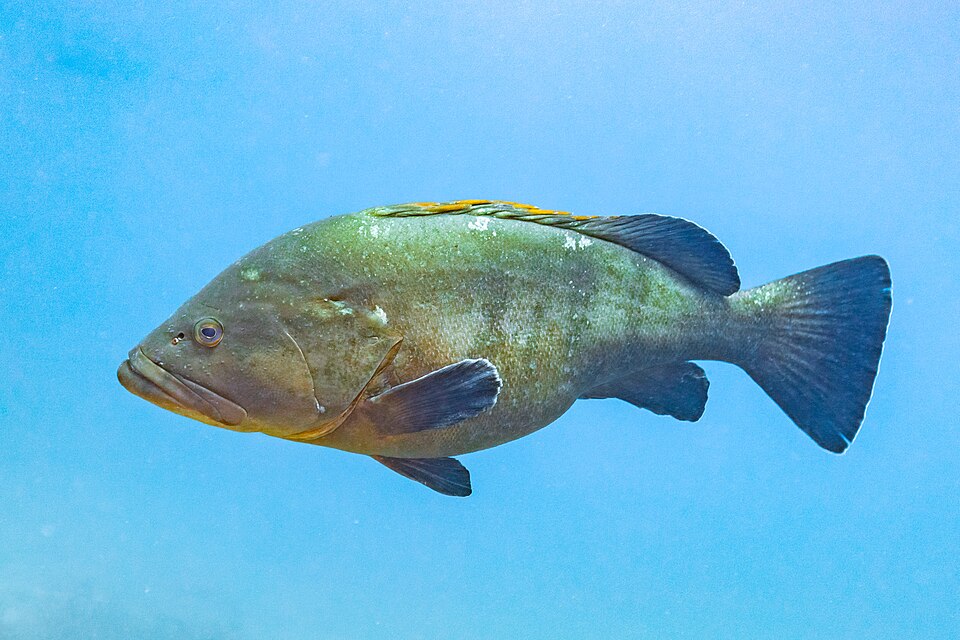
The Dusky grouper is a large fish of the Serranidae family, characterized by a gray to dark brown color and a robust silhouette. It is one of the largest grouper species in the Mediterranean, appreciated by divers for its majesty. It inhabits rocky areas and coastal reefs, where it is an important apex predator in its ecosystem.
Its body is elongated and laterally compressed, covered with smooth scales. Coloration varies from light gray to very dark brown, sometimes with light spots or transverse bands. The fins are relatively broad, with a characteristic spiny dorsal fin. The eyes are large and the mouth wide, adapted to predation.
Characteristics
Indicative values: they vary by subspecies, sex and region.
Habitat and distribution
The Dusky grouper frequents rocky areas and sea caves on the Mediterranean coast, between 5 and 400 meters deep. It prefers environments with many rocky refuges where it can retreat. It tolerates temperature variations and fluctuating salinity levels.
CURRENT RANGE
Endemic species of the Mediterranean, present throughout the basin, from the Strait of Gibraltar to the Levant. It is also found in the Eastern Atlantic near the African coast. Its distribution extends from the surface to deep rocky areas.
Behaviour
It is a solitary and territorial fish, which generally remains faithful to its rocky habitat. It is cautious towards divers but can become aggressive if it feels threatened. Crepuscular and nocturnal, it is most active at dawn and dusk, ideal times for hunting.
Reproduction
The Dusky grouper reaches sexual maturity around 4 to 5 years old. Reproduction takes place in summer, usually between June and August, with synchronized emission of sperm and eggs in groups. The larvae are planktonic and dispersed by currents before settling on reefs.
Peculiarities
The Dusky grouper is capable of slightly changing coloring depending on its environment and emotional state. Several individuals can share the same habitat without being truly social. It is a species very involved in studies of animal and ecological behavior in the Mediterranean.
Threats and conservation
Overfishing constitutes the main threat: this slow-growing and late-reproducing species is very vulnerable to commercial exploitation. Poaching, destruction of rocky habitats and coastal pollution also affect its populations. Climate change and marine warming are gradually threatening its ecosystems.
Numbers and trends vary across sources and regions. See the IUCN assessment for the latest reference data.
Gallery
1 documented photographs.
References
UICN — Liste rouge des espèces menacées
Profile updated 31 August 2026 · Reviewed by the TunisieVet editorial team.
Comments (0)
No comments yet.
CONSERVATION STATUS
Vulnerable (VU)
IUCN source, latest published assessment.
Species health
Documented diseases for this species.
This information is provided for educational purposes only and is not a substitute for a veterinary consultation. If you have any concerns about your animal's health, consult a veterinarian.
To discover around: Dusky grouper
Videos, facts, stories and records linked to this species.
Similar animals
Other species documented in Animalpedia.

TunisieVet in your pocket 📱🐾 Access your veterinary services wherever you are. [ Download the app ]
Learn more