
Presentation
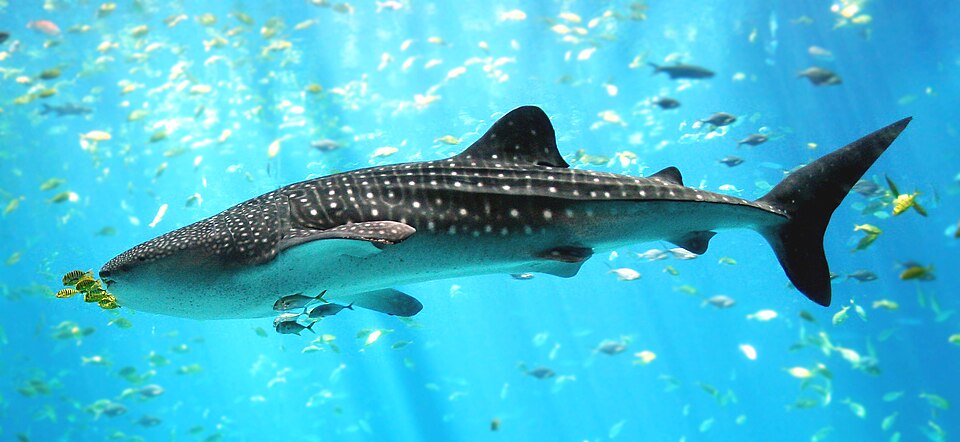
The Whale shark is the largest fish in the world and the largest shark currently alive. Despite its impressive size, it is a peaceful animal and harmless to humans, feeding mainly on plankton and small fish.
The Whale shark has a massive, sturdy body covered in dark blue gray skin dotted with very distinctive white or yellow spots and stripes. Its head is enormous and flattened, with an extremely large mouth up to 1.5 meters wide. Its pectoral and dorsal fins are proportionally small compared to its imposing body.
Did you know?
Do sharks have to swim constantly to breathe?
Characteristics
Indicative values: they vary by subspecies, sex and region.
Habitat and distribution
The Whale shark lives exclusively in tropical and subtropical ocean waters, preferring coastal and reef areas rich in plankton. It frequents warm waters between 21 and 30°C and is generally found near the surface or in shallow waters where the food concentration is higher.
CURRENT RANGE
Whale shark is present in the tropical and subtropical zones of the three major oceans: the Atlantic, Indian and Pacific. It is found particularly in the Caribbean, the Gulf of Mexico, the Red Sea, the Indian Ocean, the Persian Gulf and the waters of the Western Pacific. Its populations carry out seasonal migrations following the abundance of plankton.
Behaviour
The Whale shark is a solitary, migratory creature that constantly moves in search of areas rich in plankton. It swims slowly and deliberately, often close to the surface, where it actively feeds. This animal is generally calm and curious, showing little aggression towards other species, including humans.
Reproduction
The Whale shark is ovoviviparous, meaning the eggs hatch inside the female's body and the young are born alive. Few details are known about its reproduction due to the difficulty of studying this species in the wild. Females give birth to a variable number of young, estimated between a few hundred to several thousand fry.
Peculiarities
The Whale shark has a very particular set of teeth: its teeth are extremely small and non-functional, vestigial, because they play no role in eating. Its gill rakers, pectinate structures located in the gill slits, constitute the real filtration system. The distinctive pattern of white spots and stripes is unique to each individual, like a fingerprint, allowing researchers to identify animals.
Threats and conservation
The Whale shark faces several major threats: accidental or intentional commercial fishing, ship strikes, marine pollution and reduction of coastal habitats. The disappearance of plankton concentration areas due to climate change also affects its food resources and migration patterns.
Numbers and trends vary across sources and regions. See the IUCN assessment for the latest reference data.
Gallery
1 documented photographs.
References
UICN — Liste rouge des espèces menacées
Profile updated 29 August 2026 · Reviewed by the TunisieVet editorial team.
Comments (0)
No comments yet.
CONSERVATION STATUS
Endangered (EN)
IUCN source, latest published assessment.
Species health
Documented diseases for this species.
This information is provided for educational purposes only and is not a substitute for a veterinary consultation. If you have any concerns about your animal's health, consult a veterinarian.
To discover around: Whale shark
Videos, facts, stories and records linked to this species.
Similar animals
Other species documented in Animalpedia.

TunisieVet in your pocket 📱🐾 Access your veterinary services wherever you are. [ Download the app ]
Learn more