
Presentation
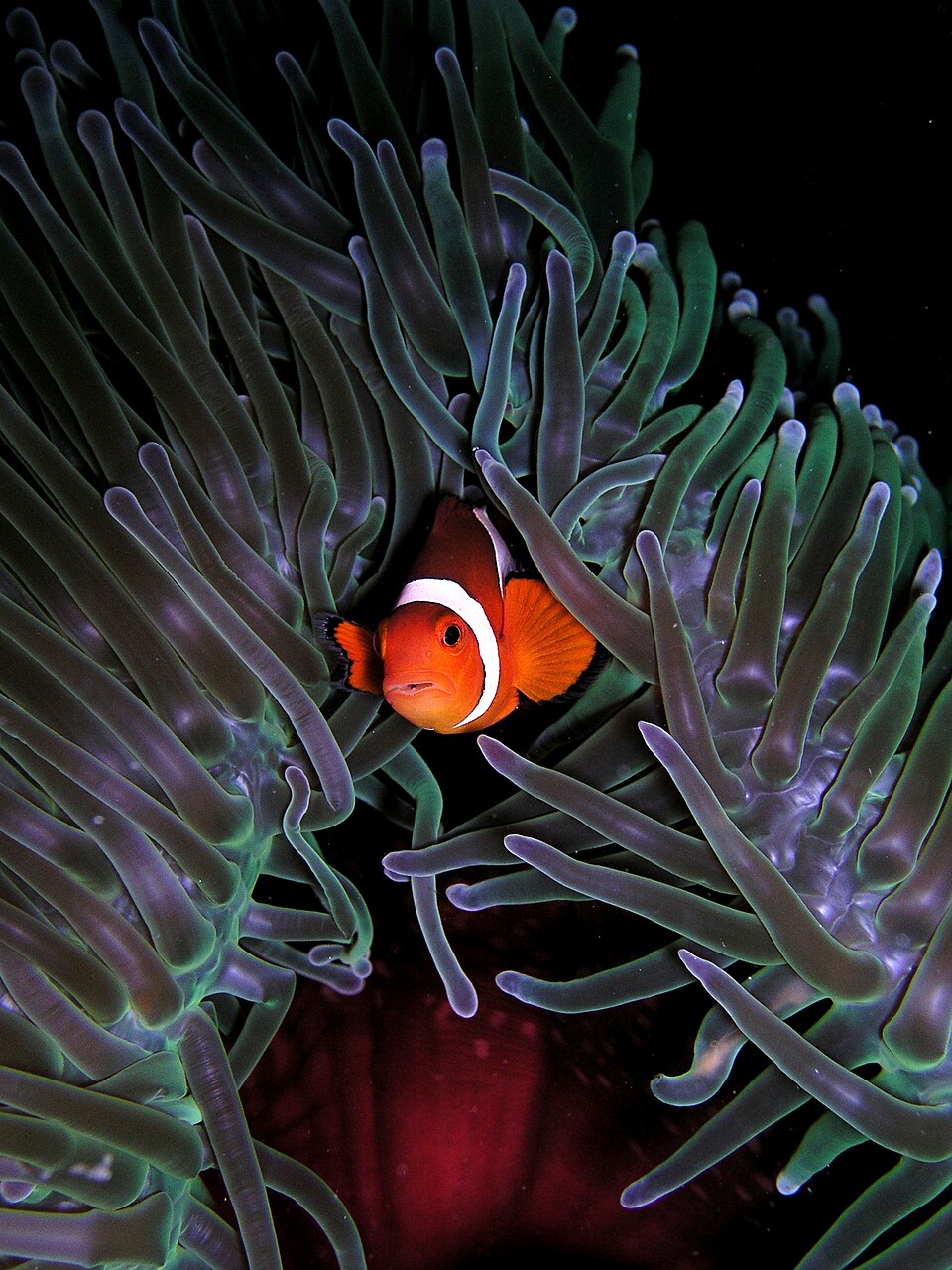
The Clownfish is a small tropical fish with a rounded body, characterized by its three distinct white bands that stand out against a bright orange background. This species has become world famous thanks to its symbiotic relationship with sea anemones, which it uses for both shelter and a food source.
Clownfish has a laterally compressed body covered in ctenoid scales. Its three white bands surrounded by black adorn a vibrant orange color system. The dorsal fin contains spiny rays, and the mouth is small and terminal, adapted to its omnivorous diet.
Did you know?
How does clownfish live in an anemone without getting stung?
Characteristics
Indicative values: they vary by subspecies, sex and region.
Habitat and distribution
The Clownfish mainly inhabits shallow coral reefs and anemone areas. It is closely related to specific species of sea anemones, including Entacmaea quadricolor and various Anemonia species. These environments provide shelter, food and predatory protection.
CURRENT RANGE
Clownfish is found in the tropical Indo-Pacific, from the Great Barrier Reef in Australia to Indonesia and Japan. Its natural range extends from the shallow coastal waters of tropical Southeast Asia and Oceania.
Behaviour
Clownfish is highly gregarious and forms organized social groups within its host anemone. He is territorial and aggressive towards conspecifics who are not part of his group. This species establishes cleaning relationships with the anemone, feeding on its parasites while benefiting from its protection.
Reproduction
The Clownfish reproduces by external fertilization. Most colonies are led by a dominant female and a dominant male, while other individuals remain non-breeding. The eggs are laid on a flat surface near the anemone and are guarded vigilantly until hatching.
Peculiarities
The Clownfish is immune to the toxins of its host anemone thanks to a special mucus covering its skin. Remarkably, this species practices sequential hermaphroditism: the dominant female can transform into a male if the dominant male dies. This is a fascinating example of animal sexual plasticity.
Threats and conservation
The species is currently stable and faces no major immediate threats. However, coral reef bleaching and coastal habitat degradation caused by climate change and pollution could indirectly affect future populations.
Numbers and trends vary across sources and regions. See the IUCN assessment for the latest reference data.
Gallery
1 documented photographs.
References
UICN — Liste rouge des espèces menacées
Profile updated 29 August 2026 · Reviewed by the TunisieVet editorial team.
Comments (0)
No comments yet.
CONSERVATION STATUS
Least concern (LC)
IUCN source, latest published assessment.
Species health
Documented diseases for this species.
See the 4 diseases of this species Find a veterinarianThis information is provided for educational purposes only and is not a substitute for a veterinary consultation. If you have any concerns about your animal's health, consult a veterinarian.
To discover around: Clownfish
Videos, facts, stories and records linked to this species.
Similar animals
Other species documented in Animalpedia.

TunisieVet in your pocket 📱🐾 Access your veterinary services wherever you are. [ Download the app ]
Learn more