
Presentation
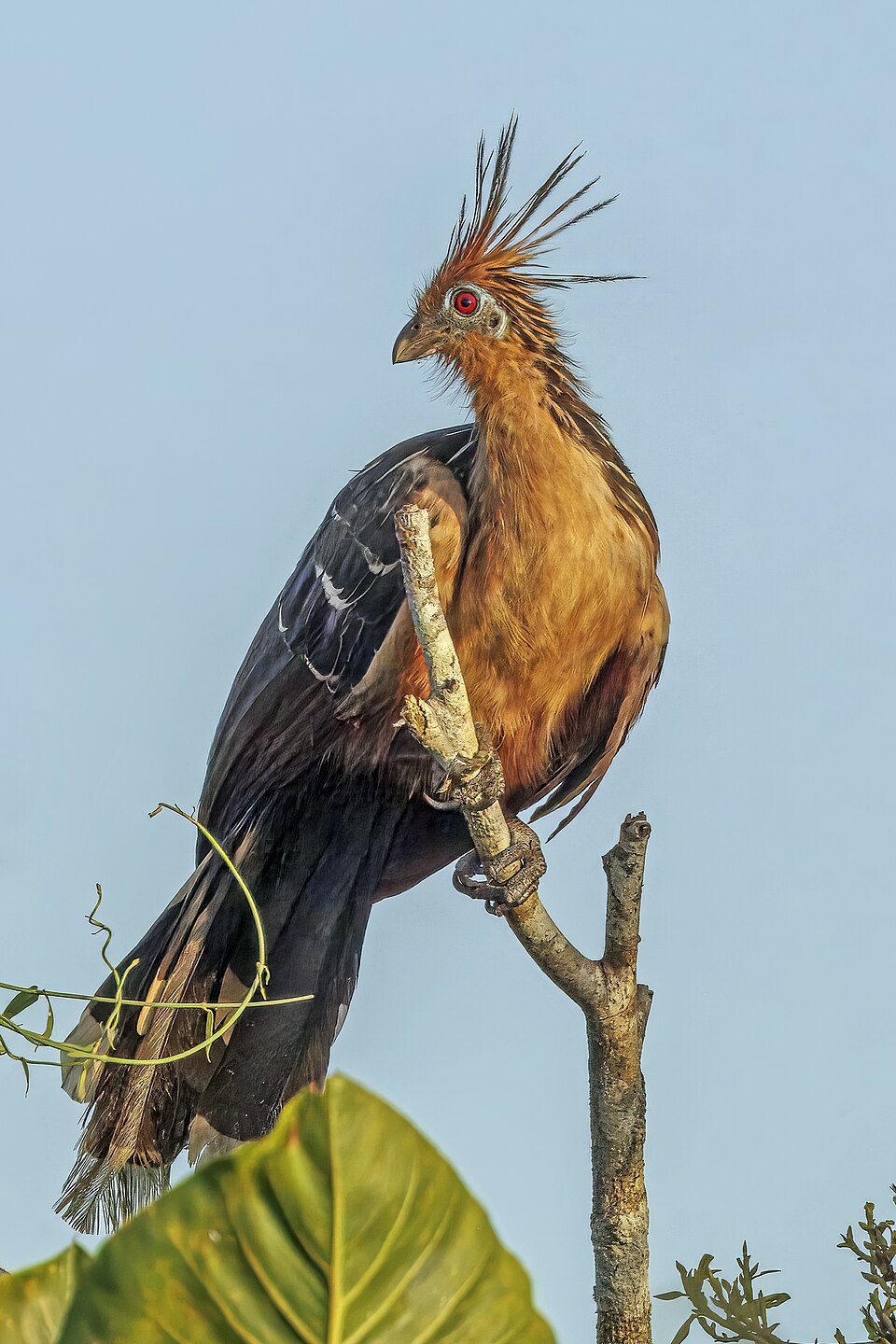
The hoatzin is a tropical bird native to South America, famous for its prehistoric appearance and its unique digestive system among birds. It features a small shaggy crest and a bare blue face with no feathers, contrasting with reddish-brown and cream plumage. Often called a « living fossil », it occupies an isolated taxonomic position that has long intrigued ornithologists. This bird lives in loud groups along waterways, within the dense vegetation bordering Amazonian rivers. Its fermentation-based digestion, similar to that of ruminants, gives it a characteristic musky odour that earned it the nickname « stinkbird ».
The hoatzin measures around 65 cm in length and displays reddish-brown plumage streaked with cream on its upper parts, with a rusty belly. Its head is adorned with a crest of fine, tousled feathers, and its bare face is bright blue surrounded by a red eye. Its wings are broad but poorly suited for sustained flight, forcing it to make short and clumsy movements between branches. The young birds possess claws on their wings allowing them to climb, a rare feature among present-day birds.
Characteristics
Indicative values: they vary by subspecies, sex and region.
Habitat and distribution
The hoatzin inhabits flooded tropical forests, mangroves, and densely vegetated riverbanks and lake shores in the Amazon region. It favours wetland areas where shrubs and vines grow, from which it feeds on leaves. Its dependence on riverside vegetation restricts its presence to the immediate water margins.
CURRENT RANGE
The species is distributed throughout the Amazon basin and adjacent wetlands in South America, including Venezuela, Colombia, Ecuador, Peru, Brazil, Guyana, and Suriname. It remains largely confined to the tropical river habitats of this region.
Behaviour
The hoatzin lives in social groups that share territorial defence and the rearing of young. It is not particularly wary but its flight is weak and noisy, forcing it to move mainly by leaping from branch to branch. The group's harsh calls and grunts carry far through the riverside vegetation. Young birds, when threatened by a predator, can dive into the water and then climb back into the trees using the claws situated on their wings.
Reproduction
The female typically lays two or three eggs in a rudimentary nest built above water on a low branch. Incubation lasts about a month and is shared by both parents and other members of the family group. Chicks are born with claws on their wings that allow them to climb from the first few days of life—an adaptation to living near water. This family cooperation improves the survival chances of the chicks against predators.
Peculiarities
The hoatzin is often regarded as an enigmatic evolutionary link, its phylogenetic position having long divided scientists. The claws present on the wings of chicks recall features observed in certain primitive fossil birds. Its fermentation-based digestion, unique among birds, earned it the nickname 'stinkbird' because of the odour it produces.
Threats and conservation
The species faces local threats from deforestation and degradation of riverside wetlands in parts of its range. Pollution of waterways and urbanisation of riverbanks also reduce its available habitat. However, it is not considered globally threatened at present.
Numbers and trends vary across sources and regions. See the IUCN assessment for the latest reference data.
Gallery
1 documented photographs.
References
Profile updated 03 September 2026 · Reviewed by the TunisieVet editorial team.
Comments (0)
No comments yet.
CONSERVATION STATUS
Least concern (LC)
IUCN source, latest published assessment.
Species health
Documented diseases for this species.
Find a veterinarianThis information is provided for educational purposes only and is not a substitute for a veterinary consultation. If you have any concerns about your animal's health, consult a veterinarian.
Similar animals
Other species documented in Animalpedia.

TunisieVet in your pocket 📱🐾 Access your veterinary services wherever you are. [ Download the app ]
Learn more