
Presentation
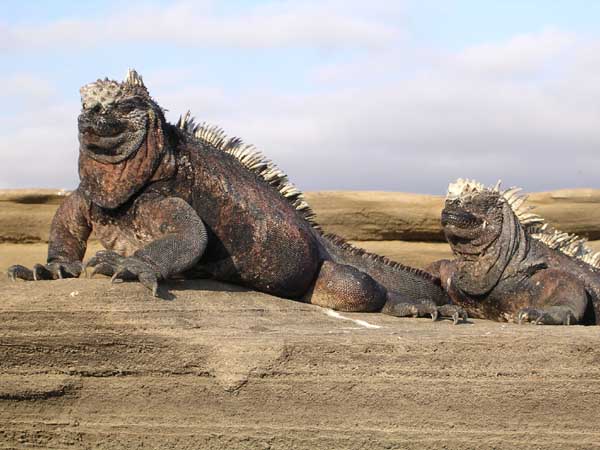
The marine iguana is a lizard endemic to the Galápagos archipelago and the only living reptile adapted to a regular marine lifestyle. It stands out for its ability to dive into the ocean to feed on algae attached to coastal rocks. Its dark, blackish-to-grayish skin helps absorb solar heat after its swims in cold water. Its size and coloration vary by island within the archipelago, with some populations displaying reddish or greenish tints during breeding season. Charles Darwin described it as an ungainly yet fascinating animal during his visit to the Galápagos. It lives in dense colonies on the volcanic rocks along the shoreline.
The body is stocky, with a laterally flattened tail that serves as a propeller for swimming. Long, robust claws allow it to grip rocks against wave action. A specialized nasal gland enables it to eliminate excess salt ingested at sea through sneezing.
Characteristics
Indicative values: they vary by subspecies, sex and region.
Habitat and distribution
The marine iguana inhabits exclusively the volcanic rocky coasts and littoral zones of the Galápagos archipelago. It alternates between the terrestrial environment for thermoregulation and the marine environment for feeding. Sandy beaches and coastal lagoons serve as nesting sites.
CURRENT RANGE
The species is strictly endemic to the Galápagos archipelago, located in the Pacific Ocean and belonging to Ecuador. Morphological variations distinguish populations according to the different islands of the archipelago. No natural population exists outside this region.
Behaviour
The species is gregarious and forms large aggregations on coastal rocks to bask in the sun. Males defend small territories during breeding season through head displays and ritualized combat. Outside this period, cohabitation is peaceful and individuals sometimes pile on top of one another to conserve heat.
Reproduction
Breeding season typically occurs between December and March depending on the island. The female digs a nest in sand or loose soil where she lays between one and six eggs. Incubation lasts approximately three to four months, with no parental care after egg laying.
Peculiarities
It is the only living lizard capable of feeding at sea on a regular basis. It can slow its heart rate and body temperature during diving to conserve energy. During periods of shortage related to the El Niño climate phenomenon, it can temporarily reduce the size of its skeleton.
Threats and conservation
Introduced predators such as cats, rats, and dogs threaten eggs and young individuals. Oil spills and marine pollution degrade its feeding habitat. Climate warming and intensified El Niño episodes reduce the availability of the algae on which it depends.
Numbers and trends vary across sources and regions. See the IUCN assessment for the latest reference data.
Gallery
1 documented photographs.
References
Profile updated 09 September 2026 · Reviewed by the TunisieVet editorial team.
Comments (0)
No comments yet.
CONSERVATION STATUS
Vulnerable (VU)
IUCN source, latest published assessment.
Species health
Documented diseases for this species.
This information is provided for educational purposes only and is not a substitute for a veterinary consultation. If you have any concerns about your animal's health, consult a veterinarian.
To discover around: Galápagos Marine Iguana
Videos, facts, stories and records linked to this species.
RECORD
unique species
Only living marine lizard
The only living lizard reptile capable of feeding regularly in a marine environment.
Similar animals
Other species documented in Animalpedia.

TunisieVet in your pocket 📱🐾 Access your veterinary services wherever you are. [ Download the app ]
Learn more