Presentation
The indri (Indri indri) is the largest living lemur and is found only in Madagascar. It is distinguished by its characteristic black and white fur and its nearly complete absence of a tail, a rare trait among primates. Active during the day, it lives in small family groups in the canopy of the humid tropical forests of eastern Madagascar. Its powerful and melodious call, audible over several kilometers, serves to mark the group's territory. This species is today seriously threatened by deforestation and hunting.
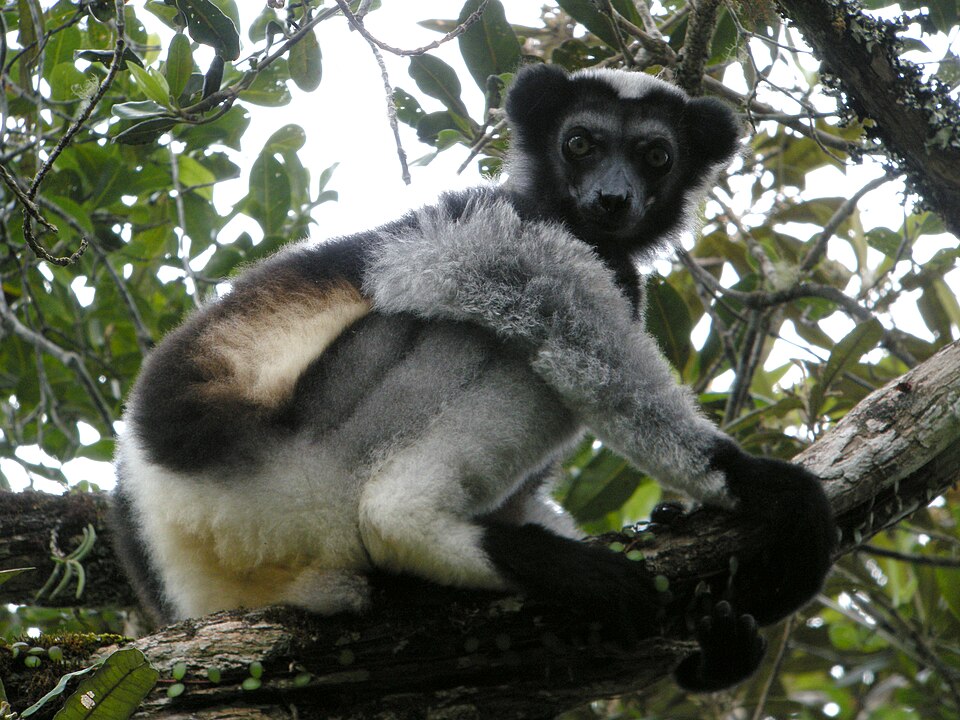
The indri has a stocky body covered with soft black and white fur and a hairless black face. Its hind limbs are very powerful and distinctly longer than its front limbs, which allows it to make impressive leaps between trees. Unlike other lemurs, its tail is reduced to a mere stump. Its large amber eyes and rounded, hairy ears give it a distinctive appearance.
Characteristics
Indicative values: they vary by subspecies, sex and region.
Habitat and distribution
The indri lives exclusively in the humid tropical forests at low and middle altitudes on the east coast of Madagascar. It occupies the dense canopy where it finds food and shelter. Its habitat is increasingly fragmented by agricultural deforestation and logging.
CURRENT RANGE
The species is endemic to Madagascar, where it occupies a restricted belt of tropical forest along the island's east coast. It is notably observed in protected areas such as Andasibe-Mantadia National Park. No natural populations exist outside Madagascar.
Behaviour
Diurnal and arboreal, the indri moves by vertical leaps from tree to tree using its powerful hind limbs. It lives in small monogamous family groups, typically comprising a pair and their offspring. The group defends a defined territory through loud vocalizations, a collective call heard several kilometers away. This territorial and social behavior remains stable over several years.
Reproduction
A female indri gives birth to a single infant every two to three years, after a gestation period of approximately four to five months. The newborn clings to its mother's belly and then moves onto her back as it grows. The young remains dependent on its parents for several years before reaching sexual maturity at around seven to nine years of age. This low reproduction rate makes the population particularly vulnerable.
Peculiarities
The indri is the largest living lemur and one of the few primates with an almost absent tail. Its song, resembling a melodious howl, is one of the most recognizable vocalizations in the animal kingdom. It has never survived long in captivity, making study in its natural environment essential.
Threats and conservation
Deforestation linked to slash-and-burn agriculture and logging is the main threat facing the species. Hunting, although traditionally limited by local taboos (fady), persists in some regions. Habitat fragmentation isolates populations and reduces genetic exchange.
Numbers and trends vary across sources and regions. See the IUCN assessment for the latest reference data.
Gallery
1 documented photographs.
References
Profile updated 02 September 2026 · Reviewed by the TunisieVet editorial team.
Comments (0)
No comments yet.
CONSERVATION STATUS
Critically endangered (CR)
IUCN source, latest published assessment.
Species health
Documented diseases for this species.
This information is provided for educational purposes only and is not a substitute for a veterinary consultation. If you have any concerns about your animal's health, consult a veterinarian.
To discover around: Indri
Videos, facts, stories and records linked to this species.
RECORD
60 to 90 cm in length
The largest living lemur
This measurement is from wild adult specimens including the short tail, making it the larg...
Similar animals
Other species documented in Animalpedia.

Be among the first to use our app. Sign up and get early Google Play access.
Discover