
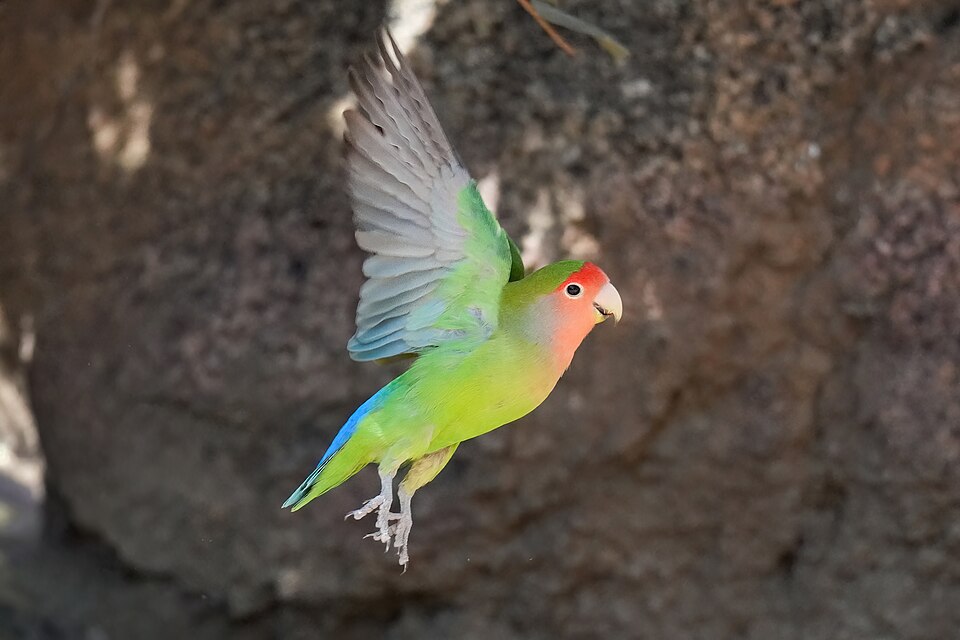
Presentation
The Rosy-faced lovebird is a small African parrot characterized by its bright green plumage and its head tinted with pink and orange. This social and affectionate bird is very popular in captivity for its playful temperament and its lively interactions with its conspecifics. Its name evokes the strong monogamy of the species, the pairs remaining inseparable throughout their lives.
A small, stocky parrot with short, rounded wings, the Rosy-faced lovebird has predominantly bright green plumage. The head has a broad pink to orange area that extends from the forehead to the cheeks and throat, contrasting beautifully with the green of the body. Its beak is powerful and slightly hooked, typical of psittacines, and its eyes are rimmed with characteristic white.
Characteristics
Indicative values: they vary by subspecies, sex and region.
Habitat and distribution
Rosy-faced lovebird frequents semi-arid and arid environments: rocky deserts, wooded steppes and low-altitude mountainous regions. It particularly likes areas where the vegetation is sparse with a few trees or bushes offering shelter and cover, particularly near water points.
CURRENT RANGE
Rosy-faced lovebird is native to southern and central Africa. Its natural range extends mainly to Namibia, Botswana, South Africa and Zimbabwe. Introduced and established populations now exist in several regions of the world, particularly in captivity where the species is widely bred.
Behaviour
Extremely social and gregarious, the Rosy-faced lovebird lives in packs and forms close-knit monogamous pairs. These birds are very vocal, producing high-pitched calls and complex vocalizations to communicate. They are playful, active and curious, spending much of their time grooming each other and interacting with their peers.
Reproduction
The Rosy-faced lovebird nests in rock cavities or tree hollows. The female lays 3 to 6 eggs and incubates them for about 21 to 25 days while the male feeds her. The young fledge after 40 to 50 days. Pairs remain united throughout their lives and fiercely defend their nesting territory.
Peculiarities
Notable for its extreme mating fidelity behavior, Rosy-faced lovebird demonstrates remarkable pair bonding rarely observed in birds. In captivity, it has developed various color mutations (yellow, orange, blue), highly sought after by breeders. Its adaptability to captivity has made it one of the most popular parrot species in amateur breeding.
Threats and conservation
The species is currently not threatened in the wild. Although trapping for the cage bird trade once impacted natural populations, Rosy-faced lovebird maintains a favorable conservation status with a stable population in the wild.
Numbers and trends vary across sources and regions. See the IUCN assessment for the latest reference data.
Gallery
1 documented photographs.
References
UICN — Liste rouge des espèces menacées
Profile updated 17 August 2026 · Reviewed by the TunisieVet editorial team.
Comments (0)
No comments yet.
CONSERVATION STATUS
Least concern (LC)
IUCN source, latest published assessment.
Species health
Documented diseases for this species.
See the 8 diseases of this species Find a veterinarianThis information is provided for educational purposes only and is not a substitute for a veterinary consultation. If you have any concerns about your animal's health, consult a veterinarian.
Similar animals
Other species documented in Animalpedia.

TunisieVet in your pocket 📱🐾 Access your veterinary services wherever you are. [ Download the app ]
Learn more