
Presentation
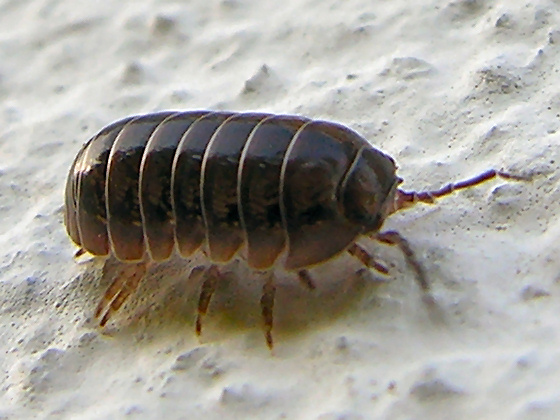
Isopods form an order of crustaceans with segmented bodies flattened from top to bottom. They include terrestrial, freshwater, and marine species. Woodlice, the most well-known terrestrial isopods, breathe through pseudo-trachea adapted for life on land. Their bodies are protected by a calcified shell divided into articulated plates, allowing some species to curl into a ball. They live in gardens, under stones, in forest leaf litter, and are sometimes raised as terrarium animals. The group contains thousands of species found on every continent. Some marine and deep-sea species grow considerably larger than their land-dwelling cousins.
The body consists of seven thoracic segments, each bearing a pair of legs, plus a segmented abdomen ending in uropods. The shell is calcareous and provides good protection against drying out and predators. Coloring ranges from grey to brown depending on the species, with some displaying more contrasting patterns. The antennae are well developed and serve for tactile and olfactory exploration of the environment.
Characteristics
Indicative values: they vary by subspecies, sex and region.
Habitat and distribution
Terrestrial isopods favor humid environments rich in organic matter, such as leaf litter, gardens, and areas beneath stones. Marine species occupy highly varied habitats, ranging from coastal zones to the deep ocean floor. Some freshwater species live in rivers and lakes. Moisture is an essential limiting factor for terrestrial species.
CURRENT RANGE
Isopods are found on all continents, with great diversity among both terrestrial and marine species. Common terrestrial species such as woodlice are encountered in most temperate and Mediterranean regions, including North Africa. Giant marine species are primarily observed in the deep waters of the Gulf of Mexico and the Pacific Ocean.
Behaviour
Most terrestrial species are nocturnal and shelter during the day in damp, dark areas to avoid drying out. Some species, such as woodlice of the genus Armadillidium, can curl completely into a ball when threatened. Gregarious behavior is common, with several individuals grouping together under the same shelter. Isopods are generally slow-moving and avoid direct light.
Reproduction
Fertilization is internal, and the female carries eggs in a ventral pouch called a marsupium until they hatch. The young, called mancas, resemble miniature adults and undergo several molts before reaching maturity. Reproduction can occur several times per year depending on climatic conditions. Growth continues throughout life through successive molts.
Peculiarities
Some deep-sea marine species, such as the giant isopod Bathynomus giganteus, reach remarkable size through abyssal gigantism. Woodlice are among the only crustaceans fully adapted to terrestrial life. Their ability to roll into a ball is a defensive adaptation that has evolved in parallel with that of glomeriid myriapods.
Threats and conservation
Populations of common isopods are generally not threatened due to their wide distribution and adaptability. Some specialized species with restricted ranges may be sensitive to habitat destruction. Soil pollution and pesticide use locally affect some terrestrial populations.
Numbers and trends vary across sources and regions. See the IUCN assessment for the latest reference data.
Gallery
1 documented photographs.
References
Profile updated 13 September 2026 · Reviewed by the TunisieVet editorial team.
Comments (0)
No comments yet.
CONSERVATION STATUS
Least concern (LC)
IUCN source, latest published assessment.
Similar animals
Other species documented in Animalpedia.
